
Sunday, March 21, 2010
Sunday Spinlessness - Waste Not
Just a quick one today. A few weeks a go I used a picture of a male Cambridgea spider to spring off into a half-baked conversation on arachnophobia. That male had probably wandered into the warmth of our house after paying a visit to a female who has a web attached to the downpipe by our kitchen window:

During the day the web's owner hides in a retreat (in this case right behind the joint in the downpipe) but at night you can see a very impressive spider sitting under her web, waiting for some tasty morsel to get trapped. Cambridgea are really forests spiders, if you hunt around a decent piece of native forest and you are bound to find a similarly constructed, but much larger, web. In the forest expectant Cambridgea mothers obscure their egg cases with twigs and dried leaves. Apparently our kitchen wall did offer much camouflage when our Cambridgea mother

You really should click on that image and see the high-res version, it's pretty cool. In order to grow, spiders have to cast off their rigid exoskeleton. You can see here our Cambridgea mother has used her discarded exoskeleton to help obscure her egg case!
The exoskeleton also gives you a clue as to how the spider has achieved its moult - the cephalothorax (the part of an arachnid body that includes the head and the thorax) is popped off and the spider pulls itself, legs and all, out through that gap. The last step of the process is photographed here.
Labels: arachnophilia, Cambridgea, might interest someone, photos, sci-blogs, spider, sunday spinelessness

Sunday, February 28, 2010
Sunday Spinelessness - Arachnophobia
If you read The Atavism regularily you may have gathered I'm quite fond of spiders (1, 2). So, by and large I'm with the Bug Chicks when if comes to arachnophobia. -No spiders will go out of there way to attack people and there's only a handful of species with toxin that packs any punch to humans so, rationally, there is really nothing to worry about. In keeping with that policy, when this handsome Cambridgea male turned up in our bathroom I saw it as a photo opportunity.
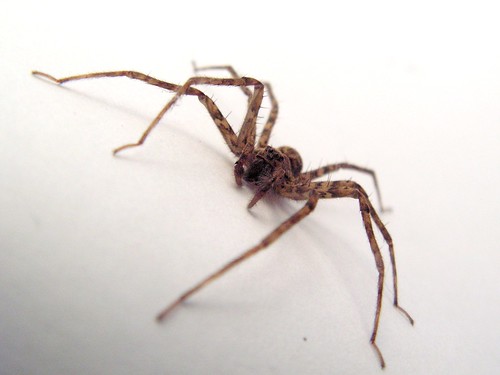
Then he ran cross my camera, up my arm and lodged himself at home on my neck. All my affection for spiders and rationality with regards to the risks lasted about a tenth of a second. I didn't actually scream but it's fair to say my heart rate was somewhat elevated and my movements were restricted. But why? What is is about spiders that freaks us out so much? I did a bit of digging through the academic databases but psychology really isn't my science and I couldn't get a clear idea. Researchers in Germany* have shown (at least among German undergraduate students) spiders do have a special place in our fears - people are more likely to respond badly to photos of spiders than other arthropods, even hymenopterans which can prose a more serious threat to people than spiders. But the question of why remains. Evolutionary psychologists have suggested arachnophobia might be an adaptation but it's hard to imagine that selective pressure applied by occasional spider bites would be sufficient to drive a specific fear of them. Perhaps lots of spiny legs, beady eyes and fearsome fangs just set off enough triggers in the brain to elicit a unique response (did I mention psychology's not my science...).
I remember reading a more plausible (and even testable) idea about the origin of arachnophobia in one of Steven Pinker's books that didn't pop up in my search of the literature. I don't have the book in front of me (and I can't even remember which one it was, although it sounds like a Blank Slate kind of an idea) so you might want to take this with even more grains of salt than you usually would with adaptationist ideas. From memory the argument went that we may be born with a general fear of all spiders and snakes but, until recently, would have learnt the few that are actually dangerous in the area we grew up in from our families. With the good guys and the bad guys separated we could stop wasting our energies on being worried by the overwhelming majority of species which are benign. An inbuilt arachnophobia with inbuilt malleability to surroundings. In the West we aren't exposed to many spiders of any sort in our youth so we retain the childish arachnophobia all our lives. It's a nice story whether it's true or not doesn't seem to have been tested.
Oh, and if my photo of a Cambridgea didn't put you off Te Ara has a much scarier one.
*Spiders are special: fear and disgust evoked by pictures of arthropods. Antje B.M. Gerdes, Gabriele Uhl, Georg W. Alpers. Evolution and Human Behavior, DOI: 10.1016/j.evolhumbehav.2008.08.005)
Labels: arachnophilia, arachnophobia, Cambridgea, environment and ecology, lynx spiders, photos, sci-blogs, sunday spinelessness

All content not otherwise marked is licensed under a Creative Commons Attribution-ShareAlike 3.0 Unported License.


