
Tuesday, June 8, 2010
If some of us have Neanderthal genes, are Neanderthals us?
 I got a little bit starry eyed writing about the Neanderthal genome the other day. I chose to retrace the arc of scientific progress that links the initial description of Neanderthal man as something different than modern humans to the point reached last month, where we are able to tag some of those differences to a single gene. Most of the news stories about the Neanderthal genome focused not on the genes that made us different from them, but a small percentage of the genome that reinforced the continuity been them and us. Genetic evidence that Neanderthals interbred with the ancestors of some modern humans. The revelation of these ancient assignations has caused some quite sensible people to say some quite silly things about what species are and what Neanderthals were. So, perhaps I can compliment my slightly hazy earlier piece with a more hardheaded take on why Neanderthals remain a species unto themselves.
Let's start with the evidence that Neanderthals interbred with the ancestors of modern humans. Modern humans (Homo sapiens) arose in Africa about two hundred thousand years ago, all modern human populations outside of Africa descend from a relatively small number of migrants who left that continent between eighty and fifty thousand years ago. When those migrants first left Africa and entered the Middle East they would have met other humans. The ancestors of the Neanderthal had moved out of Africa and established themselves in Europe and Central Asia thousands of years before. Until now we haven't known which of the four 'F's (fighting, fleeing, feeding or reproduction) followed that first contact, the Neanderthal genome has given us a clue.
When you compare individual DNA bases that are variable within modern human genomes to the corresponding sequences in the Neanderthal genome you find that non-African sequences match the Neanderthal sequence slightly (but significantly) more often than African sequences do. It's possible that this pattern is an artifact of our poor sampling of African genomic diversity (that observant nerd Christie does a good job of explaining how here) but for the sake of argument let's take it for granted that his pattern is the result of ancient interbreeding. The authors of the paper describing the Neanderthal genome estimate people with no recent African ancestry inherited between one and four percent of their genome from Neanderthals. That number is the same for Papuan and East Asian populations as it is for Europeans despite Neanderthals having lived alongside Europeans for thousands of years, suggesting any interbreeding that contributed to modern human genomes was limited to that first period of contact.
This is where the problems start. Having heard the news that Neanderthals and some of our ancestors might have once swapped genes some people remember that nice easy test of species-status from high-school biology. Something like "if two animals can interbreed then they're part the same species." So, are we Neanderthals; or are Neanderthals us? No. In fact, the Neanderthal genome serves to highlight some the mistakes we commonly make when start trying to define species.
Biologists have spent a lot of time arguing about just what a species is and how can delimit species from the creatures that we study, too often we've forgotten that those are two different arguments. DeLene from Wild Muse has a thoughtful overview of some of the factors that contribute to the "species problem" in her review of Jody Hey's book on the same topic. You should read her piece because the species problem really is a fascinating philosophical question, but I think most of the fights that erupt around competing definitions of species come from a failure to understand that defining species and organising critters into species are two different tasks. We've been studying speciation, the process by which new species arise, for a while now and we've developed a pretty good idea of how it works. Two populations stop interbreeding with each other, during that period of "reproductive isolation" genetic changes in one population can't effect the other so natural selection and random changes (called genetic drift) change each population independently. Species are populations which are on independent evolutionary trajectories.
Reproductive isolation drives the independence that is at the heart of what species are, but it's not the sine qua non of a species. James Mallet from University College London has made a special study of hybridisation, and he reckons 10% of animal species and a whopping 25% of plants interbreed with other species from time to time. As molecular tools have been applied to non-model organisms it's become increasingly clear that the "species barrier" is more porous than we'd thought, and species can maintain their independence even in the face of the occasional injection of genes from other species.(If you're interested in the wider question, I've written a bit on the species problem here. The short version is we should see competing "species concepts" as operational tools that might be used to help delimit species, but not as definitions).
Now, think about the results from Neanderthal genome. Most sequences in that genome are separated from their human counterpart by a split that happened over five hundred thousand years ago. There is pretty good evidence that Neanderthals and the ancestors of non-Africans interbred when they met each other in the Middle East about four hundred and fifty thousand years after that initial split. That gene flow had the potential to homogenise the two populations into one, but it didn't. Each lineage maintained its identity. For the twenty or so thousand years that Neanderthals continued to exist they retained identifiable morphological traits. There are fossils in Europe that some argue show a mixture of characters, but any interbreeding in that continent left no mark on modern European genomes, which have no more Neanderthal DNA than Papuan and Chinese genomes do. At the same time, the authors didn't detect any flow of modern human genes into Neanderthal genomes (so it's not a case of of modern humans swamping Neanderthal populations and erasing any trace of genetic admixture in the process). The available evidence seems to point o Neanderthals and modern humans as separately evolving populations, and a little bit of gene flow between them wasn't enough to upset that pattern.
I should stress, by saying H. neanderthalensis and H. sapiens are different species we aren't saying very much about how different Neanderthals were from us. Species are not defined by a degree of difference, or an essence that was missing in Neanderthals but is present in us, they're just another human population that was moving in a different direction (and eventually extinction). If some of us do have Neanderthal genes, then it only goes to show how fuzzy the line between our species and the rest of the biological world is.
Green RE, and many, many others (2010). A draft sequence of the Neandertal genome. Science (New York, N.Y.), 328 (5979), 710-22 PMID: 20448178
James Mallet's bit on the frequency of hybridisation is taken form here: Mallet, J. (2005). Hybridization as an invasion of the genome Trends in Ecology & Evolution, 20 (5), 229-237 DOI: 10.1016/j.tree.2005.02.010
The ideas about species and species delimitation presented above are pretty similar to Kevin de Quieroz's take:
De Queiroz, K. (2007). Species Concepts and Species Delimitation Systematic Biology, 56 (6), 879-886 DOI: 10.1080/10635150701701083
Labels: evolution, genetics, genomics, Human evolution, human genome, might interest someone, neanderthals, research blogging, sci-blogs, science

Sunday, June 6, 2010
Sunday Spinelesness - One for the arachnophobes?
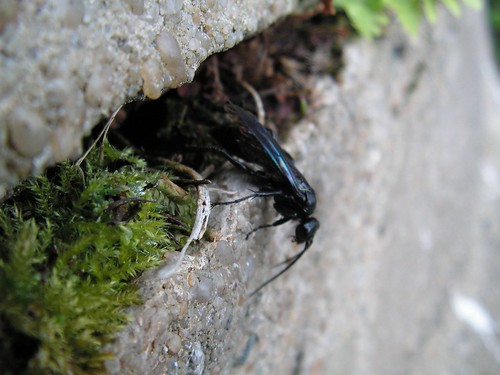
It occurs to me that some readers might be put off by my affection for spiders. I'd be interested to see which creature, the wasp or the spider, you find yourself cheering for at the end of this post. Let's introuduce them. First, the large black hunting wasp Priocnemis monachus emerging from its burrow in one of the steps on our garden path (I messed up the focus, but nature has a way of refusing to re-pose):
And the creature the black hunting wasp has been hunting, one of the native tunnelwebs Porrhothele antipodiana:
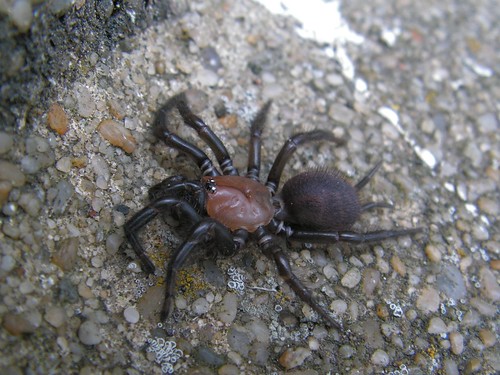
Po. antipodiana is pretty cool spider, it's one of very few that are capable of eating snails. Snails usually avoid the attentions of ground dwelling spiders by being too slimy to get a hold off and being able to retract into their shell. Po. antipodiana get's around those defenses by hooking its fangs into the snail's body and holding on while the snail struggles, produces tonnes of mucus and finally succumbs to the spider. A couple of months ago I gave a talk to a local school who wanted someone to help their study of invertebrate lifestyles and one of the kids told me that he'd seen a tunnelweb eating a snail. The budding naturalist didn't seem at all proud when I told him that he'd observed a behaviour that was only recognised by scientist 30 years ago. I guess 30 years seems an impossibly long time when your 10!
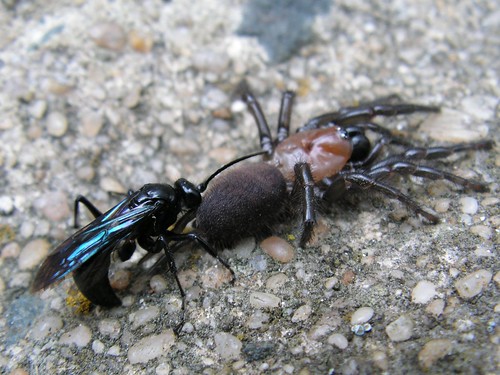
If this particular spider looks a bit bedraggled it's because it has already been anesthetised by the wasp. Pr. monachus is a member of the family Pompilidae which, like the ichneumonidae that featured here last week, use the living bodies of other arthropods as incubators to grow their young. While most of the ichneumonidae use caterpillars to grow their larvae the pompilids specialise in spiders (which has earned them the name spider wasps). There are ten described species of spider wasp in New Zealand, each targeting a range of spider species. Pr. monachus the largest of our spider wasps, and by choosing Po. antipodiana to provision her nest this one has taken on of New Zealand's largest spiders:


Labels: environment and ecology, might interest someone, parasitism, photos, Pompilidae, Porrhothele antipodiana, Priocnemis monachus, sci-blogs, spider, sunday spinelessness, wasp
Sunday, May 23, 2010
Sunday Spinelessness - Attack of the Killer Sponge!
 Chondrocladia turbiformis, a ruthless carnivore hauled from bottom of the sea off new New Zealand by NIWA scientists, has been named among the top ten new species described last year. This abyssal predator isn't a kraken, a plesiosaur that time forgot or even an improbable (but awesome) hybrid. It's a sponge.
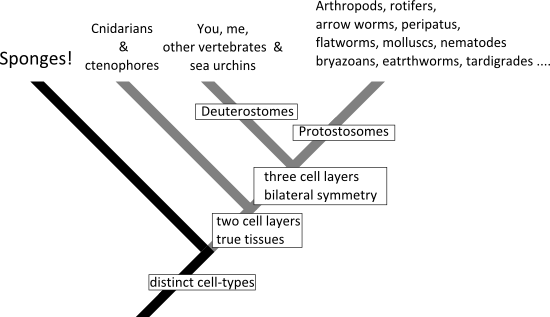
It may come as some surprise that a sponge can be a carnivore, or even that sponges are animals. Sedentary as they are, sponges tick all the boxes for inclusion in the kingdom Anamalia. They eat other organisms to make energy and build their body (differentiating them form plants and algae), they have cells enclosed by membranes (not cell walls like plants and fungi) and they are truly multi-cellular, with specialised cell-types (which sets them apart from protists). On the other hand, sponges are pretty unusual animals. Sponges have no nervous system, no gut, not circulatory system and their cells don't form tissues. The relative simplicity of sponges helps us to understand the evolutionary history of animals, by plotting some of the characteristics of modern animals onto a phylogeny we can see what order those characters evolved in:
So, sponges are useful in trying to understand the evolution of animals. But we shouldn't view modern species as steps along a path toward more complex animals. Sponges are amazing creatures in their own right, for a start they're the only animals that don't have a mouth. Most sponges feed by drawing water into the their body through pores and absorbing bacteria and small algae from that water with specialized cells on the inner surface of their bodies. The cells of the inner surface have two sets of projections to help them with this task. The tail-like flagella which beat together to get water flowing over the absorbing cells and the hair-like micro-villi which increase the cells surface area and make them more efficient absorbers (the guts of more complex animals play the same trick on a larger scale). Most sponges further increase the efficiency of this process by taking the form, and the function, of a chimney. The tubular forms are help together by a mesh of small calcium carbonate structures called spicules.
Filter feeding works well in relatively nutrient-rich shallow waters, but scientists have pulled odd looking sponges up from the bottom of the ocean. Some of those sponges still had the characteristic sponge filter feeding system, but others had lost it all together. Quite how these strange sponges were getting by in the dark and unproductive abyss without even the normal sponge feeding system remained a mystery until 1995 when French researchers found a relative of the deep sea sponges in a relatively shallow submarine cave. Abestopluma hypoa gave scientists their first chance to observe these sponges, and what they saw was amazing: it was a carnivore. In life A. hypoa projects a set of filaments into the water. Those filaments are covered in tiny spicules which act like Velcro (that's the author's own simile) grabbing passing crustaceans and holding them in place. It takes a while for the sponge to get its meal, cells make contact with prey within an hour but the actual ingestion follows a period of cell growth and movement which completely covers the animal after a day. It takes another couple of days to completely digest the crustacean.
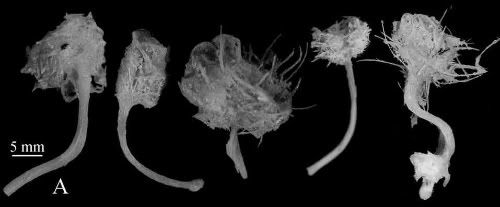
Since that first discovery scientists have discovered many more carnivorous sponges, with a surprisingly large number coming from sea mounts off New Zealand and in the Southern Ocean. The topic of today's post (I knew I'd get to it eventually...), Chondrocladia turbiformis, is one of the newest killer sponges, and it looks a bit like a mushroom:
The Chondrocladia are a bit of a special case among the carinovore-sponges because they have retained the rudiments of their filter feeding system. They don't appear to use it to supplement their diet, rather it's been re-purposed to inflate a balloon like structure the sponge uses to help capture prey. (For a stunning example of this structure in a live sponge see the photo that illustrates Olivia Judson's article here.). But the thing that really distinguishes C. turbiformis from the already amazing carnivorous sponges are its spicules:
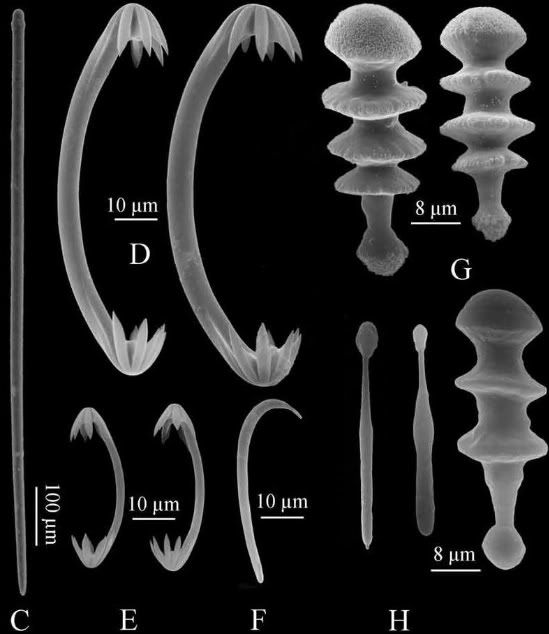
Beautiful as they are, those symmetrical curved claws in D and E are run of the mill for Chondrocladia. The spinning top spicules in G and H are something quite different. It was only through the description of C. turbiformis and a related species C. tasminae that it became apparent these spicules, with have been named trochirhabds, are present in some modern Chondrocladia species. It's not extactly clear what these cool little spiclues are doing in modern Chondrocladia but they give us a clue to the history of carnivorous sponges. Spicules just like the trochirhabds described from C. turbiformis have been found in marine sediments from the Jurassic period. It appears the carnivorous sponges that it took us until 1995 to learn about have been living in the oceans for at least 150 million years.
Vacelet, J., Boury-Esnault, N., Fiala-Medioni, A., & Fisher, C. (1995). A methanotrophic carnivorous sponge Nature, 377 (6547), 296-296 DOI: 10.1038/377296a0 Jean Vacelet,, Michelle Kelly, & Monika Schlacher-Hoenlinger (2009). Two new species of Chondrocladia (Demospongiae: Cladorhizidae) with a new spicule type from the deep south Pacific, and a discussion of the genus Meliiderma Zootaxa (2073), 57-68
Labels: carnivorous sponge, citizen science, might interest someone, porifera, sci-blogs, sponge, sunday spinelessness, taxonomy
Sunday, May 16, 2010
Sunday Spinelessness - You don't know the trouble you're in
A scene from the garden. On the left, the New Zealand Praying Mantis Orthodera novaezealandiae. On the right, a hover-fly that doesn't know how much trouble it's in.

(for those interested in the final result: the hover-fly flew off; the mantis lunged, but missed)
Labels: environment and ecology, hover-fly, might interest someone, Orthodera novaezealandiae, photos, sci-blogs, sunday spinelessness
Wednesday, May 5, 2010
Memorialising my own folly
I'm usually a pretty cautious kind of a guy. I might be physically incapable of proofreading but I at least think these posts through and make sure I'm not committing any grave errors of science before I hit the publish button. Usually.
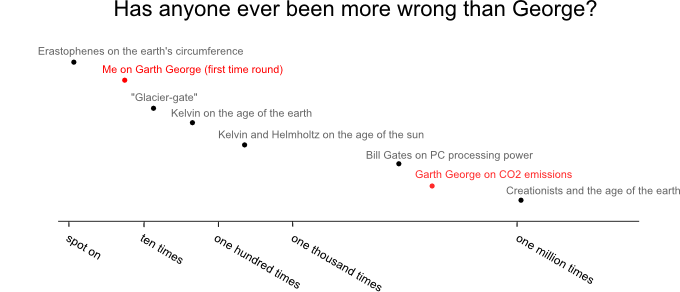
A couple of weeks ago I made fun of Garth George because he underestimated New Zealand's carbon emissions by some staggering amount. It turns I overestimated the degree of Garth George's underestimate. Or to put it another way, I screwed up that maths. Garth George is still spectacularly wrong, out by a factor of 375 000, but I had said he was out by about eight times more than that. In putting the graphics together I'd written down the inverse of George's error (about 2.75 millionths, or 2.75 x 10⁻⁶) to help me calculate the sizes for each triangle and when it came time to write up the post I mistook my notes, reading 2.75 x 10⁶ or 2.75 million.
That's not an excuse, it should have been obvious to me, as someone who passed 3rd from maths, that 3.7 x10⁸ couldn't be millions of times bigger than 1 x10³ and in writing the post I should have caught it. It's all very embarrassing, but if you are going to make fun of people you have to be prepared to be treated in the same way. So, in that spirit, here's the magnitude of my error plotted for all to see:

And the worst bit, Garth George is still among the wrongest people in history but not quite on the same level as the Young Earth Creationists (and will no doubt be overtaken by Bill Gates at some stage, if he really said that thing they say he said):
Any physical science types reading this post might want to make a joke at the expense of biologists now, can I suggest this one:
A group of biologists and a group of mathematicians meet each other at a train station on their way to a conference on ecological modeling. The biologists each line up to buy a ticket, while a single mathematician collects a few coins from each his colleagues and buys a single ticket. Both groups board the train and before the biologists can ask what the mathematicians are up to one of them yells out that the conductor is on his way. The mathematicians leave on mass, cramming into one bathroom. The conductor arrives and clips the ticket of each biologist before knocking on the bathroom door and asking “tickets please”. The mathematicians slide their single ticket under the door, it gets clipped and the mathematicians get their train journey at a fraction of the cost the biologists paid.The two groups run into each other again on the way home from the conference. This time the biologists are on to the game, so after exchanging a knowing wink with the mathematicians they send a representative off to get one ticket. But they are amazed to see the mathematicians don’t even bother with the single ticket that bought for the first journey. The biologists want to know what’s going on by the mathematicians stay tight lipped until their spy announces “conductor on his way”. The biologist scramble just as they’d seen the mathematicians do on the last trip, squeezing into a bathroom. In contrast, all but one of the mathematicians strolls down to the other bathroom in the train while the other approaches the biologists’ room, knocks on the door and asks “tickets please”.
(The moral of the story, biologists should think carefully before applying mathematical methods)
Labels: blerg, blog blogging, climate change, might interest someone, sci-blogs
Sunday, April 4, 2010
Sunday Spinelessness - A Nobel Prize Winning Insect
I think invertebrates are important. The 95% of animal species that don’t have a backbone are not simply the base of the animal kingdom’s pyramid, they are the little creatures that run the world. A third of the planet’s food production relies on honey bees, collembola and corpse-feeding insects turn dead tissue into living tissue and coral reefs can turn the nutrient-poor tropical seas into submarine rainforests. There are even a couple of invertebrate animals that have won the Nobel Prize.
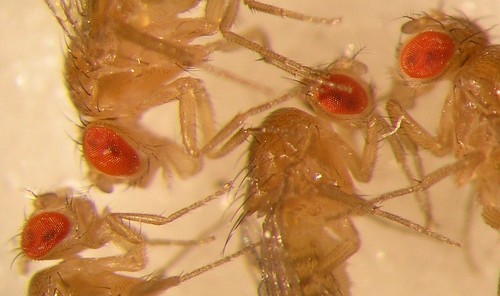
Drosophila melanogaster has probably taught us more about genetics than any other animal on earth. In the wild D. melanogaster larvae develop on rotting fruit so, just like the flesh-flies that were featured here a couple of weeks ago, they are faced with the problem of having to complete their entire developmental program in the short period of time the fruit they are born in is a viable food source. Thanks to these environmental constraints, D. melanogaster has a very short life cycle. Under optimal conditions they can go from egg to adult in a week. This remarkable developmental haste means drosophilists can run genetic experiments that cover many generations in a few months, and they can run many replicates of these experiments because each of them takes up about this much space:
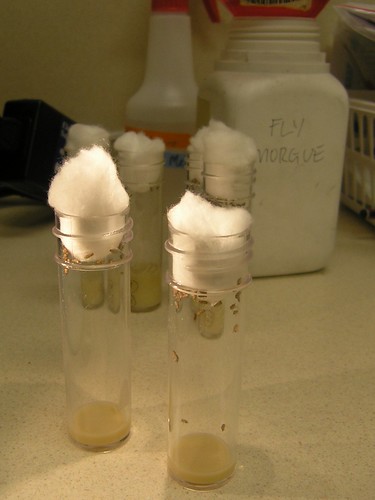
Drosophila has been kept in laboratories since the the turn of the 20th Century but T.H. Morgan was the first person to put Drosophila at the forefront of genetic research. Morgan was an embryologist by training and, like a lot of embryologists then and now, he became interested in a school of evolutionary thought called mutationism. As the name suggests, the mutationists argued that one-off mutations were the creative engine of evolution, relegating natural selection to weeding out maladaptive mutants. In order to test the creative power of mutation Morgan grew up generation after generation of Drosophila and bombarded them with anything he thought might mutate them; radium, salts, sugars, acids, bases and even centrifugal force. Two years of this mutational bombardment got Morgan nowhere, he could induce changes in his flies but none that would be stably passed on. In 1910 he found a single white eyed male.
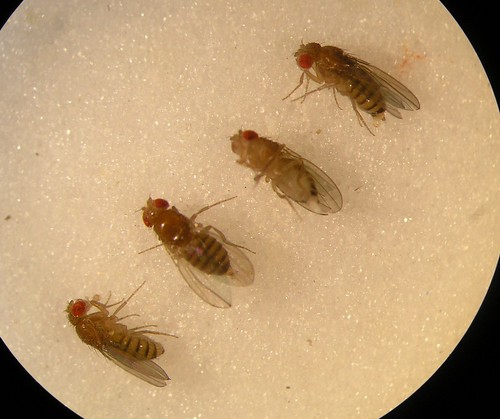
There is a story, which I can't find repeated by reliable sources, that holds that Morgan took the first white eyed male home with him in jar and slept with the jar next to his bed that night. I don't know if that story is true but that one fly does have a treasured place in the history of genetics. By crossing it to normal eyed (what geneticists call "wild type") females he was able to show that the genetic factor that made the fly's eyes white was part of the sex determining chromosome. For the first time a gene had been shown to be reside on a chromosome. A few years later he showed that multiple genes are arranged in linear fashion along chromosomes by demonstrating crossing over between the white eye gene and another called rudimentary. At Otago second year geneticists repeat Morgan's experiments, so this picture, sorting flies under a binocular microscope, will be familiar to anyone whose been through the program. (it will probably also bring back memories of escaped flies and a whiff of the (dilute) ether used to knock the files out...)
Morgan was awarded the Nobel Prize in 1933, in 1948 Drosophila research got another Nobel, this time to Hermam Muller for showing X-ray radiation could induce mutations. Geneticists have continued to use Drosophila as a model organism, perhaps most usefully in untangling the genetic interactions that underly the development process. In 1980 Christiane Nüsslein-Volhard and Eric Wieschaus presented the results of a mutational screen; that is, they mutated Drosophila stocks at random and recorded the developmental phenotypes that resulted. Nüsslein-Volhard and Wieschaus identified 15 genes involved with the very early stages of development. In quick time Drosophilists mapped that those genes to chromosomes and worked out how their products combined to pattern a developing embryo. Nüsslein-Volhard and Wieschaus' work laid the ground work for one of the most staggering findings of modern biology, almost all the genes that help shape the Drosophila embryo have counterparts in the human genome that play similar roles in our development. An insect can be a useful model for human development and disease genetics. Nüsslein-Volhard and Wieschaus were awarded the Nobel Prize in 1995, the third Nobel for work on Drosophila.
A big thanks to Sarah Morgan, one of Otago's fly pushers, for the photos that illustrate this post. Sarah's off to the US of A this week to show off her research at The Big Drosophila Meeting in Washington DC so she will probably have some less historical Drosophila science to talk about in the next little while...
Nüsslein-Volhard C, & Wieschaus E. (1980) Mutations affecting segment number and polarity in Drosophila. Nature, 287(5785), 795-801. PMID: 6776413
Rubin GM, & Lewis EB. (2000) A brief history of Drosophila's contributions to genome research. Science, 287(5461), 2216-8. PMID: 10731135
Labels: diptera, drosophila, environment and ecology, genetics, might interest someone, photos, sci-blogs, sunday spinelessness
Sunday, March 28, 2010
Sunday Spinlessness - The Other Damsel
This week's Sunday Spinelessness is dedicated to those people who wash up at this post after googling for "Austrolestes colensonis" only to be disappointed. At the time I wrote that post on our damselflies I didn't have a photo of the the New Zealand Blue Damselfly, let me correct that now. A full body shot:

And a close up:

These photos were taken at Fensham Reserve in the Wairarapa. We walked through the bush there on a bright summer's afternoon and every time we passed a break in the canopy we found a little flight of Austrolestes basking in the sun. The reflective wings were beautiful, but, as you're about to see, not easily photographed:

Labels: Austrolestes colensonis, damselflies, environment and ecology, might interest someone, Odonata, photos, sci-blogs, sunday spinelessness, Zygoptera
Friday, March 26, 2010
Does a forty thousand year old finger point to another human species?
Here's the big figure from the paper, which was presented by Johannes Krause and colleagues in Nature yesterday. It's a phylogenetic tree which relates the little finger's mtDNA to H. sapiens and H. neanderthalensis sequences (click to see a high-resolution version):
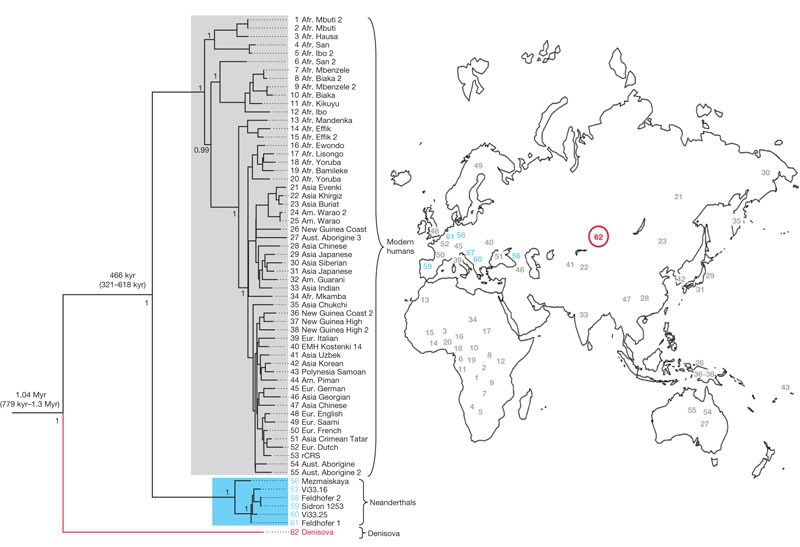
The Denisnova sequence is red, Neanderthal sequences are in blue and modern humans are grey. So, the Denisova mtDNA forms a distinct lineage that isn't represented in modern humans or in previously published Neanderthal sequences. By using the tree as the basis for molecular dating the researchers were able to estimate that Denisova lineage separated from other human mitochondrial lineages between 0.78 and 1.3 million years ago. The temporal context the molecular dating adds to the phylogenetic tree helps to us understand where this new mitochondrial lineage might fit into humanity's family tree.
I've said before that most of our species' history was played out in Africa, and, in fact, the same is true when we step up a taxonomic level and look at our genus. All the human species that have been found outside of Africa descend from migrants that moved out of that continent at some stage. Here's a schematic representing some of the species in the wider human family tree and the timing of the migrations that moved them out of Africa.
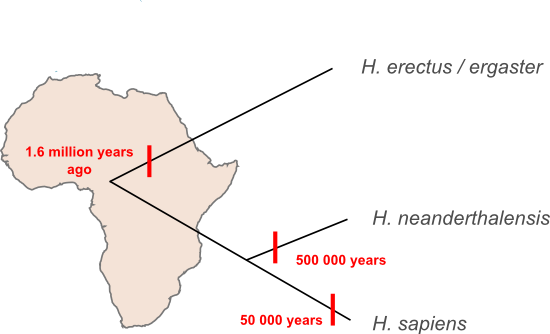
How does the new evidence presented by Krausse et al. fit into that scheme? Perhaps the simplest interpretation is the the Denisova lineage represents a new species. The estimated age of the Denisova lineage makes it too young to have been carried out of Africa by the first wave of H. erectus migrants to leave Africa and apparently too old to have been inherited from the migrants that went on to form the Neanderthal lineage. If the Denisova sequence is something new then we'll have to update our family tree, adding a new branch and a fourth migration out of Africa.
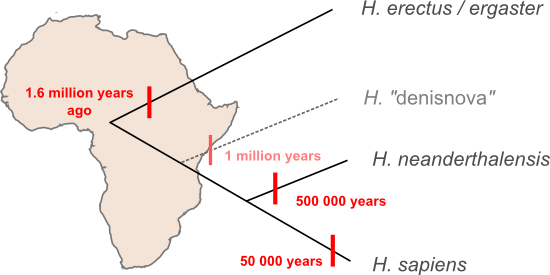
John Hawks thinks we should hold off on updating the family tree too qucikly. The Desinova specimen might be a Neanderthal. At first glance the tree presented by Krausse et al. seems to dispel that possibility since previously identified Neanderthal sequences are more closely related to modern human sequences than the new linaeage, but that tree is based entirely on mtDNA. The mitochondrial genome is inherited as if it was a single gene. We can often use trees estimated from a single gene ("gene trees") as a proxy for species-level relationships ("species trees") but, in fact, every gene in a population has its own history and there there are scenarios that can push a given gene tree away from underlying species tree. Perhaps the easiest way to visualise how you'd end up with mitochondrial lineages that diverged millions of years ago within a single species is to think about genetic lineages moving through a population while speciation happens. New species form when populations stop sharing genes with each other, in the diagram below the big black triangle represents a barrier to gene flow. What happens if multiple different gene lineages are present in the ancestral population at the time that this gene flow stops? Usually, given enough time, each species will "sort" into specific gene lineages that descend from just one of the lineages in the ancestral population, but it's also possible for one (or both) species to maintain multiple lineages for some time. Such "incomplete lineage sorting" makes gene trees bad proxies for species trees and it's just possible that something like this has happened in Neanderthals:
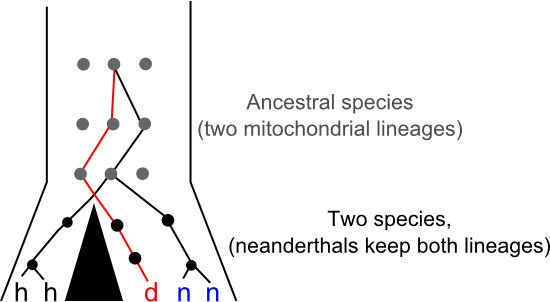
Perhaps by moving to the very Easterm edge of the Neanderthals range we've sampled for the first time a lineage that existed in that species for the whole time it was in Europe. Maybe, and Hawks surely knows a lot more about paleobiology than I do, but I don't really buy it. It's certainly possible for a species to harbour deeply divergent mitochondrial lineages, but the time it takes for gene-lineages to sort within a species is relative to the effect population size of that species. Neanderthals probably had a relatively small effective population size (and mtDNA definitely does, since only females pass it on and then in only one copy) making the retention of multiple lineages over hundreds of thousands of years seem like a long shot. As Hawkes argues, strong geographic structure in Neanderthal populations might have aided the retention of divergent genetic lineages against those odds, maybe the Denisova mitochondrial lineage was extinct in Western Europe but common in Central Asia? It's possible, but I wouldn't bet on it.
Finally, the Denisova sample might be our first look at H. erectus DNA. H. erectus remains have been recovered from China so it seems possible they were in Siberia too. As I've said, the molecular dating of the Denisova lineage probably makes it too young to be a descendant of the first wave of migration form Afirca (though, of course, there is some uncertainty associated with that dating), but it might be evidence of genetic exchange between African and the H. erectus diaspora. As we've come to understand the origin of our species we've realised that the simple "Out of Africa" model is just that, a model, and the true pattern is more complex. H. sapiens really did have its start in Africa and it really did push out into the rest of the world in the last 50 000 years or so, but during that expansion populations have continued to exchange genes. There's no reason to believe that that H. erectus could not have done the same, perhaps the main thrust of the H. erectus expansion was 1.6-2 million years ago but genes continued to flow in and out of Africa for sometime after that.
So, there are three possibilities for the Denisova sample:
- It could be a new species,
- It could be an ancient mitochondrial lineage retained in eastern Neanderthal populations but lost elsewhere
- It could be the first H. erectus sequence.
Krause, J., Fu, Q., Good, J., Viola, B., Shunkov, M., Derevianko, A., & Pääbo, S. (2010). The complete mitochondrial DNA genome of an unknown hominin from southern Siberia Nature DOI: 10.1038/nature08976
Labels: evolution, genetics, Human evolution, might interest someone, phylogenetics, sci-blogs, science, speciation
Sunday, March 21, 2010
Sunday Spinlessness - Waste Not
Just a quick one today. A few weeks a go I used a picture of a male Cambridgea spider to spring off into a half-baked conversation on arachnophobia. That male had probably wandered into the warmth of our house after paying a visit to a female who has a web attached to the downpipe by our kitchen window:

During the day the web's owner hides in a retreat (in this case right behind the joint in the downpipe) but at night you can see a very impressive spider sitting under her web, waiting for some tasty morsel to get trapped. Cambridgea are really forests spiders, if you hunt around a decent piece of native forest and you are bound to find a similarly constructed, but much larger, web. In the forest expectant Cambridgea mothers obscure their egg cases with twigs and dried leaves. Apparently our kitchen wall did offer much camouflage when our Cambridgea mother

You really should click on that image and see the high-res version, it's pretty cool. In order to grow, spiders have to cast off their rigid exoskeleton. You can see here our Cambridgea mother has used her discarded exoskeleton to help obscure her egg case!
The exoskeleton also gives you a clue as to how the spider has achieved its moult - the cephalothorax (the part of an arachnid body that includes the head and the thorax) is popped off and the spider pulls itself, legs and all, out through that gap. The last step of the process is photographed here.
Labels: arachnophilia, Cambridgea, might interest someone, photos, sci-blogs, spider, sunday spinelessness
Thursday, March 18, 2010
Illustrating Carl Zimmer's Readers
Carl Zimmer has been wondering what to do next. Obviously, he's going to keep writing his wonderful science stories and continue to maintain the Science Tattoo Emporium but where to do that , and how to make money from it, is less clear. Carl's a scientific kind of guy, so he wanted get some data to inform his decision. The results of his reader's survey are out and they're interesting. But, for all Carl's skill with words data wants to be pretty, so here are a couple of the the key conclusions of his reader's survey illustrated with the help of ggplot.
Where do readers of The Loom get their science news?

How much would they pay for an e-book from a scince writer they liked?

Labels: ggplot, might interest someone, pretty data, sci-blogs, technology
Wednesday, March 17, 2010
Lawrence Krauss on a bad day
Dunedin got to see Lawrence Krauss on a good day and a bad day this week, but that’s not to say one of his presentations was better than the other. Yesterday the award winning physicist and scientific communicator revealed to his audience that his outlook on life changes from day to day. On good days he can revel in the wonder of a universe that could come to know itself due to a series of accidents that started 10-31 seconds after the big bang and allowed the creation of first matter then atoms, stars and planets and finally astronomers. On bad days he despairs at the lack of scientific thinking in journalism and politics and thinks these problems, and the anti-scientific forces that fuel them, will probably prevent us from doing anything meaningful about climate change.
Krauss' awe inspiring story of an atom's journey from the birth of the universe to its death will gain nothing from my retelling it. If you weren't able to see it then you'l be glad to know his talk was a précis of his excellent book ATOM: An Odyssey from the Big Bang to Life on Earth...and Beyondand covers similar ground to this recored lecture. Perhaps I'm a masochist and a pessimist, but I'm going to skip the awe inspiring story to focus on what Lawrence Krauss thinks about on a bad day. His talk on "Science, Non-Science and Nonsense" described the sources of scientific confusion in society and the tactics used by those groups that seek to take advantage of it.
Krauss argued that the goal of science education and science communication should be to make sure everyone develops a functioning bullshit filter. He didn't express his thesis quite as bluntly as that, but his core idea is that spreading a scientific mindset would allow us to short circuit needless debates (is global warming real?) and let us get on to the important ones (what are we going to do about it?). He used a neat example to illustrate how this sort of scientific common sense could stop nutty ideas before they get started. UFO enthusiasts often cite the ability of the lights they observe to perform right angle turns at speed as evidence of their otherworldliness. In fact, Krauss pointed out, common sense should tell us that these apparently amazing maneuvers are evidence that the lights in question are not being emitted by a massive object moving through the sky. The only way to turn at a right angle is to stop then change direction, for a UFO to do all its slowing down and stopping so quickly a human observer couldn't perceive it would generate G-forces with a strength about 2000 times greater than earth's gravity. And quite a mess.
If the evidence used by UFO junkies is so silly then why do continue prosper? Why aren't people already filtering this sort of nonsense? The standard of scientific reporting in the media certainly has a lot to answer for. Krauss cited the normal concerns, a fractionated media market means viewers can choose a source of news that confirms their biases and the innate need of journalists to present balance is misplaced in science stories when, in almost every case, one side is wrong and we usually know which side that is. He also mentioned something I hadn't thought about before. According to Krauss, part of the problem with science coverage in mainstream reporting is that journalists don't feel qualified to make scientific pronouncements. Writers and broadcasters are happy to make bold statements on politics, financial markets and sports but will shy away from even a scientifically uncontroversial statement like "evolution is a fact."
Scientific understanding might not be helped by meek journalists and the false equality of balance but most journalists aren't setting out to deliberately mislead the public on science. Unfortunately, there are forces at work that are doing just that. Krauss had a tonne of examples from the culture wars in his native USA to draw on but he also took the time reminded us of our home grown cranks, citing the New Zealand Climate "Science" Coalition and Ray Comfort (The Apologists Nightmare [youtube video]) as evidence we aren't immune to anti-science in New Zealand. As you'd expect Krauss exposed just how vacuous the claims of intelligent design creationism and the objections of climate change denialists are, but he also attempted to deconstruct the PR strategies each group use. Both campaigns seek to take advantage of the public's sense of fairness and journalists' willingness to provide balance to any point of view. The Discovery Institute would have you believe their goal is simply to get their science a fair hearing in the classroom. But they don't have a science. For normal science, theories only make it into the school curriculum after they've been proposed, tested, retested and confirmed. The ID crowd don't want fair treatment, they want special treatment, to avoid that boring scientific process and start in the classroom!
Krauss could hardly have known this, but our own climate cranks play the same game. I hate to make an example of this article because the author usually covers science well, nevertheless it highlights the point. In an effort to provide balance to a story on how the IPCC might be made better the author contacted Vincent Gray for comment, here's the paragraph
Wellington scientist and climate change sceptic Vincent Gray said the researchers were continually coming up with "new models" but they were still "fiddling the figures" and were unlikely to restore public confidence in their work until their projections were proven
That sounds pretty fair doesn't it? Climate scientists can run their model forward in time and if their projections match observations we'll take action. Actually, it's absurd. As Krauss emphasised in his talk, the evidence for climate change doesn't only come from models, we have tonnes of data that tell us the earth is warming and the seas are rising. Combine those data with the fact recent temperature records are within the uncertainties of the IPCC's projections and sea levels are near to the upper bound of those projections and Gray's sound bite seem less fair.
Krauss had more problems than solutions in his hour long presentation. In fact, it's a testament to the passion he has for his science and skill he has as a scientific communicator that he managed make a talk made almost entirely of depressing facts seem invigorating. The only ray of hope Krauss offered us was that when people's backs are to the wall they abandon their their preconceptions and to turn to science. In 2003 George W. Bush said that he believed "both sides" of the "evolution debate" should be taught in schools. In 2005 Bush was faced with the prospect of Avian flu becoming able infect humans. Confronted with threat of a flu pandemic the Bush administration dispensed with its evolutionary agnosticism and planned for the possibility of genetic mutations allowing viruses to pass from human to human. That sort of infectivity requires conformational changes in surface proteins which create a new function, exactly the sort of phenomenon the ID crowd think is so improbable as to be effectively impossible.
Krauss will be presenting something very similar to his Dunedin talk in Auckland next week. I'd encourage anyone who has the chance to get out and seem him, he's a very chrasmatic and interesting speaker. You might even ask the question I really wish I did now- how are we going to fix all these problems?
Labels: climate change, evolution, Lawrence Krauss, might interest someone, sci-blogs, science and society, science communication, skepticism
Sunday, March 14, 2010
Sunday Spinelessness - Extreme Close-up
Almost all the photos I've used to illustrate these Sunday Spinelessness posts have been taken with my fixed lens digital camera. I think it does a pretty nice job in macro mode but sometimes you just want to get a little closer to your subject. I photographed each of the landsnails I collected for my PhD research so that I could have a record of their pigmentation, which degrades once you preserve a specimen in ethanol. Obviously, the more detail I could get the better so I borrowed some very exciting toys from the department's photography office:

The camera is a DSLR with a 100mm f2.8 macro lens, an extension tube and a twin flash. The mammal crashing this invertebrate-celebrating series is me.
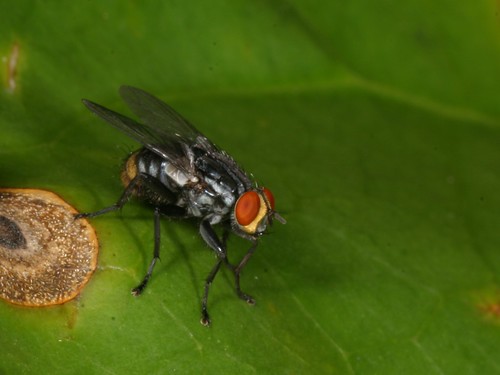
Of course, I couldn't have a toy like this to play with and limit myself entirely to photographing snails. In amongst those important snail photos I have jumping spiders, hornets, geckos and really anything else that chanced across the porch I was taking photos on. One of the more striking subjects is this red-eyed fly:
And the head-on shot...
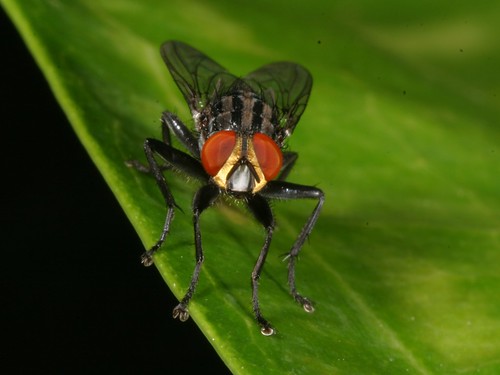
It turns out the pretty red-eyed fly is Oxysarcodexia taitensis, one of the Sarcophagidae. That family name gives you a clue to how this fly makes its living, it translates as "flesh eating" (it stems from the same root words as sarcophagus, the Greeks believed limestone ate away at corpses sealed in it). Most of the flesh-flies feed on dead animals but a few have earned a place in vertebrate nightmares, horror movies and even medical practice by depositing their maggots in on open wounds.
Relying on dead animals for food is a chancy business. Corpses are usually patchily distributed and there a plenty of other scavangers out there to compete with. This problem is especially bad for the larval stages of insects, without wings to get them to the next corpse their entire future depends on the continued existence of the flesh they are born on. The sarcophogids have developed a neat trick for making the most of corpse when they find one - they give birth to live maggots. Technically, the flesh flies are ovo-larviparous, meaning the larva develops inside an egg which is retained in the female until the larva hatches. Flesh-fly maggots can start eating as soon as they are born, maximizing their chances of getting through their lifecycle before another scavenger eats the corpse they live in.
It's easy to get freaked out about a creature that spends it's life eating decaying flesh but we should remember that flesh-flies play an important role in ecosystems. Sarcophigids and other scavengers turn dead flesh into living flesh. WD Hamilton, one of evolutionary biology's most insightful and original thinkers, recognised the important role of carrion feeding insects in his burial instructions:
"I will leave a sum in my last will for my body to be carried to Brazil and to these forests. It will be laid out in a manner secure against the possums and the vultures just as we make our chickens secure; and this great Coprophanaeus beetle will bury me. They will enter, will bury, will live on my flesh; and in the shape of their children and mine, I will escape death. No worm for me nor sordid fly, I will buzz in the dusk like a huge bumble bee. I will be many, buzz even as a swarm of motorbikes, be borne, body by flying body out into the Brazilian wilderness beneath the stars, lofted under those beautiful and un-fused elytra which we will all hold over our backs. So finally I too will shine like a violet ground beetle under a stone.".
Labels: Cook Islands, diptera, environment and ecology, flesh-fly, might interest someone, photos, Sarcophagidae, sci-blogs
Sunday, March 7, 2010
Sunday Spinelessness - Survivor
Until today these Sunday Spinelessness posts have been severely unrepresentative. I've talked about molluscs and myriopods and shown you photos of anthozoans and arachinids but nowhere in these posts have I included a post about a beetle. Which is a shame because, to a first approximation, every species on earth is a beetle. Really. Most animals are arthropods, most arthropods are insects and most insects are beetles. In all, 350 000 species have been described so far, about a third of the total number of species from all groups. The star of today's piece is one of New Zealand's 4 500 described species.

I found our star stuck in one of those deadly rhododendron shoots . I guess if I was a cold-hearted documentarian, interested only in recording the happenings of the natural world, I would have left him there to struggle. But, really, I'm just a sucker for handsomely striped elytron so I helped disentangle him from the sticky shoot.

Those impressive antennae place our specimen in the order Cerambycidae, the long horn beetles, which includes the famous huhu beetle. I can't identify it down to species but it's likely in the genus Coptomma (for what it's worth, the taxonomic shorthand for 'some species in Coptomma' is 'Comptomma. sp'). Our Coptomma didn't seem to have any long lasting effects from his run in with the rhododendron's sticky trap, he wandered off my life-raft leaf and set about cleaning himself up:

Labels: beetle, Cerambycidae, long horned beetle, might interest someone, sci-blogs, sunday spinelessness
Friday, February 26, 2010
You have to be in to win...
 So, in a fit of egotism and optimism I nominated myself (and a bunch of other people) for the Research Blogging Awards - putting myself forward in the category of "Best Lay-Level Blog". The finalists were announced today and it seems I made the list. Apparently in the next stage researchblogging.org members vote for their favourite blogs in each catergory. I think it's safe to say I'll be out of the running once voting starts but I'm really quite chuffed and... damn it I'm just gonna say it... it's an honour just to be nominated among real writers lie Brian Switek of Laelaps and Ed Yong of Not Exactly Rocket Science and the bloggers behind The Lay Scientist, Observations of a Nerd, Mauka to Makai and Cancer Research UK's blog.
Labels: blog blogging, might interest someone, research blogging, sci-blogs
Saturday, February 20, 2010
Sunday Spinelessness - Animals that don't move
There aren't many universal laws in biology. Snails proved Dollo wrong, retorviruses did for Crick's Central Dogma of Molecular Biology and every lesson on Mendel's Laws of Inheritance includes a section of the exceptions to those rules. Biology's disregard of human laws notwithstanding, you might think, at least as far as macro-organisms are concerned, you could safely generalise that animals move and plants stay still. But once you consider the ocean even that generalisation can't be supported; corals, bryozoans, sea squirts, anemones and sponges are all animals that spend their adult life in one spot.
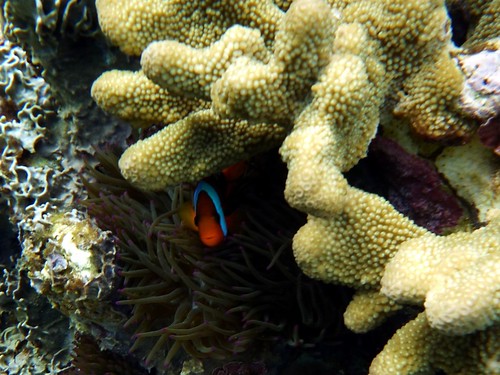
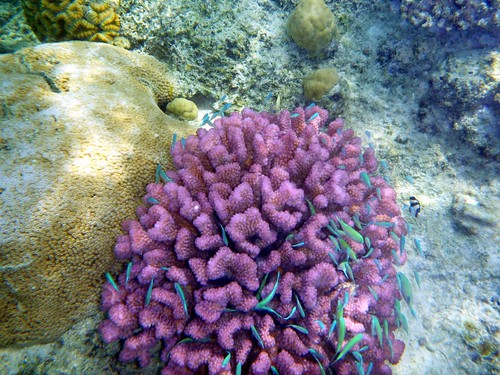
While I was in Masterton for christmas my girlfriend went to Vanuatu (no, you're right, that doesn't quite seem fair...) with a waterproof camera so I've stolen a few of her photos of coral to illustrate todays sunday spinelessness.
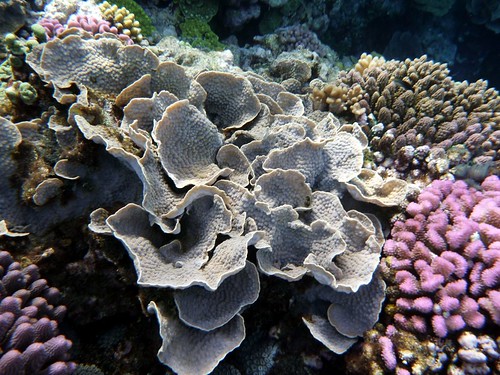
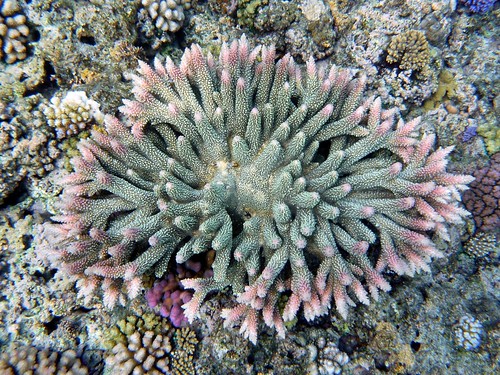
It's easy to see why early naturalist thought corals were plants but what you are looking at in those photos is not a single organism, rather it's a colony of tiny genetically identical animals. Corals are members of the phylum Cnidaria (the 'c' is silent) which includes corals, anemones and a diverse bunch of animals we call jellyfish. Such a diverse collection of animals are united under the name Cnidaria because they all employ the impressive nematocyst, a barbed harpoon like cell, to catch and deliver toxin to their prey. Cnidarians have two distinct life stages - a swimming "medusa" (adult jellyfish being the classic example) and a sessile polyp (like the sea anemones familiar to rock pool fossickers the world over). Individual coral colonies (termed "heads") are made entirely of polyps which reproduce asexually depositing a calcium carbonate base as they grow - the exact pattern in which polyps bud from their parents determines the shape a coral head takes.
Many tropical corals supplement their diets by forging a symbiotic relationship with swimming algae (arguably plants that move...) called zooxanthella, the algae get carbon dioxide from the coral's respiration while the coral gets energy from the algae. This relationship is of huge importance in the tropics because it allows corals to grow in those region's warm, nutrient poor waters. Without coral reefs, made from thousands of years of calcification from corals, tropical waters would be nowhere near as biodiverse as they are now and people whose love of animals only goes as far as that peculiar phylum Chordata should care about that:
Labels: anthozoa, cindaria, coral, environment and ecology, might interest someone, sci-blogs, sunday spinelessness
Sunday, February 14, 2010
Sunday Spinelessness - robber fly
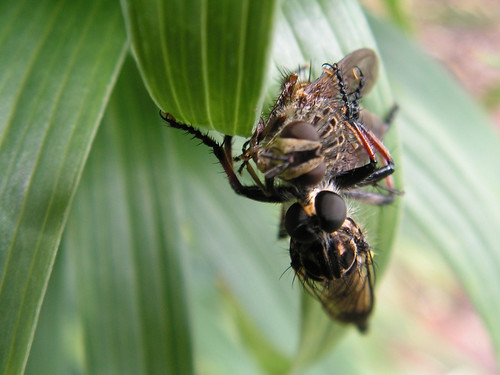
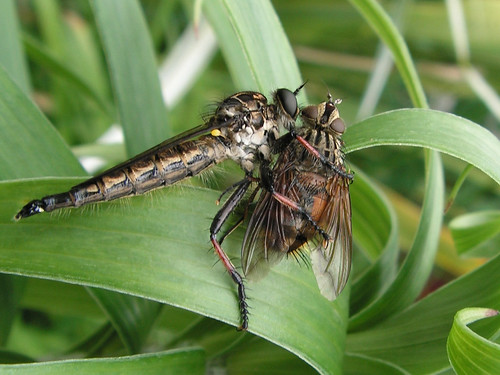
I've said before that the bugs in my parents' back yard seemed especially hungry over the Christmas break. Above you see more evidence to this fact. In the lower half of the photo is a robber fly and above is its meal, a blowfly of some sort. I've never seen live robber flies in Dunedin (though there is a dead one here) but the species captured above seems to be reasonably common in the Wairarapa. The first time I spotted one of them I struggled as to where to place it among the insects. The robber flies have long slender bodies and large rounded eyes which misled me into thinking that first sighting might be a small dragonfly. The real taxonomic position of the robber flies is spelt out in bright yellow in the next photo.
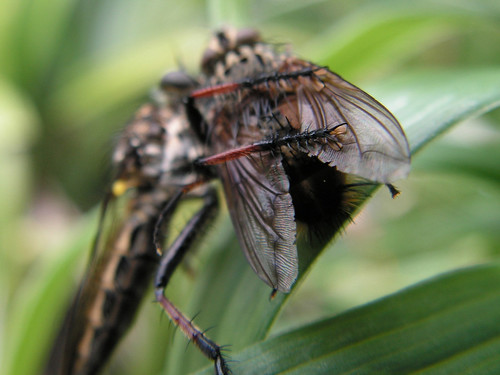
That bright yellow structur under the main wing is a haltere. Most insects have two sets of wings and we can tell quite a lot about where a given species fits in the insect scheme based on how it uses those two. Dragonflies and damselflies use both for flying, in beetles the forewings are "sclerotised" into a rigid case that protects the flight wings and the "true flies" ( order Diptera) have turned thier hind-wings into halteres - greatly reduced wings which act as gyroscopes stabilising the flies' flight and allowing them to perform aerobatic tricks. The robber flies from the extremely widespread and speciose family dipteran family Asilidae which includes a staggering 7 000 described species, meaning there are rather more robber fly species in the world than there are mammalian ones.
The features that led me to mistake that first robber fly that I saw for a dragonfly are likely the result of convergent evolution - dragonflies and robber flies are both predators that specialize in taking other insects on the wing. The robber flies differ from odonates in having piercing mouth-parts which they use to inject first a neurotoxin then digestive enzymes into their prey. The blowfly in the photos in this post is paralysed and its tissues are in the process of being liquified and sucked through the robber flies mouth parts. But ever before the neurotoxin entered the blowfly's body it was done for, the robber fly's strong "raptorial" legs are covered in sharp spikes and end in claws that offer little hope for escape once a catch is made.
Labels: Asilidae, diptera, environment and ecology, might interest someone, photos, sci-blogs, sunday spinelessness
Friday, February 12, 2010
Charles Darwin and the Origin of Spouses
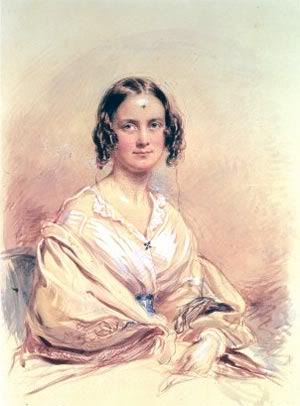
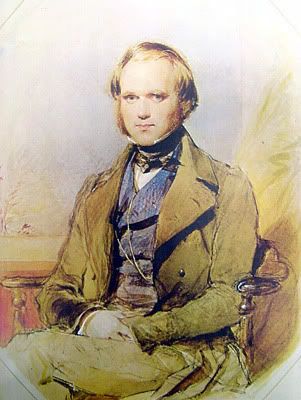
Happy Darwin Day everyone! Today would have been Charles Darwin's 201st birthday so around the world geeks are celebrating, churches are standing up to creationism and at least a few biologists are trying to eat their way through the tree of life. With Darwin Day falling so close to Valentines Day I thought it might be fun to forget about Darwin's science just for a few minutes and look at his attitude to love and marriage.
No one has ever accused Darwin about making a rush to judgement about any topic. Just as he spent years poring over the minutest detail of barnacle anatomy before he published The Origin he gave the topic of marriage careful consideration before singing on. In fact, preserved in his notebooks we have a record of the deliberations he undertook. Sometime in 1838 Darwin turned to a new page in his notes and drew a line down the middle, he added the headings "Marry" and "Not Marry" to either side of the line an proceeded to list the pros and cons of either decision. You can see the notebook here but below (presented without comment) is a transcript :
Marry
- Children — (if it Please God)
- Constant companion, (& friend in old age) who will feel interested in one
- Object to be beloved & played with —better than a dog anyhow.
- Home, & someone to take care of house
- Charms of music & female chit-chat.
- These things good for one's health.
- Forced to visit & receive relations but terrible loss of time.
Not Marry
- No children, (no second life), no one to care for one in old age.
- What is the use of working 'in' without sympathy from near & dear friends—who are near & dear friends to the old, except relatives
- Freedom to go where one liked — choice of Society & little of it.
- Conversation of clever men at clubs
- Not forced to visit relatives, & to bend in every trifle.
- To have the expense & anxiety of children
- Perhaps quarelling
- Loss of time.
- Cannot read in the Evenings
- Fatness & idleness
- Anxiety & responsibility
- Less money for books &c
- If many children forced to gain one's bread. (But then it is very bad for ones health to work too much)
- Perhaps my wife wont like London; then the sentence is banishment & degradation into indolent, idle fool
- My God, it is intolerable to think of spending ones whole life, like a neuter bee, working, working, & nothing after all.
- No, no won't do. — Imagine living all one's day solitarily in smoky dirty London House.
- Only picture to yourself a nice soft wife on a sofa with good fire, & books & music perhaps — Compare this vision with the dingy reality of Grt. Marlbro' St.
When I am with you I think all melancholy thoughts keep out of my head but since you are gone some sad ones have forced themselves in, of fear that our opinions on the most important subject should differ widely. My reason tells me that honest & conscientious doubts cannot be a sin, but I feel it would be a painful void between us. I thank you from my heart for your openness with me & I should dread the feeling that you were concealing your opinions from the fear of giving me pain.
Labels: Darwin, Darwin Day, evolution, history of science, might interest someone, sci-blogs
Sunday, February 7, 2010
Sunday Spinelessness - now with 150% more links
None of my photos today, instead I thought we should have a look at what some of web's other inveterate invertebrate bloggers have been up to.

Giant Microbe's plush Tardigrade
- Ted MacRae at Beetles in the Bush hosted the latest edition of the Circus of the Spineless which includes posts on noisy ants, maggot therapy, the place of amphipods in pop culture and no fewer than two samurai related stories.
- Weird Bug Lady (check out her Etsy shop, it's amazing...) now sells a stuffed toy in the shape of a flatworm. Yes, plush planarians!
- Sticking with the plush theme (as phrase I never thought I'd write...) the people behind the wonderful Giant Microbes have stretched their reach into Metazoa, the latest example a plush water bear (Tardigrade)! I note they are not yet available in the Australian/ New Zealand version of their store, but how can animal this cool fail to become a top seller?
- There's yet more invertebrate craft at I Love Insects where Erika finds oragami insects
- Finally, Mike at Arthropoda has more evidence of the coming insect revolution - bees have learned how to recognise our faces. I for one refuse to make the obvious joke.

Weird Bug Lady's plush planarians
Labels: might interest someone, sci-blogs, sunday spinelessness
Thursday, February 4, 2010
Did the Moa's ancestor fly to New Zealand?
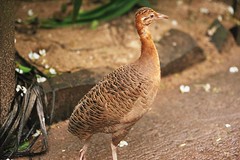
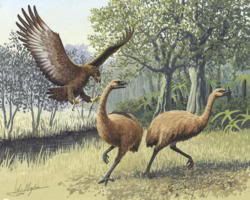

The group of birds to which the moa belonged, the ratites, have long fascinated evolutionary biologists. All the ratites are flightless (though, as we'll see they are related to the quail-like tinamous which can fly passably well) and all the major landmasses that had their start in Gondwana had at least one ratite species before humans arrived on the scene. Africa has ostriches, South America the rhea, Australians have emus and cassowary, Madagascar had the Elepahant bird and New Zealand lost the moa but retains the kiwi. The far flung distribution of the ratites and their apparent lack of ability to disperse between continents has led to them being put forward as a classic example of an idea called vicariance biogeography in which the evolutionary history of a group is driven by the geological history of the land on which they live.
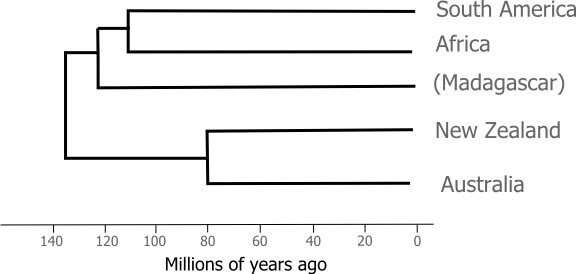
For vicariance biogeographers the evolution of the ratites was driven by the movement of the continents. The ancestor of all modern ratites was a flightless bird living in Gondwana and as each new continent split and rifted away from the super continent it took with it a population of ratites which adapted to the ecological changes brought on by their continent's journey: cassowaries in the Wet Tropics of Australia, ostriches on the African Savannah, rhea on the Pampas. It's certainly a nice story, but science has a way of ruining nice stories. The role of vicariance of evolution in the ratites was put to the test once we became able to use molecular evidence to reconstruct the relationships between species. If the geologically driven sketch of ratite evolution I presented above is right then the pattern of branching we find among ratites from different continents should match the order in which we know the continents broke up, something like this:
In 2001 Alan Cooper and colleagues sequenced the entire mitochondrial genome (some 12 000 bases of DNA) from representatives of each of the extant ratites and, remarkably, two species of moa. The long, careful process of retrieving DNA sequences from sub-fossil bones deserves a post of its own but for the sake of this article we only need to know what Cooper et al found when they used that DNA to recover the the relationships between ratite species.
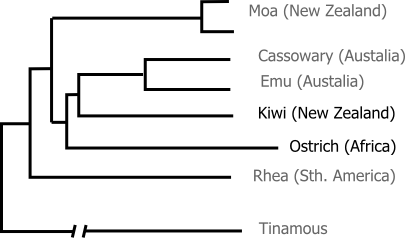
The species in bold text above don't fit the pattern that we'd expect from geology alone. If ratite relationships simply reflected the Gondwanan breakup we'd expect to see ostriches grouping with rheas (and apart from the other ratites). New Zealand's two ratite orders are even more surprising, the kiwi lineage is more closely related to the Australian ratites than it is to the moa species. When combined with a molecular clock analysis Cooper et al. concluded that modern kiwis are the descendants of ancient immigrants hailing from either Australia or islands in the Lord Howe Rise (which have since submerged). In order to explain that trans-tasman dispersal the authors reached for the last resort of the desperate biogeographer and invoked a land bridge for which there is little geological evidence. In fact, as we'll see it now seems more likely that the ancestors of the kiwi and the moa flew to New Zealand.
Even with the mitochondrial phylogeny of the group published there was considerable room for uncertainty in how the ratites related to each other. The underlying shape of ratite tree makes it particularly difficult to accurately recover with phylogenetic methods. When we use DNA sequences to estimate a phylogenetic tree we need to find species that share mutations that have accrued during the evolution of the group we're looking at. The branches that relate the different ratite species are relatively short, so there was little time for mutations that set related groups apart from more distantly related ones to accrue. Even worse, the branches that reach to the modern species (the tips of the tree) are very long meaning there has been a lot of time to any mutations that did accrue in those critical short branches to be overwritten*. There are three approaches to dealing with this problem - sequence more genes (since each unlinked gene acts as a separate witness to the evolution of the group), sequence more samples (especially if doing so breaks up a long branch) or use a better model for the way mutations accrue in the genes you are studying. People have tried all three methods to get a better look at ratite evolution. Last year a group centred around the Field Museum in Chicago published a mutli-gene phylogeny of all birds that contained a big surprise for ratite evolution- the most recent common ancestor of all ratites flew.
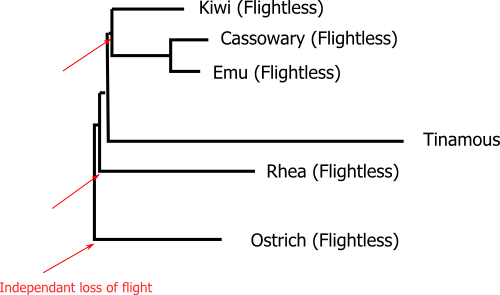
As long as the ratites grouped together in a phylogeny it was reasonable to assume that they all inherited their flightlessness from the common ancestor of the group. The Field Museum study found that, in fact, the flying tinomous fit right in the middle of the flightless ratites. So, either the most recent common ancestor of the ratites and the tinamous flew and ratite lineages have subsequently lost that ability at least three times or that ancestor was grounded and the tinamous have rediscovered flight. In vertebrates the evolution of true flight has happened three times (in bats, pterosaurs and birds) while there are hundreds of examples of birds that have given up on flying. Moreover, a group of flying birds that are prone to flightlessness is hardly anything new - at least 30 species of rail (including our own weka and takahe) have taken to life on the ground. Given the ways the odds are stacked towards losing flight it seems probable the common ancestor that relates tinamous and ratites flew. The Field Museum study didn't include any moa species and didn't attempt any molecular dating so it's hard to see just how the ancestors of the kiwi and the moa made it to New Zealand
A new study (I knew I'd get to it eventually) published in Systematic Biology throws some light on the New Zealand ratite story. Matt Philips and a team of researchers from the Alan Wilson Centre at Massey University took another look at the mitochondrial dataset used in Cooper et al's 2001 study by adding more kiwi species and using models of DNA evolution that avoid some of the pitfalls of the ratite phylogeny's difficult shape. The new ratite tree and a molecular clock analysis based on that tree confirm the idea of multiple loses of flight in the ratites and add a new finding - the closest living relatives of our giant moa are the quail-like tinamous:
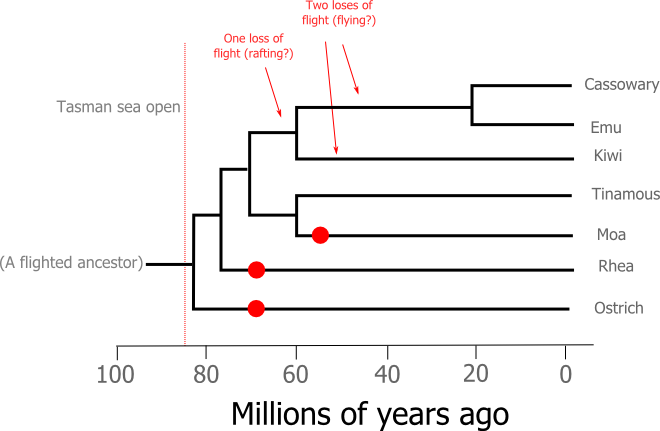
So what does the new understanding of ratite relationships mean for our ideas about the origins of New Zealand's ratites? The molecular clock doesn't quite tick with the regularity of a stopwatch, so there is a good deal more uncertainty in the timing of the events presented above than the precisely defined nodes suggest. Still, even with the uncertainty of molecular dating taken on board we can safely say that both the New Zealand ratite lineages departed from their closest relatives after the Tasman Sea opened up.
The revelation that the tinamous are the moa's closest living relatives suggests that the moa had ancestors that could fly. So, it seems the first proto-moa to arrive in New Zealand flew, or more likely was blown, here from Antarctica. Antarctica? It still seems amazing to me but 30 million years ago Antartica was still attached to South America and, without the circumpolar current to isolate from the world, was a relatively verdant continent. We know from fossils that Antarctica supported southern beech forests (still found in Chile, New Zealand and Australia) and marsupial mammals (strangely absent in New Zealand but still present in Australia and South America) so it's no great stretch to propose the representatives of another Gondwanan group lived there. Antarctica certainly seems like a more likely jumping off point for dispersing proto-moa than South America, but either way it certainly seems they made it here under their own power.
The mode of dispersal for the kiwi's ancestor is a little less clear. As we've seen we can be quite sure that they arrived in New Zealand after the Tasman Sea opened up and there is really no good evidence that there was ever a land-bridge across that sea. We can probably rule out walking. If we disregard the problem of dispersal for a second the simplest way to explain the distribution of flightlessness on the Phillips et al phylogeny is with a single loss of flight in an ancestor shared by kiwis and the Australian ratites. Under that scenario the kiwi would, presumably, have had to raft to New Zealand. Alternatively, given that we've seen the ratites seem to have an inbuilt propensity to becoming flightless we might imagine that the common ancestor shared by the kiwi and the Australian ratites could fly and each lineage has since lost that ability. In this case the kiwi could simply have flown from Australia to New Zealand (a journey that storms frequently inflict on Australian birds today). Without sufficiently old ratite fossils from either country it's hard to choose one scenario over the other.Long range dispersal by rafting is probably an important force in biogeography but if I was forced to make a bet I'd put my money on ancient flying kiwis.
The radical rethink of ratite evolution that a decade of molecular phylogenetics has forced on us raises a lot of interesting questions. What it is it about the ratite body plan, development or behaviour that makes them so prone to flightlessness? Is that repeated loss of flight, and consequent lack of pressure to keep their weight down, enough to explain the trend towards gigantism? The authors of the most recent paper suggest both trends might be explained by ratites on each continent filling the ecological niches left by the extinction of the dinosaurs. The dates on their tree are certainly consistent with the idea that each ratite lineage independently took to the ground 65 million years ago but without more fossils and more precise dates for each split it's very hard to test the idea further. I'm sure the story of ratite evolution has more surprises for us to uncover.
Links to the primary literature are provided below but you should also check out Simon Collins excellent piece in the Herald and Mike Dickison, who got his PhD studying giant flightless birds and wrote about the idea that ratites flew to New Zealand way back in 2007.
Cooper A, Lalueza-Fox C, Anderson S, Rambaut A, Austin J, & Ward R (2001). Complete mitochondrial genome sequences of two extinct moas clarify ratite evolution. Nature, 409 (6821), 704-7 PMID: 11217857 Harshman, J., Braun, E., Braun, M., Huddleston, C., Bowie, R., Chojnowski, J., Hackett, S., Han, K., Kimball, R., Marks, B., Miglia, K., Moore, W., Reddy, S., Sheldon, F., Steadman, D., Steppan, S., Witt, C., & Yuri, T. (2008). Phylogenomic evidence for multiple losses of flight in ratite birds Proceedings of the National Academy of Sciences, 105 (36), 13462-13467 DOI: 10.1073/pnas.0803242105 Phillips, M., Gibb, G., Crimp, E., & Penny, D. (2009). Tinamous and Moa Flock Together: Mitochondrial Genome Sequence Analysis Reveals Independent Losses of Flight among Ratites Systematic Biology, 59 (1), 90-107 DOI: 10.1093/sysbio/syp079Labels: biogeography, evolution, might interest someone, moa, new zealand, phylogenetics, ratites, sci-blogs, science

All content not otherwise marked is licensed under a Creative Commons Attribution-ShareAlike 3.0 Unported License.


