
Tuesday, February 12, 2013
Darwin and New Zealand
Across the world people will be marking the day by remembering Darwin the discoverer of evolution by natural selection, Darwin the cautious husband, Darwin the barnacle boffin and maybe even Darwin the geologist who explained the origin of coral atolls. I might be the only person who takes some time today to remember Darwin as a grumpy young traveler.
Darwin in New Zealand
Darwin visited New Zealand in 1835, and he really didn't like it.The New Zealand visit came four years into the HMS Beagle's voyage, and at the end of a four thousand kilometer journey from Tahiti. Darwin and the Beagle's crew had loved their time in Tahiti (Darwin records that "every voyager ... offered up his tribute of admiration" to the island p 416). With the memory of Tahiti in mind, the sight of fern-clad hills, a few European houses and a single waka to act as a greeting party was a disappointment for Darwin:
Only a single canoe came alongside. This, and the aspect of the whole scene, afforded a remarkable, and not very pleasing contrast, with our joyful and boisterous welcome at Tahiti. (p 417)Closer inspection of the land around the Beagle's mooring in the Bay of Islands didn't do much to improve the young Darwin's opinion of New Zealand
In the morning I went out walking; but I soon found that the country was very impracticable. All the hills are thickly covered with tall fern, together with a low bush which grows like a cypress; and very little ground has been cleared or cultivated .. (p 418)And if the plants weren't enough, introduced predators had already removed much of native fauna:
I saw very few birds.. It is said that the common Norway rat, in the short space of two years, annihilated in this northern end of the island, the New Zealand species. In many places I noticed several sorts of weeds, which, like the rats, I was forced to own as countrymen. (pp 427-8)In nine days of traveling around the Bay of Islands Darwin found very little to like. In comparison to the Tahitians the Māori were "of a much lower order" (p 420) and the Europeans inhabitants where "the very refuse of society" (p 420). In fact, the only place he liked was William Williams' attempt to remake England at the Mission house in Waimate North. (pp 425-30).
Now, it is obvious that Darwin meet New Zealand at a bad time. The capital, Kororareka, had well and truly earned its nickname as the "Hell Hole of the Pacific", Maori where adjusting to life alongside Europeans, and the impact of the Musket Wars and the native flora and fauna was already in decline thanks to the introduction of pests and the clearing of forests. But when you consider that Darwin was in the Bay of Islands in summer time I don't think I'm being too parochial to suggest Darwin was being just a tad grumpy when he decided there was nothing to like in our country:


New Zealand in Darwin's thinking
Darwin didn't think much of New Zealand while he was here, but I suspect he ended up regretting the brevity of his visit. About 30 years after he gladly left our islands behind, Darwin wrote a letter to Julius Von Haast to thank him for some information he'd provided, addingI really think there is hardly a point in the world so interesting with respect to geographical distribution as New ZealandDarwin spent a lot of time thinking about the geographical distribution of species. His first written account of where species might come from was spurred by thinking abut the distribution of Galapagos and Ecuadorian mockingbirds*. More importantly, if Darwin was going to do away with the popular idea that each continent's species arose more or less in their current place, he had to work out how plants and animals could get from one place to another.
He developed contacts in New Zealand and his correspondence with other scientists has many references to our plants and animals. The presence of flightless birds, bats and the effects of glaciation all come up multiple times. But New Zealand's most important influence on Darwin's thinking came via his best friend, Joseph Hooker .
Like Darwin, and many other Victorian naturalists, Hooker started his career by jumping on a ship and sailing to the other side of the world. For Hooker, that meant the HMS Erebus and trip to Antarctica via South America, New Zealand and Australia. Hooker had read Darwin's Journey of the Beagle in proof before he set off, and when he returned to England the two stayed in contact.
In 1844 Darwin "confessed" his ideas about the origin of species to Hooker. That letter contains references to the New Zealand flora, in which Darwin is fishing for facts that might support his ideas about species moving from one land to another. In the same year, Darwin started a discussion with Hooker about the distribution of Kōwhai (Sophora). The yellow-flowering Kōwhai will be familiar to all New Zealanders, but it may come as surprise that some of the "Kōwhai" species sold in garden centres aren't from New Zealand at all, but are Chilean Sophora species. The species are similar enough they'll happily hybridise given the chance.
These Chilean Kōwhai are an example of a common pattern - the floras of New Zealand, Tasmania South American and the sub-Antarctic seem to be closely related. Hooker thought this pattern arose because all these island where connected in a southern super continent. Darwin didn't like the idea of creating new land to explain a biological pattern, and instead proposed that that chance dispersal (by wind or rafting) could explain the distrbution of these species. Darwin was a keen experimentalists, and so, he set about dropping seeds in salty water and attempting to germinate them. These experiments took place in Darwin's house in Down, and apparently his children counted each germination as a victory for their dad over Hooker.
It seems Hooker couldn't provide Kōwhai seeds for Darwin's experiments, but Darwin took a record of just three equally-sized Kōwhai trees on the Chatham Islands (some seven hundred kilometers from the mainland) as evidence for long-range dispersal, and perhaps a suggestion that Kōwhai seed could survive a trip from Chile to New Zealand.
It turns out Darwin was right about Kōwhai although he got the direction wrong. Molecular studies have shown that Sophora arose in the Northern Pacfic, dispersed down to New Zealand and arrived in Chile via the Antarctic's strong circumpolar current, all in the last few million years (Hurr et al, 1999 doi: 10.1046/j.1365-2699.1999.00302.x).
Honouring Darwin Day in New Zealand
I'm not quite sure how I feel about Darwin Day. There is not doubt that Darwin was a genius, an exellent naturalist and the founder of a field of study that lives on today. But there is something a bit odd about the annual veneration of Darwin, and the rush to connect modern ideas in evolutionary biology with things Darwin wrote 150 years ago.Darwin got a lot right, and foresaw many developments in the study of evolution. But evolutionary biology is much more than 21st century 'Darwinism'. Darwin didn't know what a gene was, so is unlikely to teach us much about genomics. For me, the most important thing to learn from Darwin's writing is the way he set out about understanding the world. Darwin sought out evidence for each sub-hypothesis in his Big Idea, sometimes that meant writing to colleagues like Hooker and Haast and sometimes that meant doing experiments like his salty seeds.
Darwin never got a Kōwhai seed to experiment with, but, in his 1958 lecture on Darwinism in New Zealand, AC Flemming mentioned a study that found they can survive 4 months of immersion in salt water. That's a little shorter than the time you'd expect a seed pod set adrift from New Zealand to take before it washed up on a Chilean beach. Right now, highschool students are starting another year of biology classes - and teachers are probably preparing another re-hash of the "plant study" they've taught to Year 13 students since they were called Seventh Formers. Wouldn't it be a fitting tribute if some of those classes did something a little different, and honoured Darwin's approach to undestanding the biological world by dunking Kōwhai seeds and running an experiemnt he never got to?
Quoted passages are from Darwin's Voyage of the Beagle. Links go the the Darwin Online Fascimile.
*Forget about the finches
Labels: Darwin, Darwin Day, history of science, sci-blogs, science and society

Sunday, April 3, 2011
Sunday Spinelessness - The Entomologist who invented Daylight Saving Time
Today marks the end of the Daylight Savings Time in New Zealand, so local readers will have had an extra hour at their disposal to sleep through, get more work done, or explain to their children that they are meant to stay asleep for longer today. However you used that extra hour, you should take a moment to think of the extraordinary amateur entomologist that came up with the idea that gave it to you.
George Vernon Hudson was one of New Zealand's first and finest entomologists. He described hundreds of our insect species and worked out the lifecycles of still more by raring their larvae at his house in Karori, Wellington. Hudson was a not a professional entomologist - he had a day job as a shift worker at the Wellington Post Office. Working shifts gave Hudson a chance to get out and collect insects while others were working, and it also made him aware just how much daylight people were sleeping through during the summer. In 1895 Hudson read a paper to the Wellington Philosophical Society (part of what became the Royal Society of New Zealand) in which he advocated putting clocks forward in October so sunrise wouldn't happen hours before anyone woke up and the pushed-back sunset would mean "a long period of daylight leisure would be made available in the evening for cricket, gardening, cycling, or any other outdoor pursuit desired".
By all accounts Hudson's proposal wasn't well received. The paper itself wasn't printed (the quote above is from a follow-up he presented in 1898), but reactions to it were reported in the society's journal. William Maskell, the president of the society and a fellow entomologist, was particularly scathing (and inaccurate) when he said " the mere calling the hours different would not make any difference in the time. It was out of the question to think of altering a system that had been in use for thousands of years, and found by experience to be the best." Apparently, Hudson wasn't deterred by the bad reaction his paper got, and he kept pressing the idea. By 1898 he claimed the support from many people, particularly in Christchurch, but in the end, it all came to nothing. Daylight Saving Time as we know it was really the result of an English builder called William Willet, who came up with the idea independently and managed to get his plan considered by parliament. But the turning of the clocks, and GV Hudson's role in coming up with the idea, are the perfect excuse to show off one of my favourite possessions :


I have a copy of Hudson's first major scientific book, New Zealand Moths and Butterflies (1898). My copy used to belong to the Wellington Acclimatisation Society. It came to me by a circuitous route, but it seems the book spent at least some of the last hundred years sitting in a shed. It's largely a taxonomic work, full of anatomical details and the curious codes by which taxonomists speak to each other. That much is interesting to a specialist (and I really should donate the book to a research library), but the real stand-out feature is the 13 colour plates, each one full of Hudson's beautiful hand-drawn illustrations


On top of these wonderful illustrations, there are two letters tucked away inside the book, each written to the Acclimatisation Society by Hudson. They are probably not of outstanding historical interest, but they do tell us something about life as an amateur naturalist at the turn of the 20th Century, so I'm going to reproduce them here. In the first, written in 1898, Hudson writes to follow up a conversation he'd had with the members of the Acclimatisation Society about a truly hair-brained scheme to introduce English mayflies to New Zealand to feed the trout they'd already brought over

Dear Mr Morris,
Referring to our conversation of this afternoon regarding the introduction of the common English may-fly Ephemera vulgaris, into the New Zealand streams as food for the trout, I must say that I do not think its introduction is necessary. I have devoted considerable attention recently to the study of the various neropterous larvae which inhabit the streams including those of the Ephemeridae and I have been astonished at the great number of these larvae.
Apart from the fact that our native Ephimerae would appear to be amply sufficient for the requirements of the troutc etc, I should mention that the larvae of these insets are extremely difficult to keep in captivity and I thnk that it would be almost impossible to introduce themfrom England, except perhaps by the egg state ... I think therefore that any attempt to introduce th English may-fly into this country should certainly be discouraged
Dear Mr Rutherford,
I enclose herewith a specimen plate and some prospectives (?) of my new book on the New Zealand Neuroptera. If you could mention the book and exhibit the plate at the meeting of the Acclimatisation Society on Thursday next I should be very much obliged. The new secutary also has a copy of the plate. During Mr Morris’s time I was asked by the Society to report as to the necessity and best means of importing the British may-flies into New Zealand and in reply I said that such an importation would in my opinion be quite unnecessary ... my recommendation probably saved the Society a considerable sum of money... I think I have some claim on the Society and its members for a liberal support of my book.
So, New Zealanders: enjoy your extra hour. Those readers tuning in to this post from the Northern Hemisphere: remember to honour that fact that daylight savings was first proposed by someone that wanted to spend the extra daylight ito get out and find some bugs!
Labels: butterfly, environment and ecology, GV Hudson, history of science, sci-blogs, sunday spinelessness
Wednesday, August 18, 2010
Just trying to put the punk back into punctured lung
I'm going to be spending the rest of my week keeping up with my real work. Neither science nor the internet have chosen to rest while I catch up with that, so there are lots of interesting things happening that you should be reading about.
***
First, there's the news that from the New Zealand Medical Journal that a woman developed a pneumothorax (air on the lung) following an acupuncture treatment. As Darcy says in the linked article, the best scientific evidence says that acupuncture performed by people who think they are redirecting the flow of ineffable forces with their needles is no more effective than someone prodding people with sharp things where the eff ever they want. There might be a small benefit to having acupuncture, but it's a placebo effect. At the same time, and the present study notwithstanding, the risks associated with acupuncture are relatively small. Which all raises an interesting ethical question: should doctors send their patients to acupuncturists. Obviously treatments that have been shown to work better than a placebo should be the first tack, but if they fail is it OK to knowingly make use of the placebo effect? I don't think it's as simple as it might seem, after all acupuncture can cost a lot of money. Just as it must be a breach of trust for pharmacists to sell small vials of water to patients and call them "homeopathic remedies", surely it's wrong for acupuncturists to take money from patients to pay for their specialist skills in a bogus medical system? Perhaps some of the placebo effect would be down to the idea that the practitioner is steeped in some mystic art, put even if a quick in-clinic sham acupuncture session wouldn't to the trick other placebos treatments might, without incurring the risks associated with acupuncture (no matter how small they might be). Whatever you think, you should leave a comment on Darcy's post because he's just become a father! (It seems his place in life has finally caught up with his sense of humour)
***
There's lots of Science (yay) and Technology (meh) on the TV this week. Media7 is having a special episode on communicating science with a panel featuring Peter Griffin and Rebecca McLeod from the scibog crew. They had a show on a similar theme last year, so it will be interesting to see if anything has changed since. Our local climate cranks certainly haven't become sensible in the interim, but the media does seem to give them a little less room to be stupid so that's something .TVNZ7 also has the first episode of their new sci-tech show Ever Wondered? online. I have to admit that I haven't actually got around to seeing that yet so I can't offer much more than the fact that its there.
***
Last week I had my first crack at teaching a lab. I've done plenty of demonstrating before, which I've always enjoyed (even the lab that's mainly about ripping the heads off Drosophila larvae) but being in charge of the whole show it something else entirely. In the end I had fun, and I think the students went away happy but I have to say I wasn't prepared for the terrifying sea of blank or anguished expression that stared at me when I turned round from explaining something too quickly. So, I asked an award winning lecturer and her crew what they'd do if they faced that terrible sight, you can read the answer here.
***
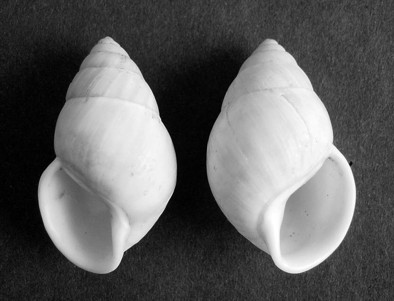
Did you know that snails can be right- or left-handed? In most individuals of most species the shell coils in a "right handed spiral" so when a the shell is placed "apex up" the opening (the aperture) is on the on the right hand side (like the shell on the right above). In a very few snail species most individuals are left-handed. In both left- and right-handed species you get a very few individuals which coil the other way but that pattern usually doesn't persist for any length of time because right- and left-handed shells tend to get in each other's way during mating. It's even been suggested that the reproductive isolation caused by right- and left-handed snails might be enough to help with the generation of new species (I don't know if anyone has ever looked at the distribution of chilarity among closely related snail species, but it might be interesting). Now, Kevin Zelnio has the story of a landsnail species that maintains an even number of right- and left-handed individuals, and just how it manages that.
***
I've been reading In Pursuit of the Gene by James Schwartz which is a really well written history of the discovery of genetics. It's reinforced my notion that statistics was entirely invented by evolutionary biologists; Galton, Pearson (of the correlation coefficient) and Fisher were all trying to understand evolution in developing their methods. I also like the strange coincidence that Hugo de Vries developed what turned out to be a poor theory of evolution based on a misunderstanding of heredity from his observations in the evening primrose. Evening primrose's scientific name is Oenothera lamarckiana, a name which honours French biologist Jean-Baptiste Lemark who has gone down in history as someone whose mistaken ideas on heredity lead him to present a flawed theory of evolution.
***
And finally, a couple of posts from here have featured in blog carnivals lately. So, go tuck in to something spineless at the Birders Lounge or read about the history of science's frauds failures and fools.
Labels: blog blogging, history of science, links, sci-blogs, skepticism
Thursday, July 29, 2010
The First New Zealanders and their rats

Crispin Jago has made a very cool thing, a periodic table of irrational nonsense. Rolling my eyes over the groups, wondering how people can believe some of these things, made me think about New Zealand's unique ecosystem of kooky ideas. We don't have to suffer creationists in any organised sense and I don't think anyone is too into ear candelling, but those TV psychics have found themselves a niche to exploit and most people seem think chiropratric and homeopathy are normal parts of medicine. Then I was reminded about our very own, home grown cranks. There are people who believe that New Zealand was settled by Celts several hundred years before it was discovered by the ancestors of modern Māori. It probably goes without saying that these people are nuts, but the idea of a pre-Māori civilization in New Zealand is one of our culture's enduring myths. It's worth talking about why people who are serious about studying our country's prehistory have discarded it.
People coming to this question for the first time my want a little bit of background. The settlement of the Pacific is one of the most interesting stories in our species' history. I did the field work for my PhD (on landsnails, and not people) in the Cook Islands and you get a feel for the enormity of that achievement when you travel around that group. To fly from one island to another you walk out across the tarmac and meet your pilot, who is almost invariably sitting on the steps to his 12 seater plane, reading the paper through massive aviator glasses. Once you're safetly stowed you get your safety briefing ("it's gonna be pretty fine all the way, should be a good flight") and you take off. The pilots don't close the door to the cockpit, so you can see out the windscreen, but all you see is ocean and sky. You can fly for an hour without seeing land in front of you or out your window. Then an island looms. A few minutes later you land, and, even among the Cook Islands, you're in a new culture. The Polynesian people who discovered and settled these tiny islands separated by such vast distances were master navigators. Without metal tools or written records, let alone maps and compasses, they very deliberately settled islands (taking livestock and crops with them), maintained trading relationships between island groups and almost certainly made it to South America (very likely beating Columbus in the process).
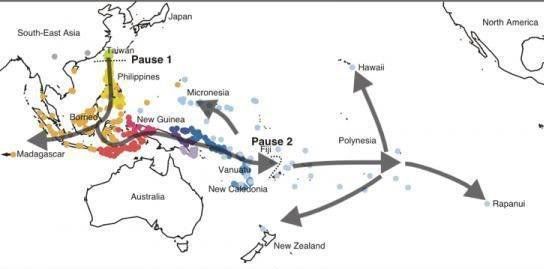
Schematic of the settlement of the Pacfic (this one is taken from a study of the evolution of Austronesian languages)
The "mainstream" view on the settlement of New Zealand fits nicely into what's known about the settlement of the Pacific. There is good evidence that the bulk of Polynesia was settled in a stepwise fashion, moving west to east with the prevailing winds. Eastern Polynesia was settled by about 800 AD. The far reaches reaches of Polynesian - Hawai'i, Rapanui and New Zealand would require a different pattern of migration (upwind, or over vast distances) and remained, with Antartica, as the last uninhabited lands on earth for hundreds of years.
The first evidence for humanity in the New Zealand archeological record comes from the Wairau bar, where artifacts similar to those from contemporaneous sites in the Society Islands and the Southern Cooks have been dated to about 1280 AD. At the same time the pollen record shows New Zealand's first wide scale deforestation, trees being replaced by bracken, scrub and charcoal. A few hundred years later the much sparser record of sub-fossil animals shows its first mega-faunal extinctions. Combined with evidence for "sattelite" settlements in the Kermadec islands (on the edge of the tropical Pacfic) you have exactly the pattern of evidence you'd expect to see with the settlement of islands as remote as Te Wai Pounamu and Te Ika a Māui - settlement as an extension of an ongoing process with clear evidence for human impacts starting from a date that makes sense in that framework
Compare that with the Celtic NZ people. The idea of Celts arriving in New Zealand without leaving any real evidence of their presence anywhere else outside of Europe hardly needs talking about. When we look within New Zealand, almost all the evidence supposed to support a pre-Maori celtic civilization amounts to big rocks that form, if you just imagine they used to be arranged slightly differently, a giant surveying network. Or astronomical observatories. Proponents of the Celtic NZ hypothesis spend very little time trying to find any evidence for the populations that must have lived, died, eaten, built, dug, farmed, and buried their dead in New Zealand to support these mad priests' plans to move megaliths across the country. And when they do the results are less are less than convincing
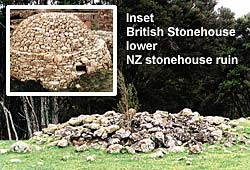
By all accounts they treat the historical method with about as much respect as the scientific one, so academics don't take them very seriously. In fact, you'd think these claims are so kooky that there was really no need to rebut them. Sadly, the Celtic NZ people seem to have convinced at least a few people that they are on to something. I'm sure part of the reason for that is New Zealanders were once taught that the ancestors of modern Māori did meet another people when they came to New Zealand.Up untill about the 1960s school textbooks said the Moriori were a Melanesian people that were driven off the New Zealand mainland by Māori, with a few survivors taking refuge on the Chatham Islands (called Rekohu in their language). That idea had been rejected by every scholar who's addressed it since the 1920s because it's clear that the Moriori descended from mainland Māori and the unique aspects of their culture were acquired during their subsequent isolation. Part of the reason the Moriori myth came about in the first place is that it fitted into a Victorian narritive view of history - a chain of never ending progress It was only right that Moriori hunter-gatherers were replaced my the adventurous and noble Māori, just as the advanced British settlers would in turn assimilate the Māori. We might have given up that story, but the Moriori myth is still tied to politics in New Zealand. For people who think the New Zealand government shouldn't make reparations for its breaches of the Treaty of Waitangi the idea that Maori themselves were once colonisers looks like a get out of jail free card. Russell Brown quoted one example in 2004:
Leaders and academics that hark back to the pre-European days of Maori domination of New Zealand have driven this opportunism. They appear to conveniently forget that Maori violently conquered the Moriori, the original settlers, and their claims of tangata whenua status and demands for compensation for historical grievances appear to many to be ill informed.
Archaeologists agree that humans first settled in New Zealand well over 1,000 years before the main Maori migration, which is estimated to have arrived around 1200 AD. Their evidence is based on the exhaustive forensic examination of historic plant and animal remains. They believe that the settlement of New Zealand was most likely a continuous process, a view that is certainly consistent with early settler journal accounts (from the proceedings of the Royal Society of New Zealand) which indicate that not only did Moriori precede Maori, but that when they arrived in the Chatham Islands, “they found the country in the possession of aboriginal natives called Hiti”- inhabitants of the “Flint age”, who used not stone, but “chips of obsidian as cutting implements.” There is also strong evidence of an early presence of people of Celtic and Chinese ancestry as well as Greek, French, Portuguese, Spanish and others - in addition to settlers of Polynesian descent.
Breathtaking. But perhaps the most amazing bit of that bizarre paragraph is that somewhere, deep under the layers of crazy, there is just a little science peaking through. We've already seen that archeologists don't agree that New Zealand was settled a thousand years before the Māori arrived. But there has been one little hint among the prehistoric "plant and animal remains" that humans might have got to New Zealand before the people that lived at Wairau Bar. Old Rat bones.
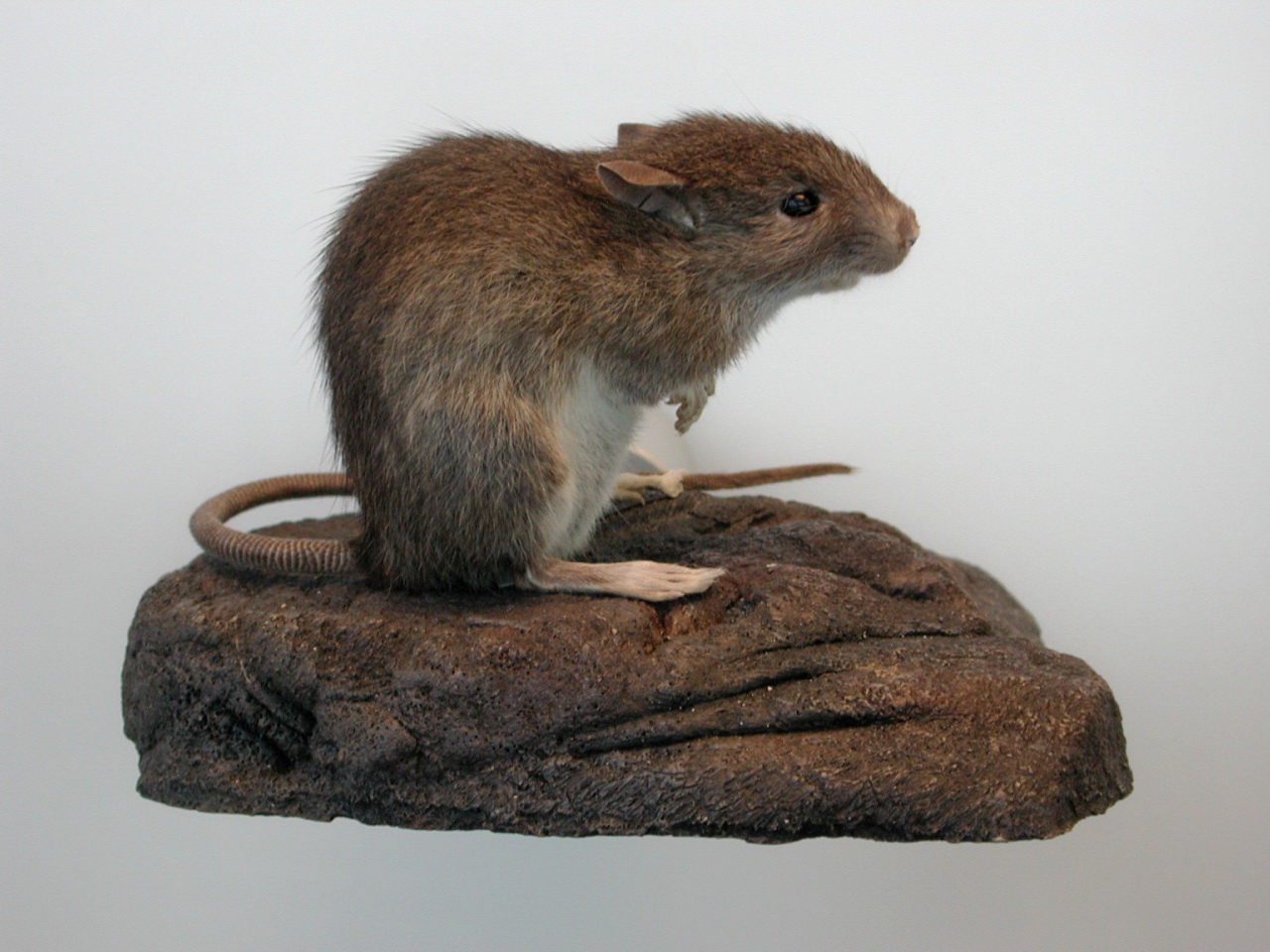
A Pacfic rat, image is CC 2.0 thanks to wikipedia user Tolter Alter Man
The Pacific rat (Rattus exulans or the kiore) is native to South East Asia and Melanesia, but it can be found everywhere Polynesian people visited. The kiore isn't much of a swimmer so the presence of R. exulans bones on an island is unambiguous evidence for human contact. In 1996 Richard Holdaway published the first radiocarbon dates for kiore bones in New Zealand, and they were surprising. Holdaway published dates for 18 bones and all but two of them were older that the first archeological evidence for humans (at 1280 AD) and some of them dated to around 10 AD. Quite how the presence of the Pacific rat in New Zealand in 10 AD gives support to the wild claims of people like Newman or the Celtic NZ crowd I can't imagine, but those results did fuel a genuine scientific controversy. Why were there rats in New Zealand almost a thousand years before there is any evidence for humans? At the time there were three answers; Holdaway himself argued that the bones were evidence that humans had visited New Zealand but either left immediately or failed to establish themselves, a few archeologists held that the bones were evidence the ancestors of Maori arrived in New Zealand a long time ago but didn't leave a mark until they adapted to the colder climate, and others said the dates must just be wrong.
Atholl Anderson dedicated a lot of time to testing the reliability of radiocarbon dates from kiore bones. The bones Holdaway had used to establish the antiquity of New Zealand's rats had come for so called "natural" sites, most notably laughing owl nests and caves, which offer little in the way of corroboratory evidence for the ages estimated from the rat bones. In contrast, Anderson focused on archeological sites (those associated with human habitation) which provide plenty of contemporaneous material to set the dates determined for rat bones in context. Anderson did indeed find the dates determined from rat bones often differed greatly to those determined from the contents of the same midden. They even found bones from well studied archeological sites that were estimated to be thousands of years older than the site! Clearly, there's something odd about those dates. The real smoking gun for the "old rats" hypothesis came when Anderson looked at the relationship between the age estimated for a bone and the date of the labwork done to determine that age. Almost all the bones measured before 1997 were older than that magic mark at 1280 AD, and every single bone measured at the same facility since 1997 was younger (or at least, the error bars cross that date):
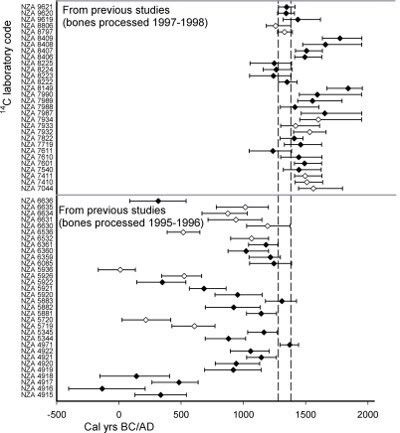
Dates estimated from rats fall into two distinct groups, depending on when they were analysed. From Wilmshust et al (2008) cited below
There is no reason to think the real age of the kiore bones sampled over time will fall into two such distinct classes (it's not as if the oldest bones will be the easiest to get to) and it's easy to bias the date estimated by carbon dating by failing to prepare the bones properly (or by introducing contamination in the lab) so it looks like the surprising results Holdaway reported where actually a lab error which has since been taken care of. It's (barely) conceivable that originally published dates were right, and that the Anderson's archeological sites were biased in some particular way, but that hypothesis really doesn't make sense given what we now know about the settlement of the Pacific. It's widely accepted that Eastern Polynesian wasn't settled until about 800 AD, meaning any earlier rats in New Zealand would have had to come from visitors from the Western Pacific. That's against the main direction of settlement, but, more tellingly, genetic evidence has established that modern kiore in New Zealand come from Eastern Polynesia. Kiore also make their first mark on New Zealand's faunal record around 1300 AD, when Plactostylus landsnails with gnawed shells show up for the first time. If you want to believe rats were in New Zealand 2000 years ago you also have to believe the first bones to be carbon dated were the oldest, dates estimated from archeological bones are more unreliable than those for bones sourced from "natural" sites and that those old rats left not descendants in modern New Zealand populations and left no mark on the New Zealand faunal record until just after Polyneisian settlement of New Zealand.
You might be wondering why someone hasn't just gone back an re-analysed the bones that made for Holdaway's original surprising results. Radiocarbon dating is a destructive process and rat bones are small, so, apparently there isn't enough bone from the original samples to re-determine their age. Recently, a team from Landcare Research and lead by Janet Wilmshurst did the next best thing, and went back to sites that gave up the apparently old rat bones and re-excavated them. I'm sure you can guess what they found, none of the bones had a pre-1280 AD date. But they didn't just look at rat bones. The subfossil record of plants is almost always more finely grained than animal records. Every year plants put out millions of seeds and pollen grains, some of which are recorded in pits and lake beds and soil horizons. The Landcare team took advantage of this high resolution record to look for the first appearance of distinctively rat-gnawed seeds, and they found them after 1280 AD, but earlier than the oldest rat bones. Importantly, some of the deposits with relatively old rat-gnawed seeds contain much older seeds, with no evidence of rats. The team plans to go on an use this high-resolution record to establish the dates of settlement for other Pacfic islands.
The sort of people who think the presence of the Pacific rat in New Zealand would be evidence for a pre-Maori Celtic population aren't likely to let evidence get in the way of their stories. They already think the entire New Zealand acadame is par of a grand conspiracty (they've apparently never tried to organise a meeting between three academics let alone pull of a conspiracy among them...). But hopefully the long story of the first New Zealanders and their rats, only summarised above, and the kinds of evidence scientists use to test their ideas will help to make it clear what such "alternative" archeologists lose when they turn their backs on established methods
This post got way longer than I thouhgt it would, and I'm emdebted to a lot of excellent source on the web to get me up to speed on the subject.
Scott Hamilton and Matthew Dentith have written extensively about the Celtic NZ crowd and Te Ara has a nice article on historical ideas on of the orign of Māori (check out the galleries in particular to get an idea of European attitudes at different times)
The orignal paper with the old dates is:
- Holdaway, R. (1996). Arrival of rats in New Zealand Nature, 384 (6606), 225-226 DOI: 10.1038/
- Anderson, A (2000). Differential reliability of 14C AMS ages of Rattus exulans bone gelatin in south Pacific prehistory Journal of the Royal Society of New Zealand, 30 (3)
- Wilmshurst, J., Anderson, A., Higham, T., & Worthy, T. (2008). Dating the late prehistoric dispersal of Polynesians to New Zealand using the commensal Pacific rat Proceedings of the National Academy of Sciences, 105 (22), 7676-7680 DOI: 10.1073/pnas.0801507105
Labels: Anthropology, Cook Islands, history of science, Maori, Pacific, Polynesia, research blogging, sci-blogs, science
Sunday, July 4, 2010
The End of Evolution ...
... well, the end of Evolution 2010 anyway. The silence that you may very well have failed to notice around here over the last couple of weeks has come about because I've been away attending my very first Proper International Conference in Portland. I haven't been as deligant a communcator of science as the guys behin Denim and Tweed or Evolution Development and Genomics who blogged, tweeted and even podcasted the meeting but I thought I'd share a few of my experiences
On the face of it flying half way around the world to talk for twelve minutes about what you've been doing for the last three years is surely insane, but I found the whole experience incredibly useful. Being based in New Zealand I've spoken to some of the very best evolutionary biologists in the world, but we are small country and I've never been exposed to such a great diversity of topics, or to such great depth of expertise within the topics that I'm most interested in as I have over the last week. It turns out even the rock star scientists whose name you know as the last one on author lists on Nature papers are just people, and nice ones at that (although my first attempt to introduce myself to Jerry Coyne failed because he was mobbed by fans who wanted autographs and photos) and that some of the most interesting and well executed studies come from people you've never heard off.
So, flying back to New Zealand with a head full of ideas and a little bit more knowledge about the wider world of evolutionary biology has made the trip well worth it. But it get's better than that. I can't find any seemly way of bringing this up so I'm just going to blurt it out: I won a freaking award! The Ernst Mayr award goes to the best student presentation at the meeting by a member of the Society of Systematic Biologists (one of the three societies that host the meetings) and this year I shared it with Jeremy Brown from Berkley* . The award will find a nice place on my CV and my wall, but it's particularly neat for me to have won something that bears Ernst Mayr's name. Mayr was one of the most important contributors to the consilience of ideas that formed the theoretical basis to modern evolutionary biology, the modern synthesis. Unlike most of the other names we associate with the modern synthesis Mayr was not a mathematician but a naturalist, and he was particularly interested in the nature of species and the process by which they arose. As it happens, I disagree with quite a lot of what Mayr had to say and my talk was about a subject he is famously not a fan of (as you read his work it becomes clear he disagreed with himself quite a lot, so I guess this is OK), but the innovative way Mayr thought and the clarity and force with he expressed his ideas helped but speciation at the heart of evolutionary biology and his contribution to our field of study was immense. So, yeah, I'm quite stoked!
You can expect some more detailed about talks and ideas that I really like over the next couple of weeks, but for now I better go check in to my next flight.(PDX->LAX->SYD->CHC->DUD might actually be insane...)
*To underline what I said about the strength of evolutionary biology in New Zealand, two other kiwis made the finalists, Gillian Gibb and Simon Hills from Massey
Labels: conference, history of science, sci-blogs, science
Friday, February 12, 2010
Charles Darwin and the Origin of Spouses
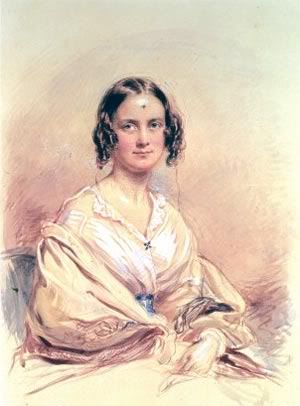
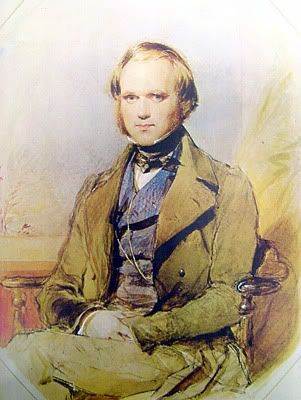
Happy Darwin Day everyone! Today would have been Charles Darwin's 201st birthday so around the world geeks are celebrating, churches are standing up to creationism and at least a few biologists are trying to eat their way through the tree of life. With Darwin Day falling so close to Valentines Day I thought it might be fun to forget about Darwin's science just for a few minutes and look at his attitude to love and marriage.
No one has ever accused Darwin about making a rush to judgement about any topic. Just as he spent years poring over the minutest detail of barnacle anatomy before he published The Origin he gave the topic of marriage careful consideration before singing on. In fact, preserved in his notebooks we have a record of the deliberations he undertook. Sometime in 1838 Darwin turned to a new page in his notes and drew a line down the middle, he added the headings "Marry" and "Not Marry" to either side of the line an proceeded to list the pros and cons of either decision. You can see the notebook here but below (presented without comment) is a transcript :
Marry
- Children — (if it Please God)
- Constant companion, (& friend in old age) who will feel interested in one
- Object to be beloved & played with —better than a dog anyhow.
- Home, & someone to take care of house
- Charms of music & female chit-chat.
- These things good for one's health.
- Forced to visit & receive relations but terrible loss of time.
Not Marry
- No children, (no second life), no one to care for one in old age.
- What is the use of working 'in' without sympathy from near & dear friends—who are near & dear friends to the old, except relatives
- Freedom to go where one liked — choice of Society & little of it.
- Conversation of clever men at clubs
- Not forced to visit relatives, & to bend in every trifle.
- To have the expense & anxiety of children
- Perhaps quarelling
- Loss of time.
- Cannot read in the Evenings
- Fatness & idleness
- Anxiety & responsibility
- Less money for books &c
- If many children forced to gain one's bread. (But then it is very bad for ones health to work too much)
- Perhaps my wife wont like London; then the sentence is banishment & degradation into indolent, idle fool
- My God, it is intolerable to think of spending ones whole life, like a neuter bee, working, working, & nothing after all.
- No, no won't do. — Imagine living all one's day solitarily in smoky dirty London House.
- Only picture to yourself a nice soft wife on a sofa with good fire, & books & music perhaps — Compare this vision with the dingy reality of Grt. Marlbro' St.
When I am with you I think all melancholy thoughts keep out of my head but since you are gone some sad ones have forced themselves in, of fear that our opinions on the most important subject should differ widely. My reason tells me that honest & conscientious doubts cannot be a sin, but I feel it would be a painful void between us. I thank you from my heart for your openness with me & I should dread the feeling that you were concealing your opinions from the fear of giving me pain.
Labels: Darwin, Darwin Day, evolution, history of science, might interest someone, sci-blogs
Thursday, December 31, 2009
The Origin of Species and the origin of species
2009 was the double celebration for evolutionary biologists, In February we markerd the 200th anniversary of Charles Darwin's birth and in November we celberated the 150th anniversary of That Book's publication. Somehow I've managed to go the whole year without dedicating a post to Darwin's ideas about speciation. Which is odd because I've spent quite a lot of thinking about, talking about and even writing about Darwin this year. So here, with about seven hours of 2009 left are a few of my thougts on Darwin and speciation.
Darwin's book was called The Origin of Species but I'm sure that most of the tributes you've read to Darwin and his book this year will have focused on how he proved evolution had happened and provided natural selection as the mechanism required to explain modern organisms in that framework - the fact and the theory of evolution . Missing among the descriptions of the events that shaped Darwin's thinking and the thousands of strands of evidence he wove to form his thesis will have been an answer to the question the title of the books seems to ask - where do new species come from. In fact, there is a prevailing view in evolutionary biology that for all his triumphs Darwin didn't quite understand species and as a result The Origin failed to provide a theory of speciatoin. I don't think it's quite that simple.
To know what someone thinks about speciation you need to know what they think about species.
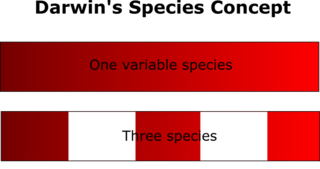
Practically, when a naturalist can unite two forms together by others having intermediate characters, he treats the one as a variety of the other, ranking the most common, but sometimes the one first described, as the species, and the other as the variety. But cases of great difficulty, which I will not here enumerate, sometimes occur in deciding whether or not to rank one form as a variety of another, even when they are closely connected by intermediate links; nor will the commonly-assumed hybrid nature of the intermediate links always remove the difficulty. The Origin, p47Darwin was the sort of person who could develop a world shattering theory, produce a body of data to support it then spent eight years looking at barnacles. Historians of science have spent a lot of ink trying to provide an explanation for "Darwin's delay". It may have been driven in part by an off-hand comment by his correspondent Hooker that only someone who has worked on the systematics of a group could hope to understand the nature of species or might just be a phenomenon all too familiar to modern systematists - a small project that grew out of control. Whatever the cause Darwin's barnacle obsession (on visiting a friend's house his son asked where his friends father "did his barnacles") clearly shaped the way he thought about species. In numerous letters of the time, especially to Hooker, he remarks on the great deal of variation he finds within barnacles of a given species and the great trouble he finds in using that variation to define the limits of species. Partly as a result of his eight years spent dissecting barnacles Darwin came to see the variation within a species as the of the same sort as the variation that exists between species and, importantly, the difference between two varieties of a given species and two distinct species as one of degree not of kind. At the risk of boiling Darwin's ideas down to the sort of diagram you might find in a powerpoint slide here's a pictorial representation.
Hence I look at individual differences, though of small interest to the systematist, as of high importance for us, as being the first step towards such slight varieties as are barely thought worth recording in works on natural history. And I look at varieties which are in any degree more distinct and permanent, as steps leading to more strongly marked and more permanent varieties; and at these latter, as leading to sub-species, and to species. The Origin, p51
It's the fact that Darwin saw no fundamental difference between varieties and species that has lead many, notably Ernst Mayr, to conclude that he didn't understand species and that The Origin was not a speciation book. I read it quite differently. To me it seems Darwin saw the term 'species' as something a systematist could apply to a group of organisms sometime after a process he called divergence (which we would now call speciation) has started to form discontinuities between them.
The big question then is what is the process that drives the discontinuities that make for species? The clearest answer to question comes in Chapter 4 of The Origin. Here is one example of Darwin's ideas about the principle of divergence.
It has been experimentally proved, that if a plot of ground be sown with one species of grass, and a similar plot be sown with several distinct genera of grasses, a greater number of plants and a greater weight of dry herbage can be raised in the latter than in the former case. The same has been found to hold good when one variety and several mixed varieties of wheat have been sown on equal spaces of ground. Hence, if any one species of grass were to go on varying, and the varieties were continually selected which differed from each other in the same manner, though in a very slight degree, as do the distinct species and genera of grasses, a greater number of individual plants of this species, including its modified descendants, would succeed in living on the same piece of ground. And we know that each species and each variety of grass is annually sowing almost countless seeds; and is thus striving, as it may be said, to the utmost to increase in number. Consequently, in the course of many thousand generations, the most distinct varieties of any one species of grass would have the best chance of succeeding and of increasing in numbers, and thus of supplanting the less distinct varieties; and varieties, when rendered very distinct from each other, take the rank of species. The Origin, p88In typically prescient fashion Darwin took a proto-ecological view to the experimental evidence that plots sown with multiple plant species where more productive than monocultures. If the the mixed-species plot is doing better than the monoculture it must mean each species is taken advantage of different resources in that plot - what we'd now call distinct ecological niches. But then he took it yet further. What would happen if we let that monoculutre grow on for several generations. We know from his barnacles and from all the examples he listed in the previous chapters of The Origin that variants will arise. A very few of those variants will be able to make use of some of the resources that were previously going untapped. Over many generations natural selection would act - the most specialised forms would produce more seeds and produce more variants while forms intermediate between the ancestral species, not being masters of either niche, would be out competed and driven to extinction. Let this process continue long enough and you'd get first new varietes and finally, since they are just very distinct varietes, new species. Darwin provides his own diagram (the only one in the book) to describe this process and its phylogenetic implications but that is, in my supervisor's words, "a rattly looking thing" so here's one from me.

I find it very hard to marry the received wisdom that Darwin failed to understand the nature of species and provided on theory of speciation with the arguments Darwin presented in The Origin. When his species concept is viewed (as I think all such concepts should be) as a diagnostic tool rather than an essential definition then his is as good as any other. His theory of speciation as presented doesn't hold up to our modern knowledge of genetics but the underlying process, selection driving ecological specialisation, forms one half of our modern models of speciation that don't involve geographical isolation and those that involve secondary contact between incipient species.
Labels: Darwin, evolution, history of science, might interest someone, sci-blogs, science, speciation

All content not otherwise marked is licensed under a Creative Commons Attribution-ShareAlike 3.0 Unported License.


