
Tuesday, February 12, 2013
Darwin and New Zealand
Across the world people will be marking the day by remembering Darwin the discoverer of evolution by natural selection, Darwin the cautious husband, Darwin the barnacle boffin and maybe even Darwin the geologist who explained the origin of coral atolls. I might be the only person who takes some time today to remember Darwin as a grumpy young traveler.
Darwin in New Zealand
Darwin visited New Zealand in 1835, and he really didn't like it.The New Zealand visit came four years into the HMS Beagle's voyage, and at the end of a four thousand kilometer journey from Tahiti. Darwin and the Beagle's crew had loved their time in Tahiti (Darwin records that "every voyager ... offered up his tribute of admiration" to the island p 416). With the memory of Tahiti in mind, the sight of fern-clad hills, a few European houses and a single waka to act as a greeting party was a disappointment for Darwin:
Only a single canoe came alongside. This, and the aspect of the whole scene, afforded a remarkable, and not very pleasing contrast, with our joyful and boisterous welcome at Tahiti. (p 417)Closer inspection of the land around the Beagle's mooring in the Bay of Islands didn't do much to improve the young Darwin's opinion of New Zealand
In the morning I went out walking; but I soon found that the country was very impracticable. All the hills are thickly covered with tall fern, together with a low bush which grows like a cypress; and very little ground has been cleared or cultivated .. (p 418)And if the plants weren't enough, introduced predators had already removed much of native fauna:
I saw very few birds.. It is said that the common Norway rat, in the short space of two years, annihilated in this northern end of the island, the New Zealand species. In many places I noticed several sorts of weeds, which, like the rats, I was forced to own as countrymen. (pp 427-8)In nine days of traveling around the Bay of Islands Darwin found very little to like. In comparison to the Tahitians the Māori were "of a much lower order" (p 420) and the Europeans inhabitants where "the very refuse of society" (p 420). In fact, the only place he liked was William Williams' attempt to remake England at the Mission house in Waimate North. (pp 425-30).
Now, it is obvious that Darwin meet New Zealand at a bad time. The capital, Kororareka, had well and truly earned its nickname as the "Hell Hole of the Pacific", Maori where adjusting to life alongside Europeans, and the impact of the Musket Wars and the native flora and fauna was already in decline thanks to the introduction of pests and the clearing of forests. But when you consider that Darwin was in the Bay of Islands in summer time I don't think I'm being too parochial to suggest Darwin was being just a tad grumpy when he decided there was nothing to like in our country:


New Zealand in Darwin's thinking
Darwin didn't think much of New Zealand while he was here, but I suspect he ended up regretting the brevity of his visit. About 30 years after he gladly left our islands behind, Darwin wrote a letter to Julius Von Haast to thank him for some information he'd provided, addingI really think there is hardly a point in the world so interesting with respect to geographical distribution as New ZealandDarwin spent a lot of time thinking about the geographical distribution of species. His first written account of where species might come from was spurred by thinking abut the distribution of Galapagos and Ecuadorian mockingbirds*. More importantly, if Darwin was going to do away with the popular idea that each continent's species arose more or less in their current place, he had to work out how plants and animals could get from one place to another.
He developed contacts in New Zealand and his correspondence with other scientists has many references to our plants and animals. The presence of flightless birds, bats and the effects of glaciation all come up multiple times. But New Zealand's most important influence on Darwin's thinking came via his best friend, Joseph Hooker .
Like Darwin, and many other Victorian naturalists, Hooker started his career by jumping on a ship and sailing to the other side of the world. For Hooker, that meant the HMS Erebus and trip to Antarctica via South America, New Zealand and Australia. Hooker had read Darwin's Journey of the Beagle in proof before he set off, and when he returned to England the two stayed in contact.
In 1844 Darwin "confessed" his ideas about the origin of species to Hooker. That letter contains references to the New Zealand flora, in which Darwin is fishing for facts that might support his ideas about species moving from one land to another. In the same year, Darwin started a discussion with Hooker about the distribution of Kōwhai (Sophora). The yellow-flowering Kōwhai will be familiar to all New Zealanders, but it may come as surprise that some of the "Kōwhai" species sold in garden centres aren't from New Zealand at all, but are Chilean Sophora species. The species are similar enough they'll happily hybridise given the chance.
These Chilean Kōwhai are an example of a common pattern - the floras of New Zealand, Tasmania South American and the sub-Antarctic seem to be closely related. Hooker thought this pattern arose because all these island where connected in a southern super continent. Darwin didn't like the idea of creating new land to explain a biological pattern, and instead proposed that that chance dispersal (by wind or rafting) could explain the distrbution of these species. Darwin was a keen experimentalists, and so, he set about dropping seeds in salty water and attempting to germinate them. These experiments took place in Darwin's house in Down, and apparently his children counted each germination as a victory for their dad over Hooker.
It seems Hooker couldn't provide Kōwhai seeds for Darwin's experiments, but Darwin took a record of just three equally-sized Kōwhai trees on the Chatham Islands (some seven hundred kilometers from the mainland) as evidence for long-range dispersal, and perhaps a suggestion that Kōwhai seed could survive a trip from Chile to New Zealand.
It turns out Darwin was right about Kōwhai although he got the direction wrong. Molecular studies have shown that Sophora arose in the Northern Pacfic, dispersed down to New Zealand and arrived in Chile via the Antarctic's strong circumpolar current, all in the last few million years (Hurr et al, 1999 doi: 10.1046/j.1365-2699.1999.00302.x).
Honouring Darwin Day in New Zealand
I'm not quite sure how I feel about Darwin Day. There is not doubt that Darwin was a genius, an exellent naturalist and the founder of a field of study that lives on today. But there is something a bit odd about the annual veneration of Darwin, and the rush to connect modern ideas in evolutionary biology with things Darwin wrote 150 years ago.Darwin got a lot right, and foresaw many developments in the study of evolution. But evolutionary biology is much more than 21st century 'Darwinism'. Darwin didn't know what a gene was, so is unlikely to teach us much about genomics. For me, the most important thing to learn from Darwin's writing is the way he set out about understanding the world. Darwin sought out evidence for each sub-hypothesis in his Big Idea, sometimes that meant writing to colleagues like Hooker and Haast and sometimes that meant doing experiments like his salty seeds.
Darwin never got a Kōwhai seed to experiment with, but, in his 1958 lecture on Darwinism in New Zealand, AC Flemming mentioned a study that found they can survive 4 months of immersion in salt water. That's a little shorter than the time you'd expect a seed pod set adrift from New Zealand to take before it washed up on a Chilean beach. Right now, highschool students are starting another year of biology classes - and teachers are probably preparing another re-hash of the "plant study" they've taught to Year 13 students since they were called Seventh Formers. Wouldn't it be a fitting tribute if some of those classes did something a little different, and honoured Darwin's approach to undestanding the biological world by dunking Kōwhai seeds and running an experiemnt he never got to?
Quoted passages are from Darwin's Voyage of the Beagle. Links go the the Darwin Online Fascimile.
*Forget about the finches
Labels: Darwin, Darwin Day, history of science, sci-blogs, science and society

Friday, February 12, 2010
Charles Darwin and the Origin of Spouses
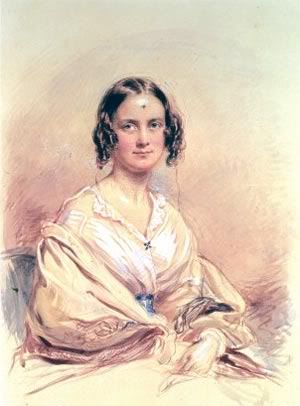
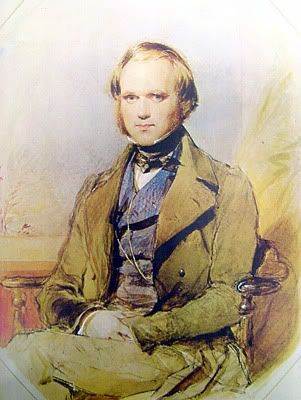
Happy Darwin Day everyone! Today would have been Charles Darwin's 201st birthday so around the world geeks are celebrating, churches are standing up to creationism and at least a few biologists are trying to eat their way through the tree of life. With Darwin Day falling so close to Valentines Day I thought it might be fun to forget about Darwin's science just for a few minutes and look at his attitude to love and marriage.
No one has ever accused Darwin about making a rush to judgement about any topic. Just as he spent years poring over the minutest detail of barnacle anatomy before he published The Origin he gave the topic of marriage careful consideration before singing on. In fact, preserved in his notebooks we have a record of the deliberations he undertook. Sometime in 1838 Darwin turned to a new page in his notes and drew a line down the middle, he added the headings "Marry" and "Not Marry" to either side of the line an proceeded to list the pros and cons of either decision. You can see the notebook here but below (presented without comment) is a transcript :
Marry
- Children — (if it Please God)
- Constant companion, (& friend in old age) who will feel interested in one
- Object to be beloved & played with —better than a dog anyhow.
- Home, & someone to take care of house
- Charms of music & female chit-chat.
- These things good for one's health.
- Forced to visit & receive relations but terrible loss of time.
Not Marry
- No children, (no second life), no one to care for one in old age.
- What is the use of working 'in' without sympathy from near & dear friends—who are near & dear friends to the old, except relatives
- Freedom to go where one liked — choice of Society & little of it.
- Conversation of clever men at clubs
- Not forced to visit relatives, & to bend in every trifle.
- To have the expense & anxiety of children
- Perhaps quarelling
- Loss of time.
- Cannot read in the Evenings
- Fatness & idleness
- Anxiety & responsibility
- Less money for books &c
- If many children forced to gain one's bread. (But then it is very bad for ones health to work too much)
- Perhaps my wife wont like London; then the sentence is banishment & degradation into indolent, idle fool
- My God, it is intolerable to think of spending ones whole life, like a neuter bee, working, working, & nothing after all.
- No, no won't do. — Imagine living all one's day solitarily in smoky dirty London House.
- Only picture to yourself a nice soft wife on a sofa with good fire, & books & music perhaps — Compare this vision with the dingy reality of Grt. Marlbro' St.
When I am with you I think all melancholy thoughts keep out of my head but since you are gone some sad ones have forced themselves in, of fear that our opinions on the most important subject should differ widely. My reason tells me that honest & conscientious doubts cannot be a sin, but I feel it would be a painful void between us. I thank you from my heart for your openness with me & I should dread the feeling that you were concealing your opinions from the fear of giving me pain.
Labels: Darwin, Darwin Day, evolution, history of science, might interest someone, sci-blogs
Thursday, December 31, 2009
The Origin of Species and the origin of species
2009 was the double celebration for evolutionary biologists, In February we markerd the 200th anniversary of Charles Darwin's birth and in November we celberated the 150th anniversary of That Book's publication. Somehow I've managed to go the whole year without dedicating a post to Darwin's ideas about speciation. Which is odd because I've spent quite a lot of thinking about, talking about and even writing about Darwin this year. So here, with about seven hours of 2009 left are a few of my thougts on Darwin and speciation.
Darwin's book was called The Origin of Species but I'm sure that most of the tributes you've read to Darwin and his book this year will have focused on how he proved evolution had happened and provided natural selection as the mechanism required to explain modern organisms in that framework - the fact and the theory of evolution . Missing among the descriptions of the events that shaped Darwin's thinking and the thousands of strands of evidence he wove to form his thesis will have been an answer to the question the title of the books seems to ask - where do new species come from. In fact, there is a prevailing view in evolutionary biology that for all his triumphs Darwin didn't quite understand species and as a result The Origin failed to provide a theory of speciatoin. I don't think it's quite that simple.
To know what someone thinks about speciation you need to know what they think about species.
Practically, when a naturalist can unite two forms together by others having intermediate characters, he treats the one as a variety of the other, ranking the most common, but sometimes the one first described, as the species, and the other as the variety. But cases of great difficulty, which I will not here enumerate, sometimes occur in deciding whether or not to rank one form as a variety of another, even when they are closely connected by intermediate links; nor will the commonly-assumed hybrid nature of the intermediate links always remove the difficulty. The Origin, p47Darwin was the sort of person who could develop a world shattering theory, produce a body of data to support it then spent eight years looking at barnacles. Historians of science have spent a lot of ink trying to provide an explanation for "Darwin's delay". It may have been driven in part by an off-hand comment by his correspondent Hooker that only someone who has worked on the systematics of a group could hope to understand the nature of species or might just be a phenomenon all too familiar to modern systematists - a small project that grew out of control. Whatever the cause Darwin's barnacle obsession (on visiting a friend's house his son asked where his friends father "did his barnacles") clearly shaped the way he thought about species. In numerous letters of the time, especially to Hooker, he remarks on the great deal of variation he finds within barnacles of a given species and the great trouble he finds in using that variation to define the limits of species. Partly as a result of his eight years spent dissecting barnacles Darwin came to see the variation within a species as the of the same sort as the variation that exists between species and, importantly, the difference between two varieties of a given species and two distinct species as one of degree not of kind. At the risk of boiling Darwin's ideas down to the sort of diagram you might find in a powerpoint slide here's a pictorial representation.
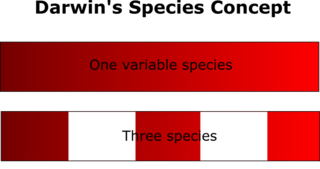
Hence I look at individual differences, though of small interest to the systematist, as of high importance for us, as being the first step towards such slight varieties as are barely thought worth recording in works on natural history. And I look at varieties which are in any degree more distinct and permanent, as steps leading to more strongly marked and more permanent varieties; and at these latter, as leading to sub-species, and to species. The Origin, p51
It's the fact that Darwin saw no fundamental difference between varieties and species that has lead many, notably Ernst Mayr, to conclude that he didn't understand species and that The Origin was not a speciation book. I read it quite differently. To me it seems Darwin saw the term 'species' as something a systematist could apply to a group of organisms sometime after a process he called divergence (which we would now call speciation) has started to form discontinuities between them.
The big question then is what is the process that drives the discontinuities that make for species? The clearest answer to question comes in Chapter 4 of The Origin. Here is one example of Darwin's ideas about the principle of divergence.
It has been experimentally proved, that if a plot of ground be sown with one species of grass, and a similar plot be sown with several distinct genera of grasses, a greater number of plants and a greater weight of dry herbage can be raised in the latter than in the former case. The same has been found to hold good when one variety and several mixed varieties of wheat have been sown on equal spaces of ground. Hence, if any one species of grass were to go on varying, and the varieties were continually selected which differed from each other in the same manner, though in a very slight degree, as do the distinct species and genera of grasses, a greater number of individual plants of this species, including its modified descendants, would succeed in living on the same piece of ground. And we know that each species and each variety of grass is annually sowing almost countless seeds; and is thus striving, as it may be said, to the utmost to increase in number. Consequently, in the course of many thousand generations, the most distinct varieties of any one species of grass would have the best chance of succeeding and of increasing in numbers, and thus of supplanting the less distinct varieties; and varieties, when rendered very distinct from each other, take the rank of species. The Origin, p88In typically prescient fashion Darwin took a proto-ecological view to the experimental evidence that plots sown with multiple plant species where more productive than monocultures. If the the mixed-species plot is doing better than the monoculture it must mean each species is taken advantage of different resources in that plot - what we'd now call distinct ecological niches. But then he took it yet further. What would happen if we let that monoculutre grow on for several generations. We know from his barnacles and from all the examples he listed in the previous chapters of The Origin that variants will arise. A very few of those variants will be able to make use of some of the resources that were previously going untapped. Over many generations natural selection would act - the most specialised forms would produce more seeds and produce more variants while forms intermediate between the ancestral species, not being masters of either niche, would be out competed and driven to extinction. Let this process continue long enough and you'd get first new varietes and finally, since they are just very distinct varietes, new species. Darwin provides his own diagram (the only one in the book) to describe this process and its phylogenetic implications but that is, in my supervisor's words, "a rattly looking thing" so here's one from me.

I find it very hard to marry the received wisdom that Darwin failed to understand the nature of species and provided on theory of speciation with the arguments Darwin presented in The Origin. When his species concept is viewed (as I think all such concepts should be) as a diagnostic tool rather than an essential definition then his is as good as any other. His theory of speciation as presented doesn't hold up to our modern knowledge of genetics but the underlying process, selection driving ecological specialisation, forms one half of our modern models of speciation that don't involve geographical isolation and those that involve secondary contact between incipient species.
Labels: Darwin, evolution, history of science, might interest someone, sci-blogs, science, speciation

All content not otherwise marked is licensed under a Creative Commons Attribution-ShareAlike 3.0 Unported License.


