Tuesday, February 12, 2013
Darwin and New Zealand
Across the world people will be marking the day by remembering Darwin the discoverer of evolution by natural selection, Darwin the cautious husband, Darwin the barnacle boffin and maybe even Darwin the geologist who explained the origin of coral atolls. I might be the only person who takes some time today to remember Darwin as a grumpy young traveler.
Darwin in New Zealand
Darwin visited New Zealand in 1835, and he really didn't like it.The New Zealand visit came four years into the HMS Beagle's voyage, and at the end of a four thousand kilometer journey from Tahiti. Darwin and the Beagle's crew had loved their time in Tahiti (Darwin records that "every voyager ... offered up his tribute of admiration" to the island p 416). With the memory of Tahiti in mind, the sight of fern-clad hills, a few European houses and a single waka to act as a greeting party was a disappointment for Darwin:
Only a single canoe came alongside. This, and the aspect of the whole scene, afforded a remarkable, and not very pleasing contrast, with our joyful and boisterous welcome at Tahiti. (p 417)Closer inspection of the land around the Beagle's mooring in the Bay of Islands didn't do much to improve the young Darwin's opinion of New Zealand
In the morning I went out walking; but I soon found that the country was very impracticable. All the hills are thickly covered with tall fern, together with a low bush which grows like a cypress; and very little ground has been cleared or cultivated .. (p 418)And if the plants weren't enough, introduced predators had already removed much of native fauna:
I saw very few birds.. It is said that the common Norway rat, in the short space of two years, annihilated in this northern end of the island, the New Zealand species. In many places I noticed several sorts of weeds, which, like the rats, I was forced to own as countrymen. (pp 427-8)In nine days of traveling around the Bay of Islands Darwin found very little to like. In comparison to the Tahitians the Māori were "of a much lower order" (p 420) and the Europeans inhabitants where "the very refuse of society" (p 420). In fact, the only place he liked was William Williams' attempt to remake England at the Mission house in Waimate North. (pp 425-30).
Now, it is obvious that Darwin meet New Zealand at a bad time. The capital, Kororareka, had well and truly earned its nickname as the "Hell Hole of the Pacific", Maori where adjusting to life alongside Europeans, and the impact of the Musket Wars and the native flora and fauna was already in decline thanks to the introduction of pests and the clearing of forests. But when you consider that Darwin was in the Bay of Islands in summer time I don't think I'm being too parochial to suggest Darwin was being just a tad grumpy when he decided there was nothing to like in our country:


New Zealand in Darwin's thinking
Darwin didn't think much of New Zealand while he was here, but I suspect he ended up regretting the brevity of his visit. About 30 years after he gladly left our islands behind, Darwin wrote a letter to Julius Von Haast to thank him for some information he'd provided, addingI really think there is hardly a point in the world so interesting with respect to geographical distribution as New ZealandDarwin spent a lot of time thinking about the geographical distribution of species. His first written account of where species might come from was spurred by thinking abut the distribution of Galapagos and Ecuadorian mockingbirds*. More importantly, if Darwin was going to do away with the popular idea that each continent's species arose more or less in their current place, he had to work out how plants and animals could get from one place to another.
He developed contacts in New Zealand and his correspondence with other scientists has many references to our plants and animals. The presence of flightless birds, bats and the effects of glaciation all come up multiple times. But New Zealand's most important influence on Darwin's thinking came via his best friend, Joseph Hooker .
Like Darwin, and many other Victorian naturalists, Hooker started his career by jumping on a ship and sailing to the other side of the world. For Hooker, that meant the HMS Erebus and trip to Antarctica via South America, New Zealand and Australia. Hooker had read Darwin's Journey of the Beagle in proof before he set off, and when he returned to England the two stayed in contact.
In 1844 Darwin "confessed" his ideas about the origin of species to Hooker. That letter contains references to the New Zealand flora, in which Darwin is fishing for facts that might support his ideas about species moving from one land to another. In the same year, Darwin started a discussion with Hooker about the distribution of Kōwhai (Sophora). The yellow-flowering Kōwhai will be familiar to all New Zealanders, but it may come as surprise that some of the "Kōwhai" species sold in garden centres aren't from New Zealand at all, but are Chilean Sophora species. The species are similar enough they'll happily hybridise given the chance.
These Chilean Kōwhai are an example of a common pattern - the floras of New Zealand, Tasmania South American and the sub-Antarctic seem to be closely related. Hooker thought this pattern arose because all these island where connected in a southern super continent. Darwin didn't like the idea of creating new land to explain a biological pattern, and instead proposed that that chance dispersal (by wind or rafting) could explain the distrbution of these species. Darwin was a keen experimentalists, and so, he set about dropping seeds in salty water and attempting to germinate them. These experiments took place in Darwin's house in Down, and apparently his children counted each germination as a victory for their dad over Hooker.
It seems Hooker couldn't provide Kōwhai seeds for Darwin's experiments, but Darwin took a record of just three equally-sized Kōwhai trees on the Chatham Islands (some seven hundred kilometers from the mainland) as evidence for long-range dispersal, and perhaps a suggestion that Kōwhai seed could survive a trip from Chile to New Zealand.
It turns out Darwin was right about Kōwhai although he got the direction wrong. Molecular studies have shown that Sophora arose in the Northern Pacfic, dispersed down to New Zealand and arrived in Chile via the Antarctic's strong circumpolar current, all in the last few million years (Hurr et al, 1999 doi: 10.1046/j.1365-2699.1999.00302.x).
Honouring Darwin Day in New Zealand
I'm not quite sure how I feel about Darwin Day. There is not doubt that Darwin was a genius, an exellent naturalist and the founder of a field of study that lives on today. But there is something a bit odd about the annual veneration of Darwin, and the rush to connect modern ideas in evolutionary biology with things Darwin wrote 150 years ago.Darwin got a lot right, and foresaw many developments in the study of evolution. But evolutionary biology is much more than 21st century 'Darwinism'. Darwin didn't know what a gene was, so is unlikely to teach us much about genomics. For me, the most important thing to learn from Darwin's writing is the way he set out about understanding the world. Darwin sought out evidence for each sub-hypothesis in his Big Idea, sometimes that meant writing to colleagues like Hooker and Haast and sometimes that meant doing experiments like his salty seeds.
Darwin never got a Kōwhai seed to experiment with, but, in his 1958 lecture on Darwinism in New Zealand, AC Flemming mentioned a study that found they can survive 4 months of immersion in salt water. That's a little shorter than the time you'd expect a seed pod set adrift from New Zealand to take before it washed up on a Chilean beach. Right now, highschool students are starting another year of biology classes - and teachers are probably preparing another re-hash of the "plant study" they've taught to Year 13 students since they were called Seventh Formers. Wouldn't it be a fitting tribute if some of those classes did something a little different, and honoured Darwin's approach to undestanding the biological world by dunking Kōwhai seeds and running an experiemnt he never got to?
Quoted passages are from Darwin's Voyage of the Beagle. Links go the the Darwin Online Fascimile.
*Forget about the finches
Labels: Darwin, Darwin Day, history of science, sci-blogs, science and society

Tuesday, January 22, 2013
Cats aren't evil, but they are a problem

Cats are a problem
Most of the reaction to Morgan's campaign has been to basically treat it as a joke. We should be clear then, that introduced predators are the number one threat to New Zealand species. Stoats, weasels possums and rats all contribute the decline of birds and lizards (and invertebrates, though we don't monitor those species closely enough to track their progress). Cats are certainly part of that problem. They have contributed to the extinction of at least 6 bird species in New Zealand, and many more populations and subspecies have been lost partly as a result of predation by cats (Merton, 1978). Cats continue to pose a threat to our wildlife. The impact of feral cats on shorebirds (plovers, dotterels, oystercatchers) and kakapo is well documented (Karl and Best, 1981 doi: 10.1080/03014223.1982.10423857). In the space of a week one cat managed to kill 102 native short tailed bats.The problem isn't restricted to wild cats. Pet cats will attack and kill native birds and lizards when they have the chance. In Dunedin the impact of tame cats is large enough that it's been estimated local bird populations (including natives) wouldn't survive if they weren't replenished by migrants from around the fringes of the city (van Heezik, et al. 2010. doi: 10.1016/j.biocon.2009.09.01)
Getting rid of cats isn't necessarily a solution
It's clear then, that cats are a problem for the conservation of native wildlife. But it's not nearly as clear that simply getting rid of cats will be much help. Every study of the diet of cats in New Zealand has found that cats kill a lot of mice and rats. These rodents are themselves predators of birds so removing one predator from our country may simply let another run amok. When feral cats were removed from Little Barrier island it led to an outbreak in kiore (Pacific rat), which threatened Cook's Petrel populations on that island (Rayner et al, 2007 avaliable via PMC ).
Should we phase out cats in New Zealand?
So, if Morgan's plan was actually do-able, should we do it? I have to honest here and tell you, I don't know. It's abundantly clear that cats, both feral and domestic, can kill native animals. It's clear that in at least some cases that killing can have a major impact on populations, but removing cats might not help all that much. If you want to know whether the impact of your typical urban moggy justifies Morgan's campaign, especially given the abundance of rats in New Zealand, you'd have to ask a conservation biologist. That's something no news organization has bothered with yet, as far as I can tell.Is this the conversation we should have started?
It's fairly obvious that Morgan's website, with its strange anthropomorphism (cats are predators sure, sadists? no) was designed to draw headlines and "start conversations". But what hope is there for environmentalists in conversation where our side wants to take people's kittens away?Introduced predators are the biggest threat to New Zealand's biodiversity, so the goal of eventually controlling these predators so tightly that they no longer pose a threat is a very worthy one. But the sort of change required to get us from today, where only 12% of the conservation estate is managed for predators, to that goal has to come from the ground up. Picking fights like this will get you headlines, but I don't think it will change anyone's mind.
Merton, Donald V. "Controlling introduced predators and competitors on islands" pp 121-128. In Temple, S.A. (ed.) Endangered birds: management techniques for preserving threatened species 1978
(image at the top via Pauline Dawson/ArtAndMyLife)
Labels: cats, conservation, new zealand, sci-blogs, science, science and society
Friday, May 25, 2012
Selling out to the mainstream media
They also asked me if I'd consider offering my on analysis of science in the news from time to time. Being of the opinion that its always better to do something about a problem rather than simply complain about it, I happily agreed. Here's the first piece to appear, a quick summary of the recent result that coffee isn't killing you and might even be prolonging your life.
I was prepared for a barrage of comments amounting "what does some evolutionary biologist/bug nerd know about medicine", but so far everyone that's taken the time to write something has been very supportive!
Labels: me elsewhere, sci-blogs, science and society, science communication, stuff
Wednesday, February 22, 2012
The Tree of Diversification (or why the March of Progress is wrong)

The so called "march of progress" has been used to describe the origin of our species thousands upon thousands of times. But it never happened. Only a few of the species depicted are potential ancestors for humans and many of them were contemporaries to each other (as the original diagram makes clear) so can hardly be different steps along a single evolutionary path.
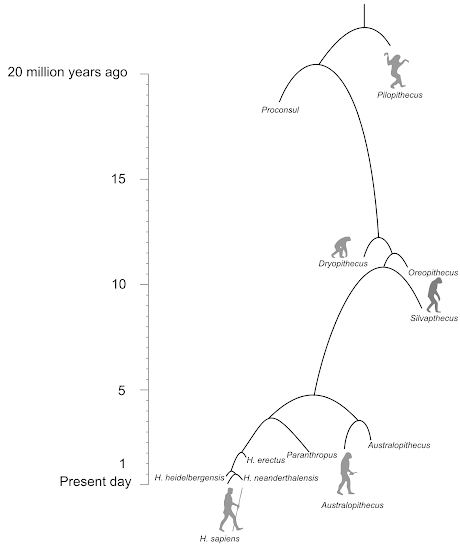
I think that when you look at it this way it becomes clear that if we want to understand how the organisms depicted in the most famous icon of evoluton came to be we need to focus not just on how changes occur in one lineage, but on how new lineage form and become capable of changing in their own directions. At the moment there are probably 10 million species on earth, and just how they got to be here is surely one of the biggest questions that biology asks us. Speciation and diversification ought to be central to the way we think about evolution.
Labels: evolution, Human evolution, phylogenetics, sci-blogs, science, science and society
Thursday, July 7, 2011
Our greatest journey
The Symphony of Science series of videos is probably the best justification for the continued existence of auto-tune. The latest of these videos, which put various scientists and science communicator's words to music, deals with the history of our species - the fact we all descend from African ancestors and that all populations outside Africa are the result of migrations that started around 150 000 ago:
It's a matter of continual disappointment and annoyance to me that most New Zealanders don't know that the person most responsible for finding our place in the biological world and locating the base of our family tree in Africa was a kiwi. Allan Wilson was a graduate of Otago University who went to Berkeley to use the new technologies that were developed for medical genetics to answer some of the oldest questions in biology. By sequencing DNA and looking at the cross-reactivity of immune system proteins, Wilson and his students established that humans only separated from other apes about 6 million years ago (as opposed to conformable distance of 25 million years paleontologists had favoured) and coined the term "Mitochondrial Eve" for one of the ancestors all modern humans can trace their origin to. This 'Eve' lived 150 000 years ago in Africa, so, just as Alice Roberts says in the video, we are all children of Africa.
These findings absolutely changed the way we think of ourselves as a species, and New Zealanders should know a kiwi was behind them! Thankfully the Royal Society has just announced one of Wilson's students, and a co-author on the most important papers, Rebbecca Cann is coming to New Zealand to talk about Wilson and his legacy. If you get a chance, I really encourage you to get along and hear her talk.
Labels: allan wilson, sci-blogs, science, science and society, science communication, video
Thursday, March 17, 2011
From a blog post to TV
There can't be many countries in which you could end up on national TV for staying up all night and writing a blog post criticising someone, but New Zealand is one them.
I knew when Campbell Live aired that interview with Ken Ring there was going to be a great deal of interest in his predictions, but I never imagined just how far my post on the topic would reach. It got more than a years worth of normal traffic for me and my wierd bugs and was quoted by an AFP article and Radio New Zealand's Mediawatch (one step towards my life goal of being interesting enough to be interviewed by Kim Hill). Then I got contacted by Tristam Clayton from Campbell Live, who was putting together a follow-up to that first interview and wanted to include me. I think the hour or so I spend filming that interview isthe scariest thing I've ever done, and I was very nervous from start to finish. Somehow, they managed to cut together a few minutes that make me sound as if I know what I'm talking about, and I'm very happy with the way it turned out. I don't think the TV3 site lets you embed their videos, but you can go and see it here (the site isn't geo-locked, so, foreign friends, you should be able to laugh at my accent):
Ken Ring’s quake theories – how scientific are they
Labels: sci-blogs, science and society
Friday, November 19, 2010
Ken Ring can't predict the weather
It's that time of year for academics in New Zealand. As soon as undergrad teaching finishes every department, organisation and society on campus decides to schedule some sort of meeting,conference or symposium - since everyone will have so much spare time. Between the three talks I'm going to end up giving this month, and the tonne of work I have to get done between them, I don't have much time to write here. So, partly inspired by people talking abut their months-old posts in Grant's piece on the length of time it can take to put a blog post together, I've decided to dive in The Atavism's "draft" folder and resurrect a few half-written posts. This one took about two months to write, and though I never quite got the copy right I do rather like the graph.
Ken Ring was on National Radio a couple of months ago, blathering on about his method of weather prediction. Ring thinks he can provide a forecast for any future date by looking at weather map that's about 18 years out of date That's how long it takes for the earth, the moon and the sun to cycle into the same relative positions in their orbits, and Ring thinks it's the moon that drives weather down here on earth. The 18 year old weather map will tell him what the atmosphere was doing last time everything lined up this way, and that will be enough to predict the next event. You probably agree that Ring's methods sound like lunacy, but Ring continually claimed in his time on air that his method had an 85 % accuracy rate. Reading Ring's website, you can see he is pretty generous when he estimates his own accuracy, like the Texas sharpshooter who shoots the side of a barn then paints a target around the bullet hole to show his prowess with a shooting iron, Ring uses any vaguely similar weather event to prop up the accuracy of his predictions. My particular favourite from that page is his prediction for 100 mm or rain in New South Wales, which was accurate, it's just that it arrived further West, two days later and was a only 20mm.
So, we shouldn't take Ring's self confidence too seriously and his method, which involves tricky maths and obscure terminology, is a prefect example of cargo cult science. But we don't have to stop there, Ring makes specific predictions that we can test. Just as the worst thing you can say about homeopathy is not that it's impossible for those dilutions to effect the human body, but that homeopathy has been shown to do nothing; the worst thing you could say about Ring's weather forecasting methods is that they don't work. I went digging for some of Ring's old claims and was thrilled to see that my Sciblogs stablemate Gareth Renowden has already done all the hard work for me! Apparently Gareth was been dealing with crazy people and weather even before he launched Hot Topic, and back in 2006 he got his hands on on Ring's predictions for rainfall and sunshine hours in each of the major centres. Gareth compared those predictions to the actual values and to the long term average kept by NIWA.
There's a bunch of stuff that can be done with that data (which Gareth kindly made available for anyone to download), but the most important thing (and this holds for almost any statistical analysis) is to take a look at it. Here's what I came up with for the rainfall data using the rather wonderful ggplot2 and inkscape :
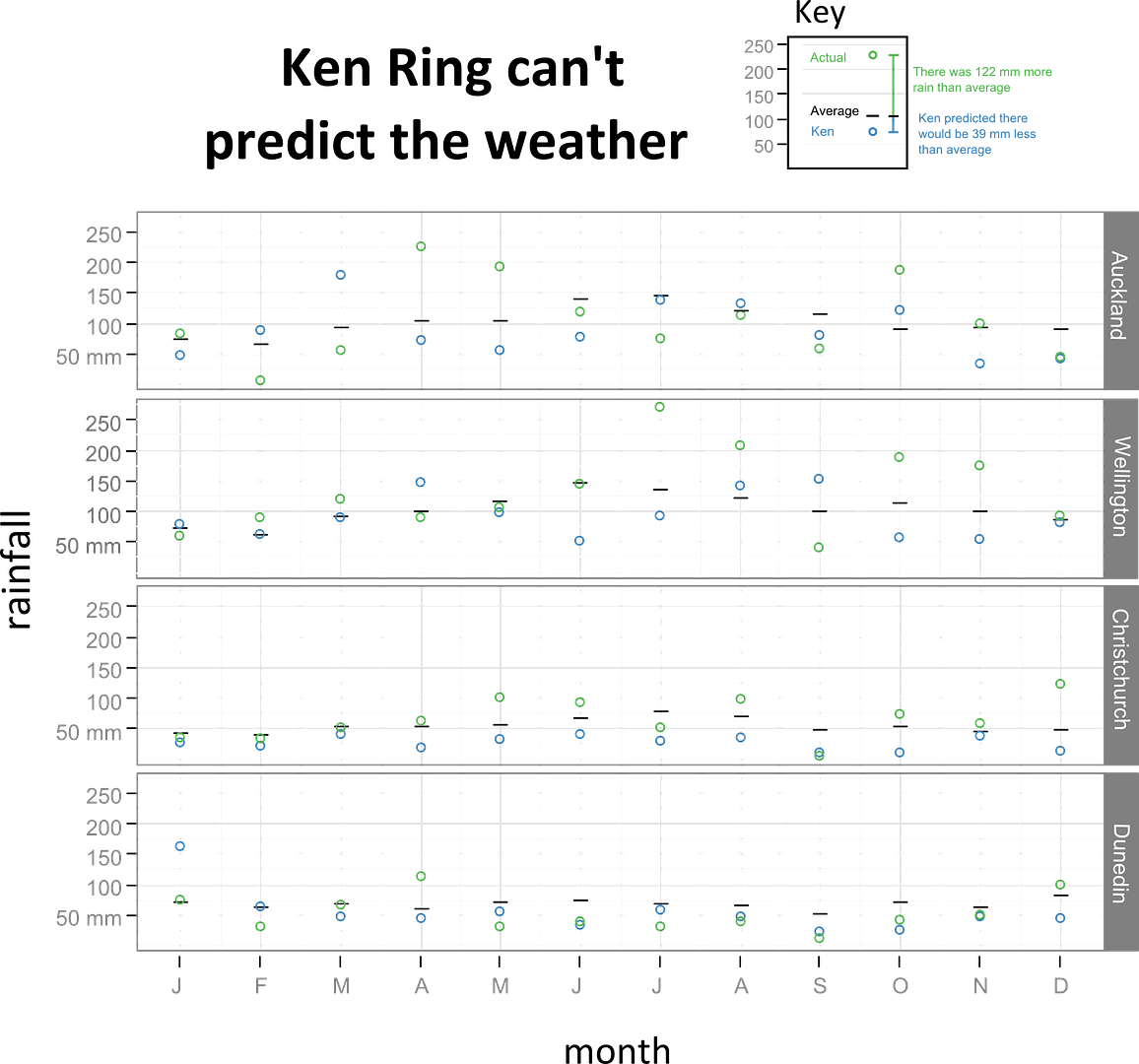 You can click on the graphic above to get a bigger version. In these graphs the long term average for each observation is the black line, Ring's predictions if the blue circle and the actual rainfall for that month in that city is the green circle.
Now, let's test the accuracy of Ring's predictions, but against what? Statistical tests often compare a set of results to what you might expect to get "by chance" but that's not very helpful in this case. For one, it's not clear what the range of possible values should be, and second, comparing the forecasts to numbers picked at random ignores the seasonal effects everyone knows contribute to weather. You don't have to know the position of the moon 18 years ago to know that Auckland is more rainy in July than January. Instead, let's compare Ring's forecasts to the easiest forecast you could ever make - just saying rainfall for a given region in a given month would match the long-term average. If there was anything to Ring's methods he should be able to do better than that. He didn't, on average Ring's prediction was 52.5 mm out from the actual rainfall where as "predicting" the average would have been 37.25 mm out.The long-term average was a better predictor, averaging 15.15 mm closer to the actual rainfall with a confidence interval spanning from -0.4 and 31 mm. We can't (quite) say from that data that Ring's forecasts have less predictive power than the long term average, but there is absolutely no evidence they're any better.
Let's lower the bar a little and forget about how close to the true value Ring's predictions came. Was he at least able to get on the right side of the average? If he predicted a drier August than average was the real value likely to indeed be direr? In this case, if you just tossed a coin 48 times, calling heads drier and tails wetter, you'd expect to be right about half the time. And would have done better than Ring. His prediction was only on the right side of the average 17 times in 48 attempts, about 35% accuracy and significantly worse that you would expect to get from tossing a coin (if you're one of those p-value fetishists p, in this case, is equal to about 0.03) .
So Ken Ring can't predict the weather. That probably doesn't surprise anyone reading my blog or at sciblogs.I wish it surprised me that the uselessness of Ring's forecasts is no barrier to him being taken seriously, selling books and appearing on radio and in newspapers. The host of the show that started by little investigation evidently took some flack for having Ring on (it was a National Radio after all) and his defense amounted to "well, we just let these people talk and you can decide what you think about it". That seems impossibly weak to me, surely the least we should do is ask people who make outrageous claims to show what evidence they have to support those claims. I'm pretty satisfied there is nothing in astrological weather forecasting, but if advocates of the method really want to put it to the test it would be easy. Get someone to provide a year's worth of old weather maps but let only half of them be of the right vintage for their method (about 18 years in Ring's case) and see if the forecasts from the supposedly predictive weather maps are better than the ones from weather maps chosen at random. How likely do you think it is that test will be run?
Labels: pretty data, sci-blogs, science and society, skepticism
Thursday, October 7, 2010
A two bird race
You are running out of time to cast the most important you will have this year - who will run your community be voted Bird of the Year for 2010? This year I stepped up an offered my services as campaign manager for the the bellbird, and frankly i've done a terrible job. With nearly 9 000 votes cast the korimako has 51, or about 0.05% of the electorate's support. I'm sure this at least parially because Forest and Bird didn't include my completely unoriginal campaign logo in their post:

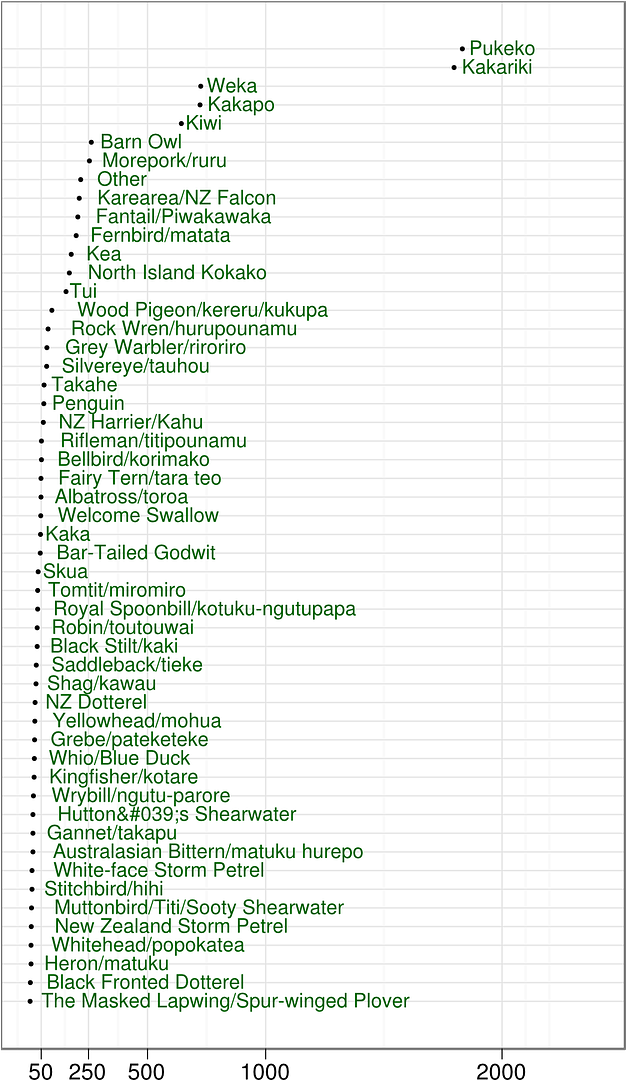
There, that got to be worth a vote or two right? I think it's all a bit late for the bellbird this year, because the poll has already become a two bird race. These are the standings scraped from the Forest and Bird site last night:

So it's a head to head battle between the Pukeko; a multinational entity which shills for one of the country's worst polluters, and the Kākāriki; a bird whose very name means green. Obviously, the bellbrid campaign still values and wants your vote, but if you can't make the korimako your bird of year, then we urge you think green!
Labels: bellbird, kakriki, pukeko, sci-blogs, science and society
Wednesday, March 17, 2010
Lawrence Krauss on a bad day
Dunedin got to see Lawrence Krauss on a good day and a bad day this week, but that’s not to say one of his presentations was better than the other. Yesterday the award winning physicist and scientific communicator revealed to his audience that his outlook on life changes from day to day. On good days he can revel in the wonder of a universe that could come to know itself due to a series of accidents that started 10-31 seconds after the big bang and allowed the creation of first matter then atoms, stars and planets and finally astronomers. On bad days he despairs at the lack of scientific thinking in journalism and politics and thinks these problems, and the anti-scientific forces that fuel them, will probably prevent us from doing anything meaningful about climate change.
Krauss' awe inspiring story of an atom's journey from the birth of the universe to its death will gain nothing from my retelling it. If you weren't able to see it then you'l be glad to know his talk was a précis of his excellent book ATOM: An Odyssey from the Big Bang to Life on Earth...and Beyondand covers similar ground to this recored lecture. Perhaps I'm a masochist and a pessimist, but I'm going to skip the awe inspiring story to focus on what Lawrence Krauss thinks about on a bad day. His talk on "Science, Non-Science and Nonsense" described the sources of scientific confusion in society and the tactics used by those groups that seek to take advantage of it.
Krauss argued that the goal of science education and science communication should be to make sure everyone develops a functioning bullshit filter. He didn't express his thesis quite as bluntly as that, but his core idea is that spreading a scientific mindset would allow us to short circuit needless debates (is global warming real?) and let us get on to the important ones (what are we going to do about it?). He used a neat example to illustrate how this sort of scientific common sense could stop nutty ideas before they get started. UFO enthusiasts often cite the ability of the lights they observe to perform right angle turns at speed as evidence of their otherworldliness. In fact, Krauss pointed out, common sense should tell us that these apparently amazing maneuvers are evidence that the lights in question are not being emitted by a massive object moving through the sky. The only way to turn at a right angle is to stop then change direction, for a UFO to do all its slowing down and stopping so quickly a human observer couldn't perceive it would generate G-forces with a strength about 2000 times greater than earth's gravity. And quite a mess.
If the evidence used by UFO junkies is so silly then why do continue prosper? Why aren't people already filtering this sort of nonsense? The standard of scientific reporting in the media certainly has a lot to answer for. Krauss cited the normal concerns, a fractionated media market means viewers can choose a source of news that confirms their biases and the innate need of journalists to present balance is misplaced in science stories when, in almost every case, one side is wrong and we usually know which side that is. He also mentioned something I hadn't thought about before. According to Krauss, part of the problem with science coverage in mainstream reporting is that journalists don't feel qualified to make scientific pronouncements. Writers and broadcasters are happy to make bold statements on politics, financial markets and sports but will shy away from even a scientifically uncontroversial statement like "evolution is a fact."
Scientific understanding might not be helped by meek journalists and the false equality of balance but most journalists aren't setting out to deliberately mislead the public on science. Unfortunately, there are forces at work that are doing just that. Krauss had a tonne of examples from the culture wars in his native USA to draw on but he also took the time reminded us of our home grown cranks, citing the New Zealand Climate "Science" Coalition and Ray Comfort (The Apologists Nightmare [youtube video]) as evidence we aren't immune to anti-science in New Zealand. As you'd expect Krauss exposed just how vacuous the claims of intelligent design creationism and the objections of climate change denialists are, but he also attempted to deconstruct the PR strategies each group use. Both campaigns seek to take advantage of the public's sense of fairness and journalists' willingness to provide balance to any point of view. The Discovery Institute would have you believe their goal is simply to get their science a fair hearing in the classroom. But they don't have a science. For normal science, theories only make it into the school curriculum after they've been proposed, tested, retested and confirmed. The ID crowd don't want fair treatment, they want special treatment, to avoid that boring scientific process and start in the classroom!
Krauss could hardly have known this, but our own climate cranks play the same game. I hate to make an example of this article because the author usually covers science well, nevertheless it highlights the point. In an effort to provide balance to a story on how the IPCC might be made better the author contacted Vincent Gray for comment, here's the paragraph
Wellington scientist and climate change sceptic Vincent Gray said the researchers were continually coming up with "new models" but they were still "fiddling the figures" and were unlikely to restore public confidence in their work until their projections were proven
That sounds pretty fair doesn't it? Climate scientists can run their model forward in time and if their projections match observations we'll take action. Actually, it's absurd. As Krauss emphasised in his talk, the evidence for climate change doesn't only come from models, we have tonnes of data that tell us the earth is warming and the seas are rising. Combine those data with the fact recent temperature records are within the uncertainties of the IPCC's projections and sea levels are near to the upper bound of those projections and Gray's sound bite seem less fair.
Krauss had more problems than solutions in his hour long presentation. In fact, it's a testament to the passion he has for his science and skill he has as a scientific communicator that he managed make a talk made almost entirely of depressing facts seem invigorating. The only ray of hope Krauss offered us was that when people's backs are to the wall they abandon their their preconceptions and to turn to science. In 2003 George W. Bush said that he believed "both sides" of the "evolution debate" should be taught in schools. In 2005 Bush was faced with the prospect of Avian flu becoming able infect humans. Confronted with threat of a flu pandemic the Bush administration dispensed with its evolutionary agnosticism and planned for the possibility of genetic mutations allowing viruses to pass from human to human. That sort of infectivity requires conformational changes in surface proteins which create a new function, exactly the sort of phenomenon the ID crowd think is so improbable as to be effectively impossible.
Krauss will be presenting something very similar to his Dunedin talk in Auckland next week. I'd encourage anyone who has the chance to get out and seem him, he's a very chrasmatic and interesting speaker. You might even ask the question I really wish I did now- how are we going to fix all these problems?
Labels: climate change, evolution, Lawrence Krauss, might interest someone, sci-blogs, science and society, science communication, skepticism
Wednesday, March 10, 2010
Talking about talking about science
I've been swamped by the requirements of my real work for the last couple of weeks which has meant I've more or less neglected The Atavism just when a set of new scientific posts might have impressed voters in the Research Blogging Awards with this blog's vitality. I do have a couple of substantive posts on the boil but for now I'm going to resort to flinging out a few links and half digested ideas on science communication
***
Let's start at sciblogs where Ken Perrot has a review of Cornelia Dean's guide for scientists Am I making myself clear? It's particularly interesting to read that Dean urges scientists to write for newspapers in the same week that Grant Guilford publihsed some clear thinking in response to nonsense about climate science. The nonsense was in The Herald and no doubt read by thousands, the sensible reply is on some obscure piece of the University of Auckland's website...
***
***
I don't think I'll be writing a pop-sci book anytime soon but, obviousy, I do think science blogs have a place in getting science out to the public so I don't quite know what to make of this very odd paper on scientific blogging. The authors take a set of posts from 11 widely read science blogs and draw the following conclusions
Science blogs are a virtual water cooler for graduate students, postdoctoral associates, faculty, and researchers from a variety of disciplines and areas of inquiry. The conversations in science blogs are also of “water cooler” quality ...
To become a tool for non-scientist participation, science blogs need to stabilize as a genre or as a set of subgenres where smaller conversations may facilitate more meaningful participation from members of the public. Science bloggers need to become more aware of their audience, welcome non-scientists, and focus on explanatory, interpretative, and critical modes of communication rather than on reporting and opinionating.
Which is what happens when you presume 11 blogs is a representative sample of the thousands of people who are writing about science on the net. Of course there are blogs that are pitched at other experts and other blogs that deal mainly in links but presumably that's because that's what the authors want to do with their blogs!
If the authors of the paper wanted to see how blogging fits in to describing scientific ideas and news to non-scientists then they might have started, not with 11 blogs plucked from google, but by selecting blogs that are aimed at a lay audience . If you want interpretation and explanation of the day's science news there are superb writers like Carl Zimmer and Ed Yong to help you out. If you want a scientist to bring their expertise to bear on some topic then there's a whole mess of blogs (1, 2 3, 4, 5... and another thousand or so here) that do just that (and I like to think The Atavism fills one small niche in that sprawling ecosystem). A thoughtful review of those blogs would have served a real purpose, it's hard to see that the published paper does. One good thing came from that paper though, I now know there is a Journal of Science Communication, I trust some of the other papers will be more useful. (If you are interested The Panda's Thumb and Blog around the Clock have more detailed reviews of the paper)
***
Finally, congratulations to Elizabeth Connor who has won the inaugural Prime Minster's Science Media Communication Prize (really, that's the flowing title given to a prize for communicating difficult ideas...) which gives her $150 000 to undertake a program that focuses on "the mystery intrigue and uncertainty of science."
Labels: sci-blogs, science and society, science communication
Wednesday, January 20, 2010
Doing Science in Public
- Fabiana Kubke has heard something strange about Tui and wants your help to check it out. She's not telling us exactly what it is that she's testing just yet but to get involved all you have to do is drop her a line with a few details when you see a Tui. Fabiana described the project and the idea of citizen science to Noelle McCarthy on National Radio so I'll let her provide the details [streaming audio]
- A group of scientists from the Univeristy of Canterbury have been documenting their work on the Chatham Islands with a blog, Life on the Edge of the World.
- The people that brought you Science Creative Quarterly have a sneaky plan: to hijack kids' freakish ability to recall details about hundreds of Pokemon "species"and use it to teach them a few things about real animals. You can read about the phylomon project here - it's brand new and looking for input from graphic artists, photographers, science geeks, gaming geeks and really anyone that's interested.
- Finally, go over and welcome another Otago geneticists to the blogosphere. Tamsin is a PhD student working on the genetics of embryonic development which means she has tonnes of stunning images to blog about.
Labels: citizen science, might interest someone, sci-blogs, science and society, science communication
Thursday, October 15, 2009
Human genomes
When I started out as a genetics student the big goal everyone was talking about was understanding "The Genome" - that monolithic set of DNA bases that make us human. Of course, there is no such thing. Pick two human genomes at random and you'll likely find 2 million single-base differences and plenty of structural differences on top of that. As with just about everything in life understanding the range of variation and the diversity in human genomes is much more interesting than focusing on the average of that diversity.
The publication of a draft sequence from the Human Genome Project in 2001 really was the begining of a new epoch in genetics (and a revelation in itself- it takes 20 000 genes to make a nematode and 25 000 to make us?) but the real value of that project has been the generation of a scaffold that subsequent projects like the super-optimistic 1000 genomes project, hapmap and the genographic project (which New Zealand researchers contribute to) have been able to inherit in their attempts to understand genomic diversity. This week Nature has a special issue focussing how data built on information from the Human Genome Project is contributing to the way we understand disease and even allowing personalised testing for genetic risk.
Unfortunately they've stuck one of the most interesting articles behind a pay wall (Nature, the people that bring you a special on science and society but don't let society read it...) Bruce Lahn and Lanny Ebenstein have an opinion piece on genetics and race.
The current moral position is a sort of 'biological egalitarianism'. ... the view that no or almost no meaningful genetically based biological differences exist among human groups, with the exception of a few superficial traits such as skin colour. Proponents of this view seem to hope that, by promoting biological sameness, discrimination against groups or individuals will become groundless.Of course, as Ebenstein and Lahn point out, there is a problem with this view - race almost certainly does have a genetic basis beyond a few superficial traits. To take the local slant Polynesians and in particular Māori represent the furthest extent of the series of migrations that followed our ancestors moving out from Africa. Settling the Pacific must have involved a series of population bottlenecks - events in which small groups form a new population representing only a fraction of the genetic diversity in the parental population. Such bottlenecks will have inevitably left a mark on the gene pool of Māori and Pacific Island populations that more recent interbreeding won't yet have erased. There will be some genes that are unique to Polynesian populations and others that are orders of magnitude more or less common than they are in other populations. If we embrace that genetic diversity we might be able to understand why Māori face a much greater risk to, for instance, diabetes, gout and liver disease than Pakeha. To, as people have really suggested, ignore that genetic diversity because racists might use it to further their stupid cause is, in the words of Lahn and Ebenstein "llogical, even dangerous" Oh, and by the way, whatever we find out about the genetic basis of race I think it's safe to say that genes won't care too much for national borders - but that's not going to stop the UK from genetically screening assylum seekers...
Labels: genetics, genomics, human genome, sci-blogs, science and society

All content not otherwise marked is licensed under a Creative Commons Attribution-ShareAlike 3.0 Unported License.