
Tuesday, June 8, 2010
If some of us have Neanderthal genes, are Neanderthals us?
 I got a little bit starry eyed writing about the Neanderthal genome the other day. I chose to retrace the arc of scientific progress that links the initial description of Neanderthal man as something different than modern humans to the point reached last month, where we are able to tag some of those differences to a single gene. Most of the news stories about the Neanderthal genome focused not on the genes that made us different from them, but a small percentage of the genome that reinforced the continuity been them and us. Genetic evidence that Neanderthals interbred with the ancestors of some modern humans. The revelation of these ancient assignations has caused some quite sensible people to say some quite silly things about what species are and what Neanderthals were. So, perhaps I can compliment my slightly hazy earlier piece with a more hardheaded take on why Neanderthals remain a species unto themselves.
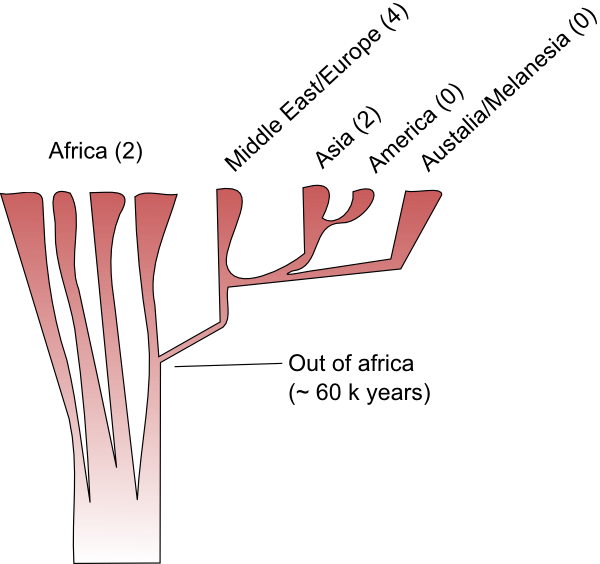
Let's start with the evidence that Neanderthals interbred with the ancestors of modern humans. Modern humans (Homo sapiens) arose in Africa about two hundred thousand years ago, all modern human populations outside of Africa descend from a relatively small number of migrants who left that continent between eighty and fifty thousand years ago. When those migrants first left Africa and entered the Middle East they would have met other humans. The ancestors of the Neanderthal had moved out of Africa and established themselves in Europe and Central Asia thousands of years before. Until now we haven't known which of the four 'F's (fighting, fleeing, feeding or reproduction) followed that first contact, the Neanderthal genome has given us a clue.
When you compare individual DNA bases that are variable within modern human genomes to the corresponding sequences in the Neanderthal genome you find that non-African sequences match the Neanderthal sequence slightly (but significantly) more often than African sequences do. It's possible that this pattern is an artifact of our poor sampling of African genomic diversity (that observant nerd Christie does a good job of explaining how here) but for the sake of argument let's take it for granted that his pattern is the result of ancient interbreeding. The authors of the paper describing the Neanderthal genome estimate people with no recent African ancestry inherited between one and four percent of their genome from Neanderthals. That number is the same for Papuan and East Asian populations as it is for Europeans despite Neanderthals having lived alongside Europeans for thousands of years, suggesting any interbreeding that contributed to modern human genomes was limited to that first period of contact.
This is where the problems start. Having heard the news that Neanderthals and some of our ancestors might have once swapped genes some people remember that nice easy test of species-status from high-school biology. Something like "if two animals can interbreed then they're part the same species." So, are we Neanderthals; or are Neanderthals us? No. In fact, the Neanderthal genome serves to highlight some the mistakes we commonly make when start trying to define species.
Biologists have spent a lot of time arguing about just what a species is and how can delimit species from the creatures that we study, too often we've forgotten that those are two different arguments. DeLene from Wild Muse has a thoughtful overview of some of the factors that contribute to the "species problem" in her review of Jody Hey's book on the same topic. You should read her piece because the species problem really is a fascinating philosophical question, but I think most of the fights that erupt around competing definitions of species come from a failure to understand that defining species and organising critters into species are two different tasks. We've been studying speciation, the process by which new species arise, for a while now and we've developed a pretty good idea of how it works. Two populations stop interbreeding with each other, during that period of "reproductive isolation" genetic changes in one population can't effect the other so natural selection and random changes (called genetic drift) change each population independently. Species are populations which are on independent evolutionary trajectories.
Reproductive isolation drives the independence that is at the heart of what species are, but it's not the sine qua non of a species. James Mallet from University College London has made a special study of hybridisation, and he reckons 10% of animal species and a whopping 25% of plants interbreed with other species from time to time. As molecular tools have been applied to non-model organisms it's become increasingly clear that the "species barrier" is more porous than we'd thought, and species can maintain their independence even in the face of the occasional injection of genes from other species.(If you're interested in the wider question, I've written a bit on the species problem here. The short version is we should see competing "species concepts" as operational tools that might be used to help delimit species, but not as definitions).
Now, think about the results from Neanderthal genome. Most sequences in that genome are separated from their human counterpart by a split that happened over five hundred thousand years ago. There is pretty good evidence that Neanderthals and the ancestors of non-Africans interbred when they met each other in the Middle East about four hundred and fifty thousand years after that initial split. That gene flow had the potential to homogenise the two populations into one, but it didn't. Each lineage maintained its identity. For the twenty or so thousand years that Neanderthals continued to exist they retained identifiable morphological traits. There are fossils in Europe that some argue show a mixture of characters, but any interbreeding in that continent left no mark on modern European genomes, which have no more Neanderthal DNA than Papuan and Chinese genomes do. At the same time, the authors didn't detect any flow of modern human genes into Neanderthal genomes (so it's not a case of of modern humans swamping Neanderthal populations and erasing any trace of genetic admixture in the process). The available evidence seems to point o Neanderthals and modern humans as separately evolving populations, and a little bit of gene flow between them wasn't enough to upset that pattern.
I should stress, by saying H. neanderthalensis and H. sapiens are different species we aren't saying very much about how different Neanderthals were from us. Species are not defined by a degree of difference, or an essence that was missing in Neanderthals but is present in us, they're just another human population that was moving in a different direction (and eventually extinction). If some of us do have Neanderthal genes, then it only goes to show how fuzzy the line between our species and the rest of the biological world is.
Green RE, and many, many others (2010). A draft sequence of the Neandertal genome. Science (New York, N.Y.), 328 (5979), 710-22 PMID: 20448178
James Mallet's bit on the frequency of hybridisation is taken form here: Mallet, J. (2005). Hybridization as an invasion of the genome Trends in Ecology & Evolution, 20 (5), 229-237 DOI: 10.1016/j.tree.2005.02.010
The ideas about species and species delimitation presented above are pretty similar to Kevin de Quieroz's take:
De Queiroz, K. (2007). Species Concepts and Species Delimitation Systematic Biology, 56 (6), 879-886 DOI: 10.1080/10635150701701083
Labels: evolution, genetics, genomics, Human evolution, human genome, might interest someone, neanderthals, research blogging, sci-blogs, science

Friday, May 28, 2010
Living up to our name
Homo sapiens means "wise man". Sometimes it's hard to think that Linnaeus was right in honouring our species with that name. We're the reason the earth is going through its sixth great extinction; people are still routinely killed for belonging the wrong race, religion or sexuality and the prospect of taking action on climate change makes a significant proportion of the population behave like children. So it's nice to be reminded every now and again about the sorts things our species can do when we put our minds to it. I've been trying to find time to write a proper post about the Neanderthal genome, but here's something to think about on a rainy Friday afternoon.
In 1857 an anatomist and a school teacher, Hermann Schaffhausen and Johann Fuhlrott, described a set of bones that had been discovered in a limestone quarry in what was then called the neanderthal region of Germany. Amazingly, the neanderthal region was named after Joachim Neander whose own name translates as "new man". A new man was exactly what Schaffhausen and Fuhlrott saw in the bones that they described. They were at once human and something "other" Chief among the characters that set the neanderthal samples apart from modern humans was the thick brow ridge that we now think of as characteristic of primitive humans. Thanks to these differences the school teacher and the anatomist concluded that the neanderthal samples were human but something quite different than modern Europeans.

"Neanderthal Man" was the first pre-human fossil to be described. At the time science had no convincing mechanism by which species might change over time and no idea of how organisms passed on traits to their offspring. Within in a couple of years Darwin had published The Origin and Mendel his Experiments on Plant Hybridization (which was promptly ignored, and only cited three times in 30 years). In time scientists discovered more human fossils; Neanderthal man showed up all over Europe and took the name H. neanderthalensis, Euguen Dobois uncovered H. erectus in Asia and host of anthropologists have since added characters like the Turkana boy, H. habilis, Ardi and a whole cast of Australopithecines to our family tree.
The science of heredity moved on too. In the 20th century geneticists, especially Hugo deVries, rediscovered Mendel's work and set about building a particulate theory of inheritance. TH Morgan showed that genes resided on chromosomes, Fisher, Wright Haldane and others synthesized Mendelian genetics with Darwin's ideas on evolution, MacLeod and McCarty showed that DNA (a chemical initially identified by Miescher) contained genetic information (though no one believed them until Hershey and Chase demonstrated it again) and, of course, Watson and Crick showed us what DNA looked like thanks to Rosalind Franklin's x-rays. It took a little over 20 years to get from Watson and Crick's double helix to first complete virus genome and another 30 to scale the 5 orders of magnitude in size between that one and the human genome.
Last month, scientists published a first draft of the Neanderthal genome. 60% of the genetic make up of species of human that has been extinct for thirty thousand years. Thanks to the work of all those scientists listed above, and countless others who go unremembered, we now have a pretty good idea about the genetic basis of the thick brow ridge that convinved Schaffhausen and Fuhlrott than neanderthal man something different than other humans. The Runx2 gene is in a region of the genome that has been selected for in the H. sapiens lineage. We know from the work of yet more scientists that Runx2 is one of the most important genes regulating bone growth in humans and is associated with malformations of the skull. It's no great stretch to imagine that our species lost the brow ridge that that we associate with primitive humans thanks to changes in the expression pattern of Runx2.
It some ways that's a trivial piece of information, we've known for a long time that most morphological change is likely due to changes in the expression pattern of development genes. But isn't it wonderful to think that in the span of two human lifetimes we've moved from knowing nothing of our species' history to the point that we are developing hypothesis on the molecular basis of the changes that made us different from the host of human species we've since discovered.

Labels: evolution, genetics, genomics, Human evolution, human genome, sci-blogs, science
Friday, February 26, 2010
Nucleotide diversity - what two new African genomes mean

As I've said before there really is no such thing as the human genome. There are millions of differences between individual genomes and we are each born with about 150 new muations. In an age in which we can sequence assemble and analyse entire genomes in two years understanding the breadth of human genetic diversity is at last an achievable goal and if you want to understand human diversity then you need to look to where we came from. Trace any family tree back far enough and you will end up in Africa and, in fact, most of human history was played out entirely in that continent. Modern humans arose in Africa about 250 000 years ago and only spread out to Europe and the rest of the world in the last 60 000 years, displacing Homo erectus in the process. The migrants that founded the modern European, Asian and American populations would have carried with them only fraction of humanity's genetic diversity when they left Africa but untill recently genomics has focused on those populations. Until last week the two African genome sequences available to researchers were both from Yoruban volunteers to the hapmap project. Although those sequences are very useful they represent only one tip in the deeply branching tree of humanity
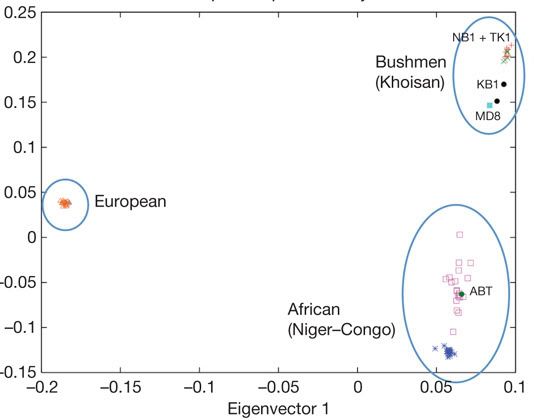
To broaden our understanding of African genomes Schuster et al looked to the South of the continent and at two people in particular. !Gubi is a Khoisan (or bushman), a member of a one of the earliest diverging groups within the humanity while Desmond Tutu hails for various Bantu peoples. The results taken from theses genomes along with lower density sequencing and genotyping of other Bantu and Khoisan volunteers reinforces just how much genetic diversity exists within Afirca. By using a method called principle component analysis to reduce a the correlations among millions of single base pair differences (single nucleotide polymorphisms or SNPs) to a smaller set of uncorrelated vectors you can see patterns in the genetic diversity of groups. Applying this method to West African (Bantu and Yoruba), Khoisan and European populations reveals the comparative genetic homogeneity within Europeans and that the difference between the two African groups is comparable to that between either of them an Europeans.
The paper is available to under a creative commons license here and if you feel suitably qualified you can play with their data which has been released on the Galaxy framework.
Labels: evolution, genetics, genomics, Human evolution, human genome, research blogging, sci-blogs, science
Tuesday, October 27, 2009
Some updates
- My support for the Bellbird in the annual Bird of Year poll was not enough for it raise above a mid-table finish. In a fit of creativity kiwis voted the Kiwi as their favourite bird with rifleman and kea filling the minor placings.
- That nutty paper about insect metamorphosis was held up at PNAS while the editorial board looked into Lyn Margulis' own claim that she went through seven reviewers to find two that would sign off on it. Even so, the paper will make it to a dead-wood issue of PNAS along with a letter from Gonzalo Giribet who told a Nature reporter the idea was "the most stupid thing that has ever been proposed"- should be fun.
- Finally, if you thought that the idea of their being some genetic differences between human races wasn't a controversial idea then you might check out two threads (1, 2) that started when Larry Moran talked about the same article at The Sandwalk.
Labels: bellbird, evolution, human genome, Korimako, population genetics, sci-blogs, science
Thursday, October 15, 2009
Human genomes
When I started out as a genetics student the big goal everyone was talking about was understanding "The Genome" - that monolithic set of DNA bases that make us human. Of course, there is no such thing. Pick two human genomes at random and you'll likely find 2 million single-base differences and plenty of structural differences on top of that. As with just about everything in life understanding the range of variation and the diversity in human genomes is much more interesting than focusing on the average of that diversity.
The publication of a draft sequence from the Human Genome Project in 2001 really was the begining of a new epoch in genetics (and a revelation in itself- it takes 20 000 genes to make a nematode and 25 000 to make us?) but the real value of that project has been the generation of a scaffold that subsequent projects like the super-optimistic 1000 genomes project, hapmap and the genographic project (which New Zealand researchers contribute to) have been able to inherit in their attempts to understand genomic diversity. This week Nature has a special issue focussing how data built on information from the Human Genome Project is contributing to the way we understand disease and even allowing personalised testing for genetic risk.
Unfortunately they've stuck one of the most interesting articles behind a pay wall (Nature, the people that bring you a special on science and society but don't let society read it...) Bruce Lahn and Lanny Ebenstein have an opinion piece on genetics and race.
The current moral position is a sort of 'biological egalitarianism'. ... the view that no or almost no meaningful genetically based biological differences exist among human groups, with the exception of a few superficial traits such as skin colour. Proponents of this view seem to hope that, by promoting biological sameness, discrimination against groups or individuals will become groundless.Of course, as Ebenstein and Lahn point out, there is a problem with this view - race almost certainly does have a genetic basis beyond a few superficial traits. To take the local slant Polynesians and in particular Māori represent the furthest extent of the series of migrations that followed our ancestors moving out from Africa. Settling the Pacific must have involved a series of population bottlenecks - events in which small groups form a new population representing only a fraction of the genetic diversity in the parental population. Such bottlenecks will have inevitably left a mark on the gene pool of Māori and Pacific Island populations that more recent interbreeding won't yet have erased. There will be some genes that are unique to Polynesian populations and others that are orders of magnitude more or less common than they are in other populations. If we embrace that genetic diversity we might be able to understand why Māori face a much greater risk to, for instance, diabetes, gout and liver disease than Pakeha. To, as people have really suggested, ignore that genetic diversity because racists might use it to further their stupid cause is, in the words of Lahn and Ebenstein "llogical, even dangerous" Oh, and by the way, whatever we find out about the genetic basis of race I think it's safe to say that genes won't care too much for national borders - but that's not going to stop the UK from genetically screening assylum seekers...
Labels: genetics, genomics, human genome, sci-blogs, science and society

All content not otherwise marked is licensed under a Creative Commons Attribution-ShareAlike 3.0 Unported License.


