
Sunday, September 19, 2010
Sunday Spinelessness - Throwing pesky males off the scent

In sexually reproducing species, the costs of making the next generation often fall unevenly on males and females. Take the rough periwinkle, Littorina saxatilis for an example.

Periwinkles are snails that live in the harsh zone between the sea and the shore on rocky beaches. Life in the inter-tidal means a periwinkle can expect to spent some if its day underwater, some high and dry, and be buffeted by waves the rest of the time. Female L. saxatilis have tweaked the typical marine snail lifecycle in response to their harsh habitats. Instead of laying a lot of eggs which hatch as tiny swimming plankton, L. saxatilis females retain a relatively few eggs within their shells. Safely stowed by their mothers, the young snails can develop to such a size that they are able to look after themselves once they hatch. Which is all well and good, but the maternal care displayed by these periwinkles means males have very different interests than females when it comes to mating. From a male's point of view more is always better, since every mating will increase the number of offspring he will sire. For females it's a different story, they can only retain so many eggs so only need so many matings to maximise the number of offspring they will produce.
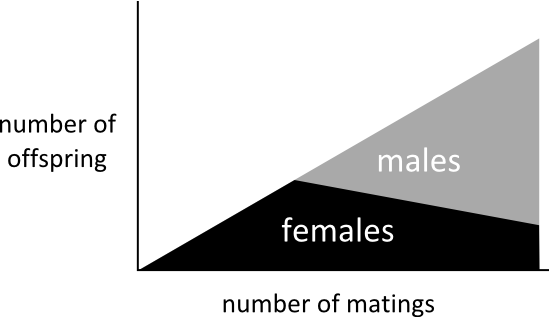
In my little sketch of this sexual conflict I've suggested females actually decrease the number of offspring they produce with each mating after some optimal point. That's with good reason, as mating almost always comes at some cost. The examples from species with sexual conflicts can be gruesome; male bedbugs exclusively inseminate females by puncturing their abdomen with a hypodermic penis, some male water striders will attract the attention of predators unitl would-be mates yield to their advances, and ducks, well, Carl Zimmer has said enough about the ducks. There doesn't seem to be anything quite as unsavoury going on with these snails, but Joannesson and colleagues were able to show mating still comes at a cost. Inter-tidal creatures are always at risk of being washed off their rocks. Enough rough periwinkle lives have been lost to the waves that all around the world L. saxatilis populations have evolved into two distinct morphological types, a form with a large muscular foot capable of tightly gripping rocks dominates low on the shore while a less muscular form lives higher on the beach. Since a mating couple presents twice as much surface area to an incoming wave, you might expect mating increases the chance a periwinkle gets swept from the rocks. To test this idea researchers got crafty. Literally. They broke out the hot glue guns and stuck empty shells on to females and saw what happened. They showed that periwinkles sporting an extra shell were more likely to fall off a platform dragged underwater in a laboratory tank and less likely to survive in the wild.
L. saxatilis populations are often very dense (around 200 snails per square metre in this study) so females don't have to go out of their way to provision their eggs with sperm and, given the cost of mating, it's in their interest to dissuade males as much as possible. So how do they do it? In general, snails seek out other snails by following chemical cues in the trail of mucous they leave behind them. Periwinkles males in particular have been shown to follow female trails when they are on the lookout for a mate, so there must be some clue in the mucous that marks it as belonging to a female. To see how L. saxatilis males do at finding females the researchers collected populations of this species, and three other periwinkle species that live in much sparser populations on Swedish beaches. They then filmed these captive snails moving about in the laboratory and totaled up this distance each male covered in following female and male trails. By comparing L. saxatilis males' tracking ability with males from these other species the researchers could isolate the effects of the sexual conflict in L. saxatalis . These other species have sparser populations and different mating systems, which mean females are less likely to achieve the optimal number of matings and sexual conflict is less likely to arise. Here's what they found.
Each point in these charts is the result recorded from one male, the position of the point depends on this distance he covered following male trails (the y- or vertical axis) and the distance covered following female trails (the x- or horizontal axis). So, in the first chart the majority of males spend the majority of their time following female trails and one crawled to the beat of his own drum and followed male trails to the tune of 400 millimetres without showing the slightest interest in females at all. The same overall patter, males following female trails significantly more often than male trails, is repeated in each of the other species (charts 'a' through 'c') but not in L. saxatilis. Male L. saxatilis don't seem to be able to pick male and female trails, even when a different population was subjected to the test (so it's not a local effect in the Swedish snails) and when they were given an hour to get sniffing. So what's going on? Are females deliberately putting pesky males of their scent, or do males in such a densely packed species just not have to bother with tracking females? As the authors point out, the latter seems unlikely since the males' inability to pick female trails leads to an unusually large number of male-male couplings in the wild. Time spent tracking and mounting a male is time that could be spent in search of a female. So, even in a dense population, it's in a males' interest to be able to tell the difference between male and female trails. To put it to the test, the researchers ran one more test. This time the L. saxatilis males were observed among females from another species (the flat periwinkle L . fabalis). In this test, even with the species gap, the L. saxatilis males have no trouble picking out females:
So, given the chance, L. saxatilis males can find female trails but it seems female L. saxatilis aren't giving them the chance. By smelling like males these females reduce the burden of unwanted matings and frequently set males up on accidental male-male couplings
Johannesson, K., Saltin, S., Duranovic, I., Havenhand, J., & Jonsson, P. (2010). Indiscriminate Males: Mating Behaviour of a Marine Snail Compromised by a Sexual Conflict? PLoS ONE, 5 (8) DOI: 10.1371/journal.pone.0012005
Labels: evolution, research blogging, sci-blogs, sexual conflict, snails

Sunday, August 29, 2010
Sunday Spinelessness - New Zealand's GIANT Sprintgtails
I know, a couple of week it was multiple exclamation points, then a reference to lyrics from a band anyone who is remotely cool is trying to forget they ever liked and this week it's all caps all the way. Hopefully, by the end of this post you'll agree that, this time at least, the subject left me with no option.
I missed out a little fact about peripatus when I wrote about them the other day: Dunedin is full of them. There is even a local endemic species which appears to be restricted to one patch of "bush" which is little more than a road-side paddock. So, before I wrote that post I went on a little excursion to another reserve that I know has peripatus in the hope I'd find something to illustrate my ravings. I didn't uncover any of those wonderful animals, but what I did find was every bit as cool:
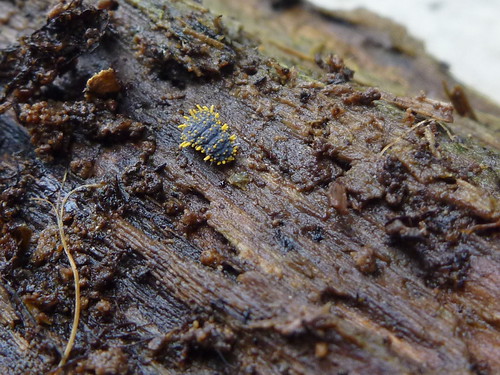
The little grey-blue thing with the bright yellow spikes is Holacanthella paucispinosa, one of New Zealand's giant springtails. Are you amazed yet? Perhaps you need to know a little more about normal springails before you can appreciate the quiet grandeur of the giants.
I've writen about springtails (also known as Collembola) before, but they're animals that are worth two takes. Springtails are small, six legged arthropods which live mainly in the soil and leaf litter and such moist habitats. This might be the first time you've heard of them, but they've been around you for your whole life. They live on every continent (including Antarctica) and there are as many as 100 000 of them in your average square metre of soil. If you were to go outisde now and pick up a clump of soil from your garden or your lawn you'd almost certainly see a bunch of tiny elongate or globular creatures crawling around and, a few seconds later, vaulting off into the air. That bouncy behavior is achieved with an organ that is neither a spring nor a tail. It's called the furcula (meaning "little fork") an it is held under tension under the abdomen. When a springtail senses danger it can release the furcula, driving it into the ground and flinging the animal away from the threat.
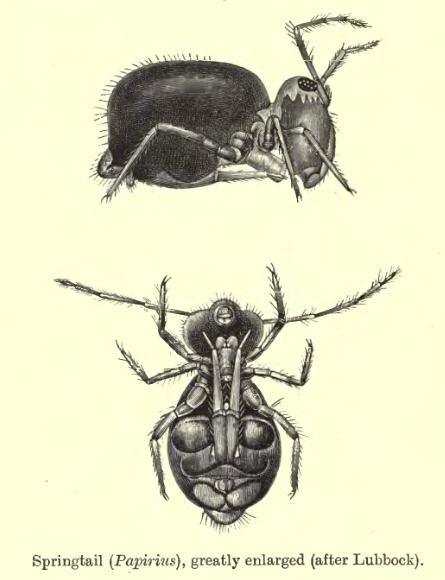
Drawing of a springtail from a British National History Museum display, the furcula is the fork-like organ on the underside of the animal
When they aren't flinging themselves around at random, springtails are playing an important role in the health of the soil. They contribute to the breaking down of organic matter themselves, and, at least as importantly, they move spores from mycorrhizal fungi from plant to plant. Mycorrhza are among the most important organisms on earth. They live on the roots of plants, where they help process soil minerals for their host in exchange for a more or less constant flow of sugars for the plant's photosysthesis. Almost all plant species have Mycorrhzal relationships, and the fungi are key players of the productivity of ecological and agricultural plantations. These two important jobs make springtails a major contributor to nutrient cycling in the soil. Given their enormous abundance and important jobs you might wonder why you don't hear a bit more about springtails. Well, most springtails are really, really small. To prove the point, I've just popped outside and pulled a brick from a retaining wall in our garden (it's OK, the giant clay back stayed up):
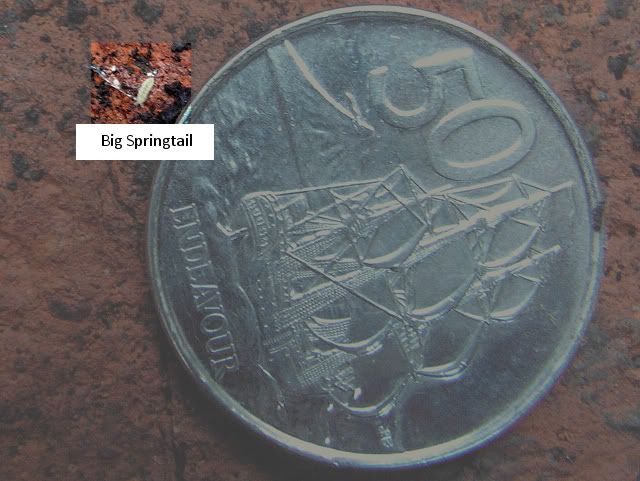
The tiny white thing in the upper left is a pretty big springtail (for North American readers, a New Zealand 50 cent coin is almost exactly the same size as a quarter). I didn't think to add something to provide scale in the H. paucispinosa photos, but that springtail would happily cover the "50" on the coin. H. paucispinosa's big cousin from up north, H. duospinosa, would cover a good deal more than half the diameter of the coin.
New Zealand has a fair few giant invertebrates. Every time I introduce myself as someone who studies snails I get asked about the giant carnivorous Powelliphanta (I study small snails that eat plants and are generally considered less cool). Then there's flax snails, weta, the glorious giant bush dragonfly (kapokapowai) and a one and a half metre long long earthworm. The Holacanthella usually get missed off the list of New Zealand giant invertebrates, even though they are many times larger than most of their relatives. I've done my bit in trying to fix that. These are the springtails I mentioned spending a summer looking for in my previous post. I did a summer studentship with Mark Stevens from Allan Wlison Centre in which we collected new samples from all over the country to get a gauge on just where they live and how they are doing. We published some of our results in the New Zealand Journal of Zoology .

As you might have guessed from our paper's venue, we didn't present any earth shattering new results. Instead, we laid the ground for anyone that wanted to do some more detailed studies of these creatures. We looked at all the currently described species in museum collections (Te Papa has pictures of two of the type specimens online) and in our new specimens and found that the existing key, the algorithm by which someone can identify a specimen to a species, didn't quite work. Some of the characters that were meant to diagnose species were found in some individuals of all species So we updated the keys, and presented updated data on the distribution of each species (there were only 18 locality records published when we started). Together, these results might form the basis of further studies.
The distirbution of giant springtail species and populations might be particularly interesting, since they are reliant on rotting hardwood logs for life and don't appear to able to disperse over any great distance. This lack of dispersal ability might mean that genetic relationships between Holacanthella populations might bare the mark of ancient geological and climatic events which have been overwritten in more dispersive animals. The Holacanthella's Australian cousin, the Acanthanura (which it's my patriotic duty to point our aren't quite as big as our giants.) have been used to infer small patches of forest that survived the last ice age. Their reliance on hardwood also makes the New Zealand's giant springtails interesting from a conservation point of view. We spent a lot of the summer in Wellington's hills looking for H. spinosa which was recorded all around the city at the turn of the 20th century. Most of those forests have been logged, and, though there is plenty of regenerating native bush around Wellington, H. spinosa didn't seem to survive the logging. By contrast, managed forests around Nelson and the Tongariro National Park had species-rich and dense population. It seems the giant springtails are particularly susceptible to changes in their forests. In fact, we even suggested that the presence of giant sprintails in a forest patch can be used as a marker for forest health ("canaries in the undergrowth"), in which case the City Council should be pleased to learn they are living in the little forest fragment I found these guys in!
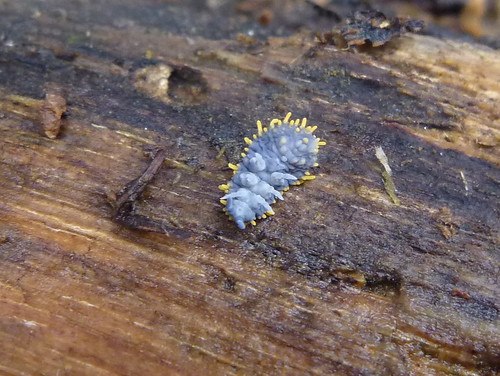
Too big to flail: Giant springtails are too massive to fling themselves about, so they've lost their furcula
I'm sure there are people think that our little paper on these creatures forms part of the "avalanche of low quality research" that is ruining everything for everyone. But, I can't tell you how many fascinating talks I heard at the Evolution meetings about the apple maggot fly, the three spined stickleback and the wild monkey flower. None of those creatures are any more likely an imoprtant model for evolutoinary biology than there names suggest, the only reason it became apparent that they represent important natural experiments is because people did the ground work, worked out a little about these species and published it in a small journal. There will probably never be a Nature paper out New Zealand's GIANT springtails, but you can't know that before you do the research!
Oh, I guess I should answer the most common question I get about these guys: I have no idea why they are covered in spikes.
Steens, M., Winter, D., Morris, R., McCartney, J., & Greenslade, P. (2007). New Zealand's giant Collembola: New information on distribution and morphology for Holacanthella Borner, 1906 (Neanuridae: Uchidanurinae) New Zealand Journal of Zoology, 34 (1), 63-78 DOI: 10.1080/03014220709510065
Labels: collembola, environment and ecology, Holacanthella, my research, photos, research blogging, sci-blogs, sunday spinelessness
Thursday, July 29, 2010
The First New Zealanders and their rats
Crispin Jago has made a very cool thing, a periodic table of irrational nonsense. Rolling my eyes over the groups, wondering how people can believe some of these things, made me think about New Zealand's unique ecosystem of kooky ideas. We don't have to suffer creationists in any organised sense and I don't think anyone is too into ear candelling, but those TV psychics have found themselves a niche to exploit and most people seem think chiropratric and homeopathy are normal parts of medicine. Then I was reminded about our very own, home grown cranks. There are people who believe that New Zealand was settled by Celts several hundred years before it was discovered by the ancestors of modern Māori. It probably goes without saying that these people are nuts, but the idea of a pre-Māori civilization in New Zealand is one of our culture's enduring myths. It's worth talking about why people who are serious about studying our country's prehistory have discarded it.
People coming to this question for the first time my want a little bit of background. The settlement of the Pacific is one of the most interesting stories in our species' history. I did the field work for my PhD (on landsnails, and not people) in the Cook Islands and you get a feel for the enormity of that achievement when you travel around that group. To fly from one island to another you walk out across the tarmac and meet your pilot, who is almost invariably sitting on the steps to his 12 seater plane, reading the paper through massive aviator glasses. Once you're safetly stowed you get your safety briefing ("it's gonna be pretty fine all the way, should be a good flight") and you take off. The pilots don't close the door to the cockpit, so you can see out the windscreen, but all you see is ocean and sky. You can fly for an hour without seeing land in front of you or out your window. Then an island looms. A few minutes later you land, and, even among the Cook Islands, you're in a new culture. The Polynesian people who discovered and settled these tiny islands separated by such vast distances were master navigators. Without metal tools or written records, let alone maps and compasses, they very deliberately settled islands (taking livestock and crops with them), maintained trading relationships between island groups and almost certainly made it to South America (very likely beating Columbus in the process).
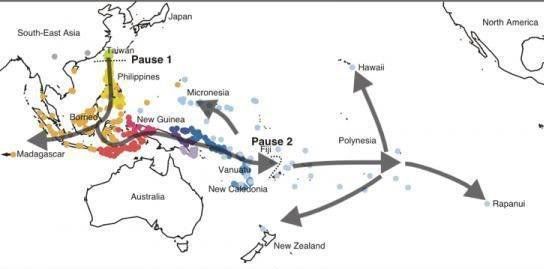
Schematic of the settlement of the Pacfic (this one is taken from a study of the evolution of Austronesian languages)
The "mainstream" view on the settlement of New Zealand fits nicely into what's known about the settlement of the Pacific. There is good evidence that the bulk of Polynesia was settled in a stepwise fashion, moving west to east with the prevailing winds. Eastern Polynesia was settled by about 800 AD. The far reaches reaches of Polynesian - Hawai'i, Rapanui and New Zealand would require a different pattern of migration (upwind, or over vast distances) and remained, with Antartica, as the last uninhabited lands on earth for hundreds of years.
The first evidence for humanity in the New Zealand archeological record comes from the Wairau bar, where artifacts similar to those from contemporaneous sites in the Society Islands and the Southern Cooks have been dated to about 1280 AD. At the same time the pollen record shows New Zealand's first wide scale deforestation, trees being replaced by bracken, scrub and charcoal. A few hundred years later the much sparser record of sub-fossil animals shows its first mega-faunal extinctions. Combined with evidence for "sattelite" settlements in the Kermadec islands (on the edge of the tropical Pacfic) you have exactly the pattern of evidence you'd expect to see with the settlement of islands as remote as Te Wai Pounamu and Te Ika a Māui - settlement as an extension of an ongoing process with clear evidence for human impacts starting from a date that makes sense in that framework
Compare that with the Celtic NZ people. The idea of Celts arriving in New Zealand without leaving any real evidence of their presence anywhere else outside of Europe hardly needs talking about. When we look within New Zealand, almost all the evidence supposed to support a pre-Maori celtic civilization amounts to big rocks that form, if you just imagine they used to be arranged slightly differently, a giant surveying network. Or astronomical observatories. Proponents of the Celtic NZ hypothesis spend very little time trying to find any evidence for the populations that must have lived, died, eaten, built, dug, farmed, and buried their dead in New Zealand to support these mad priests' plans to move megaliths across the country. And when they do the results are less are less than convincing
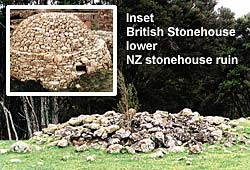
By all accounts they treat the historical method with about as much respect as the scientific one, so academics don't take them very seriously. In fact, you'd think these claims are so kooky that there was really no need to rebut them. Sadly, the Celtic NZ people seem to have convinced at least a few people that they are on to something. I'm sure part of the reason for that is New Zealanders were once taught that the ancestors of modern Māori did meet another people when they came to New Zealand.Up untill about the 1960s school textbooks said the Moriori were a Melanesian people that were driven off the New Zealand mainland by Māori, with a few survivors taking refuge on the Chatham Islands (called Rekohu in their language). That idea had been rejected by every scholar who's addressed it since the 1920s because it's clear that the Moriori descended from mainland Māori and the unique aspects of their culture were acquired during their subsequent isolation. Part of the reason the Moriori myth came about in the first place is that it fitted into a Victorian narritive view of history - a chain of never ending progress It was only right that Moriori hunter-gatherers were replaced my the adventurous and noble Māori, just as the advanced British settlers would in turn assimilate the Māori. We might have given up that story, but the Moriori myth is still tied to politics in New Zealand. For people who think the New Zealand government shouldn't make reparations for its breaches of the Treaty of Waitangi the idea that Maori themselves were once colonisers looks like a get out of jail free card. Russell Brown quoted one example in 2004:
Leaders and academics that hark back to the pre-European days of Maori domination of New Zealand have driven this opportunism. They appear to conveniently forget that Maori violently conquered the Moriori, the original settlers, and their claims of tangata whenua status and demands for compensation for historical grievances appear to many to be ill informed.
Archaeologists agree that humans first settled in New Zealand well over 1,000 years before the main Maori migration, which is estimated to have arrived around 1200 AD. Their evidence is based on the exhaustive forensic examination of historic plant and animal remains. They believe that the settlement of New Zealand was most likely a continuous process, a view that is certainly consistent with early settler journal accounts (from the proceedings of the Royal Society of New Zealand) which indicate that not only did Moriori precede Maori, but that when they arrived in the Chatham Islands, “they found the country in the possession of aboriginal natives called Hiti”- inhabitants of the “Flint age”, who used not stone, but “chips of obsidian as cutting implements.” There is also strong evidence of an early presence of people of Celtic and Chinese ancestry as well as Greek, French, Portuguese, Spanish and others - in addition to settlers of Polynesian descent.
Breathtaking. But perhaps the most amazing bit of that bizarre paragraph is that somewhere, deep under the layers of crazy, there is just a little science peaking through. We've already seen that archeologists don't agree that New Zealand was settled a thousand years before the Māori arrived. But there has been one little hint among the prehistoric "plant and animal remains" that humans might have got to New Zealand before the people that lived at Wairau Bar. Old Rat bones.
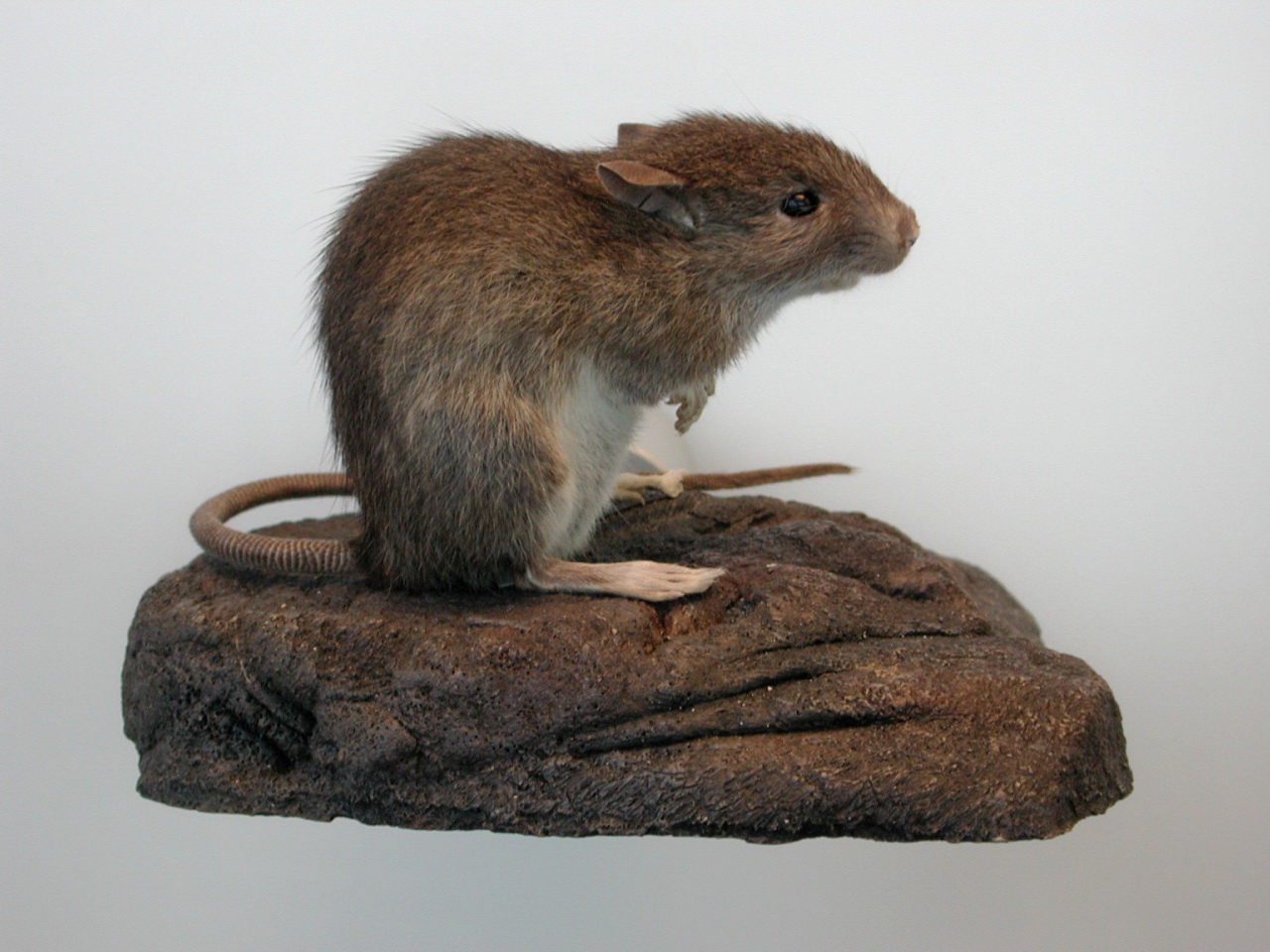
A Pacfic rat, image is CC 2.0 thanks to wikipedia user Tolter Alter Man
The Pacific rat (Rattus exulans or the kiore) is native to South East Asia and Melanesia, but it can be found everywhere Polynesian people visited. The kiore isn't much of a swimmer so the presence of R. exulans bones on an island is unambiguous evidence for human contact. In 1996 Richard Holdaway published the first radiocarbon dates for kiore bones in New Zealand, and they were surprising. Holdaway published dates for 18 bones and all but two of them were older that the first archeological evidence for humans (at 1280 AD) and some of them dated to around 10 AD. Quite how the presence of the Pacific rat in New Zealand in 10 AD gives support to the wild claims of people like Newman or the Celtic NZ crowd I can't imagine, but those results did fuel a genuine scientific controversy. Why were there rats in New Zealand almost a thousand years before there is any evidence for humans? At the time there were three answers; Holdaway himself argued that the bones were evidence that humans had visited New Zealand but either left immediately or failed to establish themselves, a few archeologists held that the bones were evidence the ancestors of Maori arrived in New Zealand a long time ago but didn't leave a mark until they adapted to the colder climate, and others said the dates must just be wrong.
Atholl Anderson dedicated a lot of time to testing the reliability of radiocarbon dates from kiore bones. The bones Holdaway had used to establish the antiquity of New Zealand's rats had come for so called "natural" sites, most notably laughing owl nests and caves, which offer little in the way of corroboratory evidence for the ages estimated from the rat bones. In contrast, Anderson focused on archeological sites (those associated with human habitation) which provide plenty of contemporaneous material to set the dates determined for rat bones in context. Anderson did indeed find the dates determined from rat bones often differed greatly to those determined from the contents of the same midden. They even found bones from well studied archeological sites that were estimated to be thousands of years older than the site! Clearly, there's something odd about those dates. The real smoking gun for the "old rats" hypothesis came when Anderson looked at the relationship between the age estimated for a bone and the date of the labwork done to determine that age. Almost all the bones measured before 1997 were older than that magic mark at 1280 AD, and every single bone measured at the same facility since 1997 was younger (or at least, the error bars cross that date):
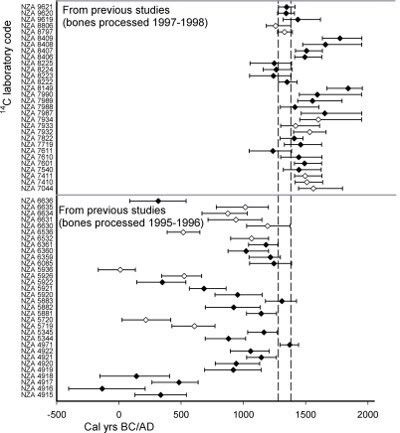
Dates estimated from rats fall into two distinct groups, depending on when they were analysed. From Wilmshust et al (2008) cited below
There is no reason to think the real age of the kiore bones sampled over time will fall into two such distinct classes (it's not as if the oldest bones will be the easiest to get to) and it's easy to bias the date estimated by carbon dating by failing to prepare the bones properly (or by introducing contamination in the lab) so it looks like the surprising results Holdaway reported where actually a lab error which has since been taken care of. It's (barely) conceivable that originally published dates were right, and that the Anderson's archeological sites were biased in some particular way, but that hypothesis really doesn't make sense given what we now know about the settlement of the Pacific. It's widely accepted that Eastern Polynesian wasn't settled until about 800 AD, meaning any earlier rats in New Zealand would have had to come from visitors from the Western Pacific. That's against the main direction of settlement, but, more tellingly, genetic evidence has established that modern kiore in New Zealand come from Eastern Polynesia. Kiore also make their first mark on New Zealand's faunal record around 1300 AD, when Plactostylus landsnails with gnawed shells show up for the first time. If you want to believe rats were in New Zealand 2000 years ago you also have to believe the first bones to be carbon dated were the oldest, dates estimated from archeological bones are more unreliable than those for bones sourced from "natural" sites and that those old rats left not descendants in modern New Zealand populations and left no mark on the New Zealand faunal record until just after Polyneisian settlement of New Zealand.
You might be wondering why someone hasn't just gone back an re-analysed the bones that made for Holdaway's original surprising results. Radiocarbon dating is a destructive process and rat bones are small, so, apparently there isn't enough bone from the original samples to re-determine their age. Recently, a team from Landcare Research and lead by Janet Wilmshurst did the next best thing, and went back to sites that gave up the apparently old rat bones and re-excavated them. I'm sure you can guess what they found, none of the bones had a pre-1280 AD date. But they didn't just look at rat bones. The subfossil record of plants is almost always more finely grained than animal records. Every year plants put out millions of seeds and pollen grains, some of which are recorded in pits and lake beds and soil horizons. The Landcare team took advantage of this high resolution record to look for the first appearance of distinctively rat-gnawed seeds, and they found them after 1280 AD, but earlier than the oldest rat bones. Importantly, some of the deposits with relatively old rat-gnawed seeds contain much older seeds, with no evidence of rats. The team plans to go on an use this high-resolution record to establish the dates of settlement for other Pacfic islands.
The sort of people who think the presence of the Pacific rat in New Zealand would be evidence for a pre-Maori Celtic population aren't likely to let evidence get in the way of their stories. They already think the entire New Zealand acadame is par of a grand conspiracty (they've apparently never tried to organise a meeting between three academics let alone pull of a conspiracy among them...). But hopefully the long story of the first New Zealanders and their rats, only summarised above, and the kinds of evidence scientists use to test their ideas will help to make it clear what such "alternative" archeologists lose when they turn their backs on established methods
This post got way longer than I thouhgt it would, and I'm emdebted to a lot of excellent source on the web to get me up to speed on the subject.
Scott Hamilton and Matthew Dentith have written extensively about the Celtic NZ crowd and Te Ara has a nice article on historical ideas on of the orign of Māori (check out the galleries in particular to get an idea of European attitudes at different times)
The orignal paper with the old dates is:
- Holdaway, R. (1996). Arrival of rats in New Zealand Nature, 384 (6606), 225-226 DOI: 10.1038/
- Anderson, A (2000). Differential reliability of 14C AMS ages of Rattus exulans bone gelatin in south Pacific prehistory Journal of the Royal Society of New Zealand, 30 (3)
- Wilmshurst, J., Anderson, A., Higham, T., & Worthy, T. (2008). Dating the late prehistoric dispersal of Polynesians to New Zealand using the commensal Pacific rat Proceedings of the National Academy of Sciences, 105 (22), 7676-7680 DOI: 10.1073/pnas.0801507105
Labels: Anthropology, Cook Islands, history of science, Maori, Pacific, Polynesia, research blogging, sci-blogs, science
Tuesday, June 8, 2010
If some of us have Neanderthal genes, are Neanderthals us?
 I got a little bit starry eyed writing about the Neanderthal genome the other day. I chose to retrace the arc of scientific progress that links the initial description of Neanderthal man as something different than modern humans to the point reached last month, where we are able to tag some of those differences to a single gene. Most of the news stories about the Neanderthal genome focused not on the genes that made us different from them, but a small percentage of the genome that reinforced the continuity been them and us. Genetic evidence that Neanderthals interbred with the ancestors of some modern humans. The revelation of these ancient assignations has caused some quite sensible people to say some quite silly things about what species are and what Neanderthals were. So, perhaps I can compliment my slightly hazy earlier piece with a more hardheaded take on why Neanderthals remain a species unto themselves.
Let's start with the evidence that Neanderthals interbred with the ancestors of modern humans. Modern humans (Homo sapiens) arose in Africa about two hundred thousand years ago, all modern human populations outside of Africa descend from a relatively small number of migrants who left that continent between eighty and fifty thousand years ago. When those migrants first left Africa and entered the Middle East they would have met other humans. The ancestors of the Neanderthal had moved out of Africa and established themselves in Europe and Central Asia thousands of years before. Until now we haven't known which of the four 'F's (fighting, fleeing, feeding or reproduction) followed that first contact, the Neanderthal genome has given us a clue.
When you compare individual DNA bases that are variable within modern human genomes to the corresponding sequences in the Neanderthal genome you find that non-African sequences match the Neanderthal sequence slightly (but significantly) more often than African sequences do. It's possible that this pattern is an artifact of our poor sampling of African genomic diversity (that observant nerd Christie does a good job of explaining how here) but for the sake of argument let's take it for granted that his pattern is the result of ancient interbreeding. The authors of the paper describing the Neanderthal genome estimate people with no recent African ancestry inherited between one and four percent of their genome from Neanderthals. That number is the same for Papuan and East Asian populations as it is for Europeans despite Neanderthals having lived alongside Europeans for thousands of years, suggesting any interbreeding that contributed to modern human genomes was limited to that first period of contact.
This is where the problems start. Having heard the news that Neanderthals and some of our ancestors might have once swapped genes some people remember that nice easy test of species-status from high-school biology. Something like "if two animals can interbreed then they're part the same species." So, are we Neanderthals; or are Neanderthals us? No. In fact, the Neanderthal genome serves to highlight some the mistakes we commonly make when start trying to define species.
Biologists have spent a lot of time arguing about just what a species is and how can delimit species from the creatures that we study, too often we've forgotten that those are two different arguments. DeLene from Wild Muse has a thoughtful overview of some of the factors that contribute to the "species problem" in her review of Jody Hey's book on the same topic. You should read her piece because the species problem really is a fascinating philosophical question, but I think most of the fights that erupt around competing definitions of species come from a failure to understand that defining species and organising critters into species are two different tasks. We've been studying speciation, the process by which new species arise, for a while now and we've developed a pretty good idea of how it works. Two populations stop interbreeding with each other, during that period of "reproductive isolation" genetic changes in one population can't effect the other so natural selection and random changes (called genetic drift) change each population independently. Species are populations which are on independent evolutionary trajectories.
Reproductive isolation drives the independence that is at the heart of what species are, but it's not the sine qua non of a species. James Mallet from University College London has made a special study of hybridisation, and he reckons 10% of animal species and a whopping 25% of plants interbreed with other species from time to time. As molecular tools have been applied to non-model organisms it's become increasingly clear that the "species barrier" is more porous than we'd thought, and species can maintain their independence even in the face of the occasional injection of genes from other species.(If you're interested in the wider question, I've written a bit on the species problem here. The short version is we should see competing "species concepts" as operational tools that might be used to help delimit species, but not as definitions).
Now, think about the results from Neanderthal genome. Most sequences in that genome are separated from their human counterpart by a split that happened over five hundred thousand years ago. There is pretty good evidence that Neanderthals and the ancestors of non-Africans interbred when they met each other in the Middle East about four hundred and fifty thousand years after that initial split. That gene flow had the potential to homogenise the two populations into one, but it didn't. Each lineage maintained its identity. For the twenty or so thousand years that Neanderthals continued to exist they retained identifiable morphological traits. There are fossils in Europe that some argue show a mixture of characters, but any interbreeding in that continent left no mark on modern European genomes, which have no more Neanderthal DNA than Papuan and Chinese genomes do. At the same time, the authors didn't detect any flow of modern human genes into Neanderthal genomes (so it's not a case of of modern humans swamping Neanderthal populations and erasing any trace of genetic admixture in the process). The available evidence seems to point o Neanderthals and modern humans as separately evolving populations, and a little bit of gene flow between them wasn't enough to upset that pattern.
I should stress, by saying H. neanderthalensis and H. sapiens are different species we aren't saying very much about how different Neanderthals were from us. Species are not defined by a degree of difference, or an essence that was missing in Neanderthals but is present in us, they're just another human population that was moving in a different direction (and eventually extinction). If some of us do have Neanderthal genes, then it only goes to show how fuzzy the line between our species and the rest of the biological world is.
Green RE, and many, many others (2010). A draft sequence of the Neandertal genome. Science (New York, N.Y.), 328 (5979), 710-22 PMID: 20448178
James Mallet's bit on the frequency of hybridisation is taken form here: Mallet, J. (2005). Hybridization as an invasion of the genome Trends in Ecology & Evolution, 20 (5), 229-237 DOI: 10.1016/j.tree.2005.02.010
The ideas about species and species delimitation presented above are pretty similar to Kevin de Quieroz's take:
De Queiroz, K. (2007). Species Concepts and Species Delimitation Systematic Biology, 56 (6), 879-886 DOI: 10.1080/10635150701701083
Labels: evolution, genetics, genomics, Human evolution, human genome, might interest someone, neanderthals, research blogging, sci-blogs, science
Friday, February 26, 2010
Nucleotide diversity - what two new African genomes mean
As I've said before there really is no such thing as the human genome. There are millions of differences between individual genomes and we are each born with about 150 new muations. In an age in which we can sequence assemble and analyse entire genomes in two years understanding the breadth of human genetic diversity is at last an achievable goal and if you want to understand human diversity then you need to look to where we came from. Trace any family tree back far enough and you will end up in Africa and, in fact, most of human history was played out entirely in that continent. Modern humans arose in Africa about 250 000 years ago and only spread out to Europe and the rest of the world in the last 60 000 years, displacing Homo erectus in the process. The migrants that founded the modern European, Asian and American populations would have carried with them only fraction of humanity's genetic diversity when they left Africa but untill recently genomics has focused on those populations. Until last week the two African genome sequences available to researchers were both from Yoruban volunteers to the hapmap project. Although those sequences are very useful they represent only one tip in the deeply branching tree of humanity
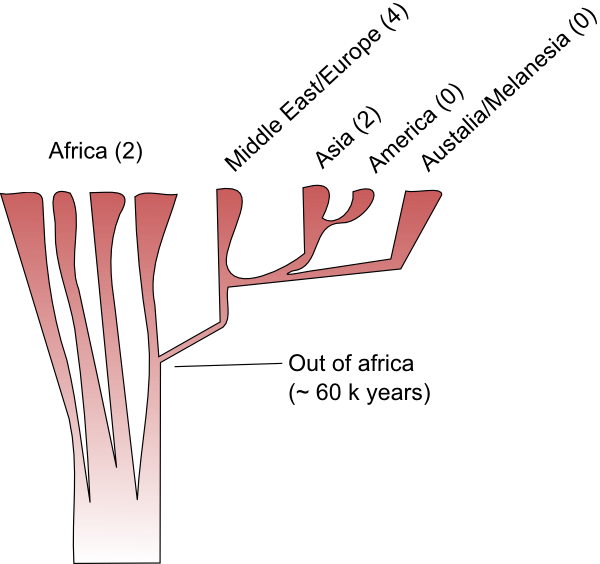
To broaden our understanding of African genomes Schuster et al looked to the South of the continent and at two people in particular. !Gubi is a Khoisan (or bushman), a member of a one of the earliest diverging groups within the humanity while Desmond Tutu hails for various Bantu peoples. The results taken from theses genomes along with lower density sequencing and genotyping of other Bantu and Khoisan volunteers reinforces just how much genetic diversity exists within Afirca. By using a method called principle component analysis to reduce a the correlations among millions of single base pair differences (single nucleotide polymorphisms or SNPs) to a smaller set of uncorrelated vectors you can see patterns in the genetic diversity of groups. Applying this method to West African (Bantu and Yoruba), Khoisan and European populations reveals the comparative genetic homogeneity within Europeans and that the difference between the two African groups is comparable to that between either of them an Europeans.
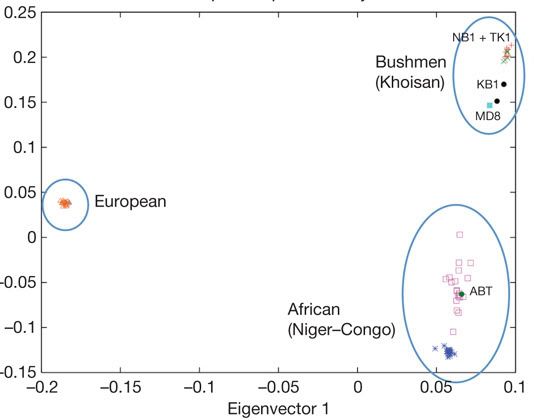
The paper is available to under a creative commons license here and if you feel suitably qualified you can play with their data which has been released on the Galaxy framework.
Labels: evolution, genetics, genomics, Human evolution, human genome, research blogging, sci-blogs, science
You have to be in to win...
 So, in a fit of egotism and optimism I nominated myself (and a bunch of other people) for the Research Blogging Awards - putting myself forward in the category of "Best Lay-Level Blog". The finalists were announced today and it seems I made the list. Apparently in the next stage researchblogging.org members vote for their favourite blogs in each catergory. I think it's safe to say I'll be out of the running once voting starts but I'm really quite chuffed and... damn it I'm just gonna say it... it's an honour just to be nominated among real writers lie Brian Switek of Laelaps and Ed Yong of Not Exactly Rocket Science and the bloggers behind The Lay Scientist, Observations of a Nerd, Mauka to Makai and Cancer Research UK's blog.
Labels: blog blogging, might interest someone, research blogging, sci-blogs

All content not otherwise marked is licensed under a Creative Commons Attribution-ShareAlike 3.0 Unported License.


