
Sunday, February 17, 2013
Sunday Spinelessness - Mostly True Facts about land snails
It's a pretty good link too. Ze Frank's "True Facts" series of zoological oddities has finally got to the best creatures on earth, land snails:
Pretty much everything Frank says about snail mating is true so, laptop permitting, I'll use next week's post to expand on how anatomy and behaviour have co-evolved to give us produce these mating habits, and how they effect evolutionary processes in land snail populations.
Labels: land snails, sci-blogs, snails, sunday spinelessness

Sunday, July 22, 2012
Sunday Spinelessness - New Zealand microsnails
The local land snail fauna displays a pattern that is quite common for New Zealand animals - we have a very large number of species but those species are drawn from relatively few taxonomic families. Since taxonomic groups reflect the evolutionary history of the species they contain, that pattern most likely arises because New Zealand is (a) quite hard to get to, so few would-be colonists make it here and (b) full of ecological niches and geographic pockets that can drive the formation of new species. In total, there are are probably about 1200 native land snail species in New Zealand - about ten times the number found in Great Britain, which is approximately the same size. That diversity extends to the finest scales - individual sites in native forest might have as many as 60 species sharing the habitat. New Zealand forests probably have the most diverse land snails assemblages in the world (although tropical ecologists, who generally hold that diversity in terrestrial habitats almost invariably increases as you approach the equator, have argued against this conclusion).
You may now be asking why, if this land snail fauna is so diverse, have you never seen a native snail. Well, you've probably walked past thousands of them without noticing. Most of our native land snail species are from the families Punctidae and Charopidae, groups that are sometimes given the common name "dot snails". Meembers of these families are usually smaller than 5 mm across the shell, and are restricted to native forest and in particular to leaf litter. But in native forests, where there's leaf litter there's snails. Grab a handful of leaves, or pull up a log and you're likely to find a few tiny flat-spired snails going about their business. Hell, down here in Dunedin you can even find charopids living under tree-fuschia in a suburban garden.
Like so many native invertebrates, we know very little about our land snails. Lots of people have dedicated substantial parts of their lives to documenting and describing the diversity of these creatures, but even so we don't have a clear understanding of how the native species relate to each other or to their relatives in the rest of the world, or even where one species starts and another ends. Without such a basic understanding, its very hard to ask evolutionary and ecological questions about these species, so for now we remain largely ignorant of the forces that have created the New Zealand land snail fauna.
For the time being I can tell you that a lot of them are really quite beautiful. Since most people don't have handy access to a microscope to see these critters, I thought I would share a few photos from this largely neglected group over the next few weeks. The 2D photographs, with the relatively fine depth of field, don't quite record the beauty of these 3D shells, but I hope it's at least a window into the diversity of these snails.
Let's start with a snail that is very common in Dunedin parks and forests. This is a species from the genus Cavellia (the strong, sine-shaped ribs being the giveaway) but I won't be able to place it to species until a new review of that genus is published.

This particular shell is from an immature specimen, and is about 2mm across. When flipped, you can see an open umbilicus that lets you see straight through to the apex of the shell.

Labels: molluscs, native snails, photos, sci-blogs, snails, sunday spinelessness
Sunday, June 17, 2012
Sunday Spineless - How some snails became red-blooded

The ghost Powelliphanta is a pretty cool snail, but there's actually an albino snail that's even more interesting. Every now and again a truly albino individual of the freshwater snail Biomphalaria glabrata pops up. Looking at these mutants we can learn something about the evolutionary history of the these snails:

Free from the pigments that would usually make shell opaque we can see the feature that sets Biomphalaria and other species form the family Planorbidae (ramshorn snails) apart from every other snail. The planorbids are the only red-blooded snails on earth. So why are these snails so different?
As we all know, in order to live animals need to get oxygen from their environment into their bodies. For small animals this doesn't represent a huge problem. Oxygen will flow form areas of high partial pressure (a concept analgous to concentration, but accounting for some of the weird ways gasses behave) to areas in which Oxygen is being used up. So, for instance, most insects pull air directly into their bodies with a set of open tubes (called tracheae). Once the air makes it into those tubes oxygen will passively diffuse into the insect's tissues.
Big animals have a much bigger problem*. Not only do larger animals need much more oxygen to fuel their bodies, they also have to actively transport that Oxygen because the distances it is required to travel can't be achieved by passive diffusion. Lungs and gills are both organs dedicated to pumping more oxygen into animal bodies, and many animals use blood, and special proteins dissolved in blood, to move oxygen about.
In vertebrates the oxygen-carrying protein is called hemoglobin. Very simply, a hemoglobin molecule is a cage used to hold iron atoms in such a way that they will bind to an oxygen atom. The iron containing group in the hemoglobin protein (called heme) gives our blood its red colour and its hemoglobin circulating through that snail's body that makes it red.
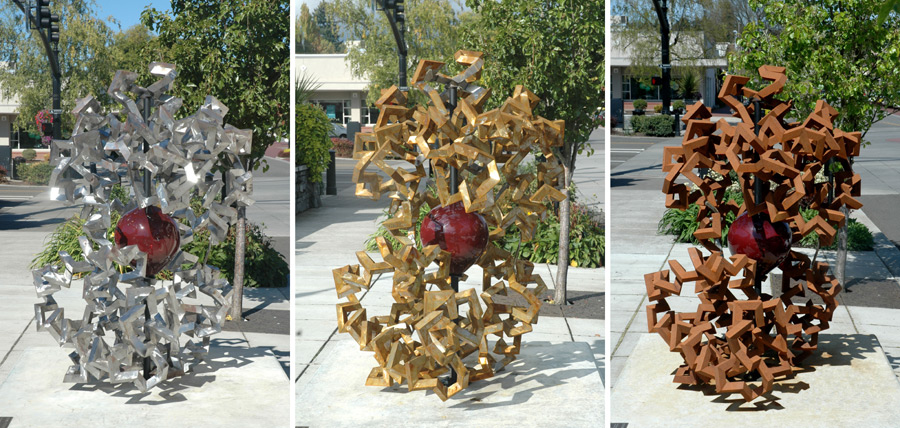
As with every problem life faces, invertebrates have come up with many more interesting ways to move oxygen around than their spined relatives. Annelids (earthworms and their kin), brachiapods and spoon worms have a whole set of iron-containing proteins to do the job. Even more interestingly, molluscs and some arthropods have a protein that uses Copper rather than Iron atoms to co-ordinate an oxygen molecule. This molecule, called hemocyanin, takes on a green-ish blue hue when oxygen binds to it and changes its conformation.
Most snails get through life fine with hemocyanin as the only oxygen-carrying molecule in their blood, so why have Biomphalaria and their cousins become red-blooded? Part of the reasons lies in their lifestyle. Planorbid snails breath with lungs (which only work in air) but live underwater. If you make your living by holding your breath while diving then you really want to have some way of holding on to as much of the oxygen you get form each breath for as long as possible. It seems that Biomphalaria hemoglobin is more efficient at using the oxygen stored in lungs while diving than any hemocyanin could be.
It's all well talking about why an animal might have evolved a particular trait. But in evolutionary biology it's generally much more intresting to try and work out how. How does an air-breathing snail make its own hemoglobin from scratch? A team lead by Bernhard Lieb asked just that question a few years ago, and found the answer: Biomphalaria hemoglobin was made by cobbling together parts of existing proteins. When Lieb et al (2006, doi: 10.1073/pnas.0601861103) isolated hemoglobin from red-blooded snails they found it was made up of two different components (called peptides), each of which has 13 different sub-components (called domains). When the team compared the sequence of those peptides and their domains to other molluscan proteins they found similarties between the hemoglobin sequences and another iron-containing protein called myoglobin.
Myoglobin is a small molecule that is usually restricted to muscles where is acts as a store of Oxygen (in snails, myoglobin is most commonly found in the muscles that drive the radula, the rasp like organ used to break down food). The Biomphalaria hemoglobin sequences are more closely related to each other than they are to myoglobins from any other species. This pattern suggests the sequences that make up the snail hemoglobin descend from a single common ancestor. Subsequent changes to each of these descendants have allowed the descendants proteins to group together and become "super myoglobins" capable of transporting oxygen through the body.
*The huge number of ways size matters in biology were wonderfully explained by JBS Haldane. I'd reproduce the most famous passage here, but it's probably even better if you discover it by yourself.
Labels: sci-blogs, snails, sunday spinelessness
Sunday, May 6, 2012
Sunday Spinelessness - Each thing by its right name
For a moment she rediscovered the purpose of her life. She was here on earth to grasp the meaning of its wild enchantment and to call each thing by its right name...
I've recently learned the name of two species that turned up on these pages unnamed. So, let me introdue you to Thalassohelix igniflua (last seen in "they're alive!"):


Labels: Dunedin, sci-blogs, snails, sunday spinelessness, taxonomy
Sunday, April 29, 2012
Sunday spinelessness - live-bearing land snails

This behaviour seems to be particular common in snails that live in rocky outcrops, and those that live in the tropics, especially the Pacific. I'm not sure about what species the snail depicted above fall into - but they are from the sub-family Microcystinae, which is one of the dominant groups of land snails in the Pacific and is made up entirely of live-bearing species. The large evolutionary radiations that used to live in Hawai'i and the Society Islands were also all live-bearers.
So why give birth to live young? It is easy to see why live-bearing is an advantage to snails living in rocky habitats with few places to deposit eggs. It's less clear why the Pacific is full of live-bearers. It has been suggested that tropical weather can lead to unpredictable patterns of boom and bust - with snails that can hold on to and grow their offspring in the bad times and release them "ready to go" when conditions are better having an advantage over egg-layers. As far as I know no one has ever come up with a way of testing that idea, so the reasons for the prevalence of live-bearers in the Pacific remains an open question.
Labels: photos, sci-blogs, science, snails, sunday spinelessness
Sunday, April 1, 2012
Sunday Spinelessness - A marsupial snail
Snail shells are beautiful. You don't need to know anything special about biology or maths to see that:
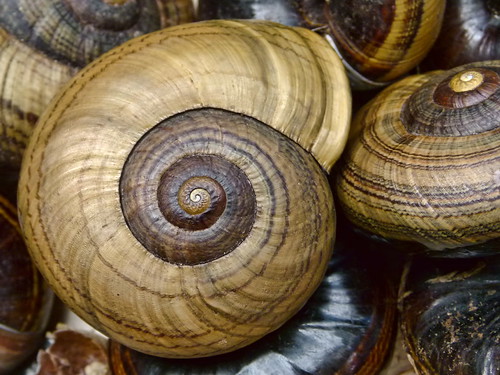
But, as is so often the case, the more you learn about snail shells the more beautiful they become. I'm not much of a mathematician. To be honest I find a lot of maths to be a horribly complex, and seemingly arbitrary, and I could never really follow it past basic algebra. Still, every now and again I'm struck by the beauty of a system that can explain parts of reality with such ease (and by envy for those who can see so much deeper than me). The mathematical description of snail shells is one of those cases in which the maths is easy enough for me to understand, and so I can appreciate the elegance.
The simplest way to model a snail's growth would be to say it adds its shell at a constant rate. In that case, we could know the size of a shell at any given time (x) using the exponential function ex (e being the base of the natural logarithm, which you can think of as the base unit for any pattern of continuous growth). You can probably remember the exponential function from high school maths, it's the one that gets big quickly:

The exponential function can tell us how big a shell gets, but of course, shells don't simply grow, they also spiral at the same time. If we want to model both the growth and the spiral pattern of a snail's shell we need to leave our familiar "x,y" system of placing points (called the Cartesian coordinate system) and think in "polar coordinates".
Just as any point in a two-dimensional space can be identified by its distance from another point along horizontal and vertical axes (x and y), it can also be identified by its angle and distance from another point. Think about a point at x=3 and y=2, you can just as easily, and just as uniquely, identify that point with polar-coordinates:

r = e k.θ
Here "θ" (theta) is an angle relative to the starting point, "r" is the amount of growth the spiral has made by the time is swings around to that angle and k determines the "tightness" of the spiral the shell forms. I was playing around with Wolfram Alpha in preparation for this post, drawing spirals with different values of k, when I came across this spiral at k = -0.2:


With a little bit of tweaking you can make a paua (k = -0.6) or something close to a tightly-turning charopid (k = -0.1).


Just changing one parameter in a pretty simple equation is enough to produce spirals that fit most snails' shells. In fact, spirals like these ones, which are called logarithmic spirals, pop up in nature all the time - from the arms of galaxies to the nerves in your eyes. Logarithmic spirals have some pretty cool properties, the most interesting of which is that not matter how large they grow they ever change shape. A snail that grows according to these equation will be the same shape from the day it's born to the day that it dies.
If you know a bit more maths you can extend these models into a third dimension and, with one more parameter, create flat disc-like shells or tall conical ones. I think it's truly amazing that you can get a good approximation of snail shells using so few parameters - but it's worth remembering mathmatical constructs are just models we use to examine reality. David M. Raup got a bit carried away with the mathematical description of shells in the 1960s, and created what he called the "museum of all shells" by exploring the three dimensional shapes you could make by tweaking just three parameters in a model of shell-growth. But Raup's virtual musuem doesn't include all the shells that snails can grow. Biology is weird, and any "law" that a biologist might claim to have discovered will have an exception. None of the shells above quite fit the spiral I've super-imposed on them, and some snails grow shells that radically deviate from logarithmic growth . My favourite example of such a radical departure are the "worm snails", marine snails that cement the apex of their shell to a rock then grow an almost un-coiled tube of a shell.
Worm snails grow in way that is radically different from most of their close relatives, but more subtle deviations from logarthmic spiralling are just as interesting. Remember these guys?


Land snails usually don't do much for their young. A few snails lay extra large clutches, so that the first of their offspring to emerge will have eggs to eat before they set off on their lives. Others hang on to their eggs, either within their shells or withing their body. Libera fratercula takes parental investment to a much greater level. Here's an older shell:


I can tell you a lot more about these snails. Allen Solem described the "brood pouch" and a little of their ecology in 1968, but he worked from old shells and no one has studied their behaviour in situ to be able to measure the impact of this strange adjustment to snail-life has on parents.
The shell photographs onto which I've super-imposed the sprials are all Creative Commons Licensed courtesy of Te Papa 1,2,3.
Labels: maths, photos, sci-blogs, science, snails, sunday spinelessness
Sunday, March 25, 2012
Sunday Spinelessness - Looking into the sprial

Check out Aydin Orstan's post about the protoconch and a few other useful terms for describing shell shapes.
Labels: native snails, sci-blogs, snails, sunday spinelessness
Friday, March 23, 2012
On the radio
I find it very hard to listen to recordings of my own voice, but I did manage to get through that audio once. So, I should say that "a bloke called Ernst Mayr" is perhaps taking the antipodean lack of reverence for important people a little too far. And I don't know what I said the Galapagos has nightingales - it was the Galapagos mockingbirds that Darwin was interested in.
I was a little bit nervous about doing the interview, but in the end far the most difficult part of the whole process was trying to find three songs so share. Here's one that missed the cut, decided it was just a bit too cute:
Sunday, March 11, 2012
Sunday Spinelessness - Libera fratercula


It's not really possible to write about Pacific land snail faunas in the present tense - it's quite likely most of the species Solem described are now extinct as the result of habitat destruction and introduced pests. In the Cooks there were two major radiations, the Sinployea and Minidonta of Rarotonga, both now severaly eroded. The Cook's Libera are less diverse, but also have an interesting evolutionary history. There are forest-dwelling Libera species in many islands in the SW Pacific, and Rarotonga was no different with one species L. cavernula making its living in the vegetation. Libera fratercula (the handsome species photographed above) appears to be the closest relative of L. cavernula (that is, the two species arose within Rarotonga) but at some stage this lineage gave up on forest and started living on the beach. Specifically, L. fratercula lives in the piles coral rubble that accumulate on Rarotonga's beaches, having been broken away from the island's fringing reef. This is a harsh environment, with changes in temperature, saltiness and moisture occuring all the time - but the switch appears to have worked out for L. fratercula, which still has quite large populations around island whereas L. cavernula is now missing presumed extinct.
Rarotonga has plenty of coral rubble, but the other islands in the Southern Cook Islands are basically made of coral rubble. Mitiaro, Mangia, Atiu and Mauke are all small islands that have already gone through the all the steps of the typical life cycle of a pacific island: a fiery birth as a volcano; subsequent erosion into an ever smaller, flatter island; treading water as an atoll and finally dipping below the surface for ever. The islands of the Southern Cooks got another shot at life when, about 2 million years ago, fresh volcanic activity lifted the crust on which they sit and thrust the fossilsed remains of their coral reefs above the surface. These so-called makatea islands have no shortage of coral rubble and the Rarotongan L. fratercula populations live in just the right place to be swept out to sea. It seems that, among the thousands of snails that must have died having been washed out to sea, at least a few washed ashore on the makatea islands and took advantage of all that coral. Libera fratercula has made it to each of these smaller islands and they each have (or at least have had) populations of this species.
There's on more really cool think about about L. fratercula - but I'll have to wait until I take a few more photos (sadlt no field work required) to talk about that one. Here's a close up for the mean time:
*Hey, I can dream....
Labels: Cook Islands, endodontidae, Libera fratercula, my research, sci-blogs, snails, sunday spinelessness
Sunday, February 26, 2012
Sunday Spinelessness - They're alive!
It would take the most dedicated reader of The Atavism to remember the empty snail shell I wrote about last year. I'll admit even I'd mainly forgotten about myself, but this weekend I went on a little mini-field trip to collect a few samples for a colleague's ongoing project. In planning that trip I did remember the slightly mysterious shells I found last winter, and so decided to head back and see if I could get a few more to send along an an expert who might be able to put a name to them.
Sure enough, I found plenty more empty shells in different states of aging , but deep within the leaf litter I also uncovered one shell that was still playing house to an animal. I couldn't quite be sure there was a healthy animal in the shell when I first picked it up, since the snail was already retracted inside. Thhe easiest way to encourage a sleeping snail out from its shell is to warm in up, so I clasped it in my palm for about a minute and, well, here's the result:
Obviously, having taken the photographs I put this snail back under the nice moist leaf litter from which I'd taken it. Since then I've done a bit of research and I'm fairly confident that I've now identified this population down to genus level. But I've wrong about these things before (most recently by en entire superfamily...) so I'm still going to send the empty shells I collected from the same site to someone who has much more expertise than I do. I'll keep you updated on just exactly what these creatures are.
Labels: Dunedin, environment and ecology, molluscs, native snails, photo, sci-blogs, snails, sunday spinelessness
Sunday, September 18, 2011
Sunday Spinelessness - Speciation by magic
Some of the most contentious debates within evolutionary biology are to do with how new species arise (a process we call speciation). For instance, it's not clear how much ecology* matters when it comes to speciation. Some authors argue that speciation and ecological adaptation are usually seperate processes - the second making species distinct only after speciation has separated them. Others argue that ecological adaptation can itself be an important part of the speciation process and maybe even be enough to drive species apart.
Like many ideas in evolution, this debate goes back to Darwin's time. People who really ought to know better will sometimes tell you that, despite its name, The Origin of Species doesn't have a theory of speciation. You should tell those people to read Chapter 4. Darwin did have a theory of speciation, and it explicitly placed ecological competition between newly formed species as the key to driving species apart from each other. We've learned a few things about biology since Darwin's time, and it turns out his verbal arguments don't hold up to mathematically rigorous models of the ones genes work in populations. Natural selection can't push a population apart more quickly than genetic recombination (the mixing of genes that happens in each generation) pulls it back together. So, species can't arise soley from selection. In fact, the modern conception of speciation revolves around the flow of genes between populations. If a population isn't sharing genes with others it's free to evolve independantly and take on the properties that make species distinct.
Although people have talking about gene flow with regard to speciation since Darwin's time, Ernst Mayr is probably the person most associated with establishing this idea among evolutionary biologists. Mayr took the importance of 'reproductive isolation' to its logical extremes - arguing lack of gene flow was not just a pattern that created species but actually the definition of a species (I disagree) and that speciation almost exclusively occured because of geographical barriers that keep populations apart from each other (leaving no room for selection).
But the gene-flow conception of speciation still leaves a tiny bit of room for selection as a driver of speciation. For instance, imagine a trait that could, at once, be subject to ecological competition and prevent gene flow between members that don't share the trait. Then selection would be acting to keep diverging species away form each other at the same time as adapting them to their habitat. Sergey Gavrilets, a theoretical evolutioanry biologist, called models of speciation that rely on these sort of quirks "magic trait" models, partly to represent some scepticsm that such traits could exist in the wild. But empiricists have known for a long time that these sorts of traits really are out there. For instance, many plant eating insects only mate on their host-plant. So, if two diverging species are adapting to particular hosts plants, that same adaptation process will be preventing them from mating with each other. Other examples of these magic traits include body size in fish, beak size in birds, wing colouration in butterflies and, now, shell characters in land snails.
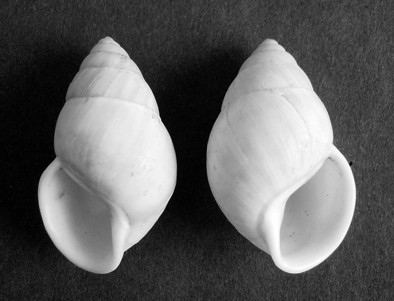
Snails can be left- or right-handed. Or, at least, the sprial of a snail's shell can turn clockwise (making a right-handed or dextral spiral) or anti-clockwise (a left-handed or sinistral spiral) and the direction of spiraling is decided by a single gene (inherited from the mother, suggesting in may be an imprinted gene as snail's don't have sex chromosomes) . Most species are predominately right-handed and very few individuals within a species don't match the predominant spiraling direction (I only know of one exception to this rule). In fact, I've spent more time than most people looking at snails, and I've never seen a left-handed one (trust me, I check!). There's a very good reason one individuals within one species are predominately of one spiraling direction - left-handed land snails have great trouble mating with right-handed ones. Land snails are all hermaphrodites and they mate by lining up extending their gentals through a pore on the 'spiral side' of their body (if you aren't invert-phobic, there are plenty of photographs of this process here). But mirror-image snails, espacially those with relatively flat shells, struggle to line up in this way, and when they do their shells bump into each other. For this reason, 'mirror' snails (which do arise in populations all the time) struggle to reproduce and leave few descendants.
The direction in which a snail's shell coils also has ecological implications. Animals that specialise in eating snails have adapted to attacking right-handed shells. So, for instance, Pareas snakes always attack from the left and have lopsided jaws that help them work the snail out of the shell:
The Japanese land snail genus Satsuma provides a natural experiment to test this idea. Satsuma snails come in left- and right-handed forms and some populations share their homes with the snake eating Pareas iwasakii snakes. Masaki Hoso and his colleagues (Hoso et al 2010, http://dx.doi.org/10.1038/ncomms1133) looked at the distribution of left- and right-handed Satsuma species and their relationships with each other.

From this data they concluded that sinistral Satsuma species have evolved multiple times and almost always in regions that are currently home to snail-eating snakes. So shell shape really does seem like a magic trait here - left handed shells get an ecological advantage that allows them to survive and it also prevents them from sharing genes with right handed snails.
So Satsuma snails are another example of magic traits in the wild. But I think they are an opportunity to understand a bit more about speciation. The hardest thing about studying speciation is separating the differences that cause speciation with those that arise once species stop sharing genes. In the case of Satsuma we know a change one gene caused speciation so any other traits that differentiate left- and right-handed snails living along side each other happened after the fact. The number of left-right species pairs, and the different ages of the lineages they represent gives us a unique chance to understand the how interactions between newly formed species shape their futures.
Surely that's infinitely more interesting that another round of the evolution-creation controversy?
You should also check odd Ed Yong's take on this study, which is predictably excellent.
*I'm sorry to do this, because I don't want to be one of tiresome people who complain about the way language changes, but the science of ecology is something quite different from what's fast becoming the modern definition of the word. Ecology is the study of the way organisms interact with each other and their environment and (as far as I can tell) mainly involves counting a lot of things then doing some clever statistics on the resulting numbers. It's not (directly) about conservation or sustainability and it's certainly not an idea invented by advertisers who worked out adding 'eco-' to a products name and putting it in a plain box allowed them to sell it at twice the price.
Labels: environment and ecology, sci-blogs, science, snails, speciation, sunday spinelessness
Sunday, August 21, 2011
Sunday Spinelessness - Sluglett
I spend quite a lot of my time trying to convince people that very few snails or slugs are interested in eating their lettuces. But it has to be said, there are a few terrestrial gastropods that are serious pests. In New Zealand, those are all introduced species and the "grey field slug", Deroceras reticulatum, is the one we run into most often. These slugs can destroy freshly planted vege gardens, they're a major pest for commercial growers and they can force out native species in disturbed forests. So, they're unquestionably bad news. But the baby one I found in the cauliflower today was quite cute:


Labels: environment and ecology, photos, sci-blogs, snails, sunday spinelessness
Sunday, August 14, 2011
Sunday Spinelessness - A Sunday Spiral
I had planned to write about snail shells today. Specifically, about how chance mutations that change the direction of a shell's spiral might be enough to create a new species. I guess that story will have to wait another week, today I'll just share (what I think is) a particularly beautiful spiraled shell I found recently.

I'm not sure what species of snail once lived in this shell. I found this one, and 20 or 30 more, under logs and in leaf litter in the the fuchsia-dominated remnant forest (yes, in New Zealand fuchsia comes in tree-form) in Fraser's Gully. There's a clue to the taxonomic placement of the animal that used to inhabit the shell on the flip-side.

The hollow cone shape that forms at the bottom of some snail shells is called an 'umbilicus', and it's a taxonomically informative character. In the New Zealand land snail fauna, the family Charopidae is assoicated with large open umbilcuses like this one. There are charopids that have closed shells, and there are snails from other families that have this sort of open umbilcus - so its presence isn't the final word, but it's something to go on and I'll have to do a bit of sleuthing at some stage and see if I can work out what these snails are.
Whatever their placement, I was taken by these shells because of their lovely pattern. Something I more or less failed to capture in the obligatory front-on shot of the shell (sorry, I don't even have time to photoshop the blue-tac out today!):

Labels: environment and ecology, photos, sci-blogs, shell, snails, sunday spinelessness
Sunday, June 26, 2011
Sunday Spinelessness - Snails can be speedy too
Sorry for anyone looking forward to the next part of a series on the first animals - that posts needs more editing than I have time to do this evening.
Instead, I'm going to jump on an internet bandwagon and show you a surprising video that's been doing the rounds:
As I've said before, we have some seriously big invertebrates in New Zealand, but none of them are more impressive than our giant carnivorous snails. We tend to think of snails and slugs as pests that destroy our lettuce plants, but snails are the most diverse group of molluscs and they have adapted to eat a whole range of food. Most snails scrape algae and fungi off surfaces, others are plant eaters, a few are parasites with no mouth at all and a surprisingly large number of them are carnivores. The scrapers and the herbivores eat by extending a rasp-like organ called the radula out from their mouths to chip away add the food at hand and rake into their mouths:

Typical snail feeding anatomy from wikimedia user Debivort - image is CC 3.0
Great as this method is for eating immobile plants and algae, it doesn't really work for carnivorous snails whose prey has the ability to run away. Indeed, most carnivorous snails have seriously re-arranged their feeding anatomy to accommodate their lifestyle. The video above gives us a rare chance to see it in action. Once the snail has worked out where the worm is (using its two sets of tentacles - the smaller ones below are for smelling while the longer ones have eyes on their tips) its pharnyx fulls with blood and is rapidly thrust outside of its body, surrounding the worm. Once the worm is enveloped, the snail's sharp radular teeth will hold on, and start to break its body up as its dragged deeper into the digestive system. Although the actually moment of capture happens with a swiftness that belies snails' reputation as slow moving animals, the rest of the eating process takes a bit longer. The radular teeth are not particularly efficient and it will take several passes for the (still living) worm to be sloughed off into edible pieces.
All of New Zealand's carnivourous snails are from the Southern Hemisphere family Rhytididae. All told we have around 60 species in 6 genera. The video doesn't tell us what species were looking at, but it's probably from the one of the two related genera Powelliphanta and Paryphanta (if you forced me to pick, I'd says this was Po. augusta since the video comes from DoC and, as we'll see, they have a population of that species in captivity). Both these genera contain large worm-eating species with extraordinarily beautiful shells:
Image is CC 2.0from Flickr user SidPix
Most of the Powelliphanta species aren't yet formally described, and seems like there is some interesting evolutionary biology going on in this group. A number of species appear to be linked to each other in what is called a 'ring species' - a long chain of populations in which those adjacent to each other can interbreed but populations distant from each become quite distinct (and probably couldn't interbreed given the chance). I'd really love to get the chance to apply some genetic tools to understanding what's going on there, and, in fact, sorting out the number of species in this genus has important conservation implications. Unfortunately, for all their fearsome eating habits, most of our rhytidids are at risk of extinction. Like the rest of our fauna, they have no natural defence against introduced mammalian predators like possums. Habitat destruction also threatens their future, since some species appear to be adapted to very fine-scale differences in habitat, which makes the risk we took in translocating an entire species that had the temerity to live on mountain with a coal seam seem utterly crazy to me.
Labels: powelliphanta, rhytididae, sci-blogs, snails, sunday spinelessness
Sunday, April 17, 2011
Sunday Spinelessness - The sight of a wild slug eating
Did you know that I'm in the pocket of big bussiness ? Or that I set out to bamboozle people with fancy graphs? Or that I show the typical arrogance of the modern scientist? Well, it was news to me as well, but all this, and much more, appeared in the comments underneath my article on Ken Ring's (non)ability to predict earthquakes when it was picked up by the National Business Review. One of my crtics did a little research about me and decided that... well I'm not sure what he decided:
As for people like David Winter - well he is in the pocket of people like the NBR - after all if the economy goes down the gurgler he just might not get any more freebee grants so he can go off and study snail trails. Studying snail trails wouldn't engage someone for many hours a day, no doubt why he has had time to pen the "syndicated" article above. So here we have people like David Winter and the NBR "feeding" of the Christchurch earthquake.
I've had plenty of support, both public and private, in funding my research and I'm very grateful for it, but I'm not sure propping up a right-wing newspaper would be a very good way to expand spending on basic research. As it happens, I have never studied snail trails (although there's plenty of science in that mucous), but I've looked into something I'm sure my anonymous critic would be equally dismissive of.
I want to know what my snails eat. That might seem like an easy question to answer, couldn't I just set up in the field with a notebook and write down what I see? Not really, land snails are generally only active for a small proportion of the day, and even if you can observe them feeding it's hard to tell what they're eating. The lettuce-destroying slugs and snails we are familiar with are the odd ones out in the malacolgical world - most land snails don't eat live plants, instead, they prefer decaying matter or algae and fungi growing on various surfaces (some others are carnivores). So, to try and learn something about the diet of my land snails I broke out a scalpel and started collecting the gut contents from my preserved specimens and picking through them to see what they've been eating (and if there are differences between species).
I'll talk about those results one day, but while I was doing those dissections I started finding and more of the leaf veined slugs I've written about before. Including babies:


Which made me think: what are these guys eating? As ever, I turned to google for an answer and Te Ara had it "their biology is poorly known, but they are thought to live mainly on algae and fungi on the surface of plants". Sure enough, searching through the literature on the 30 or so species of leaf veined slug in New Zealand, there is no indication of what it is that they eat. That was too depressing for me, we know so little about the biology of our native invertebrates, but this species (Athoracophorus bitentaculatus) isn't particularily rare, we should at least know what this one eats.
Don't worry, I didn't start sacrificing cute little slug-lets in the name of science. There's another way to get gut contents (note also, that even flattened slugs have the strangely twisted anatomy of the snails from which they descended):

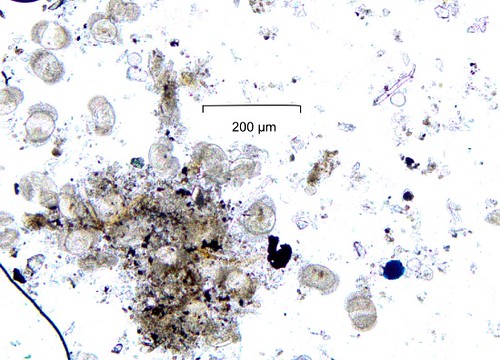
So, I took to stepping outside an night time, finding a couple of slugs, and placing them in a bucket. In the morning I'd move them back to the shrubs from which they'd been plucked and scoop a few fecal samples out of the bucket to inspect along with my dissections. And here's what I found when I looked down the microscope:
And a little closer:
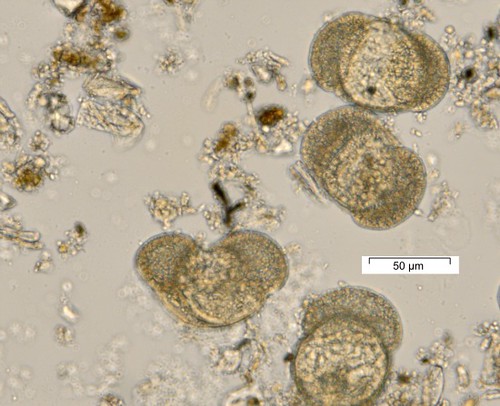
It's took me a pretty long time to work out what these three-lobed structures were, but I'm pretty sure I know now. They're pollen grains. You can tell a lot about the world from studying pollen grains, each year plants put out millions of these structures, each once identifiable to a taxonomic group. To a trained eye, a series of pollen samples from a old lake bed can reveal past climate change or the evolutionary history of our country. Pollen can even solve crimes. To my eyes... well, I think these are from the massive pine tree next door ( the smaller lobes are "bladders" designed to catch the wind and let the pollen fly, and are unique to pines and their relatives).
It's not actually clear that the slugs were going out of their way eat pollen, it might just have been on the surface they were eating from and unavoidable. It's certainly clear that a lot of grains made it through the digestive system intact. So I still hadn't really cracked the mystery of what these guys were eating. Then, a couple of weeks ago I noticed something. The railing along the pathway the leads down to our front door is covered in algae and fungi, with a very distinctive pattern:


These are slug feeding trails. As they slide across a surface, slugs and snails use an organ called the radula to rasp away and remove the food. I must have walked past this evidence a thousand times without ever thinking about it! The next night I went out with my deeply amateur night-shoot gear and, sure enough, there the slugs were:


So, now we know, leaf veined slugs do indeed live on algae and fungi (and possibly pollen too) but not only on the surface of plants!
I don't know how I managed to write this post without checking for similar posts at Snail's Tale's by Aydin Örstan, the blogosphere's preeminent malacologist (I'm sure there's a trophy for that). Remarkably, Aydin has found pine pollen in fecal samples from slugs, and has found feeding tracks left by the same species! Perhaps his Arion and my Athoracophorus fill the same niche on opposite sides of the world.
Hello boingboing readers! If you want to find some more backyard science, I've also been keeping an eye on a little colony of spiders (1,2,3) and I once tried to find out what makes bumblebee workers get working. If you're a fan of spineless creatures in general, you should check circus of the spineless which collects posts from all over the web (and all over the world). The last edition was hosted by Zen Faulkes at Neurodojo and you can find the older ones here.
Labels: environment and ecology, leaf veined slugs, photos, sci-blogs, snails, sunday spinelessness
Sunday, February 6, 2011
Sunday Spinelessness - Hadda beetle
Time for another tropical beetle from Vanuatu, and what could be more charming than a ladybird*?

Or its absurdy spikey larvae?


This ladybird is probably a bit larger, a bit rounder and a bit oranger than the ones you are used to seeing in your garden. The more familiar ladybirds are more that just a pretty set of elytra, they're a force for good. Both the larvae and the adults of most of the familiar red and black ladybirds eat aphids, so having a few around in your garden saves on insecticide:
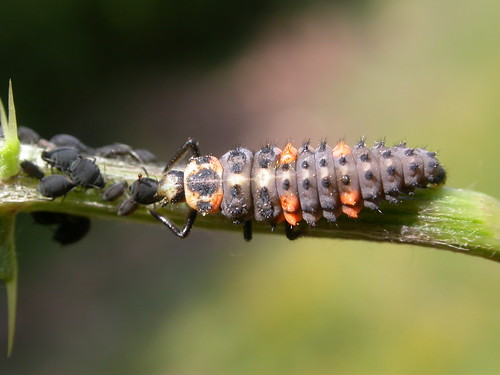
Ladybird larvae 'controlling' aphids, thanks to Gilles San Martin for making this image CC 2.0
The big orange ladybird in that first photo is not nearly so helpful. It's Henosepilachna vigintioctopunctata**, commonly known as the 28 spotted ladybird or the hadda beetle. The hadda beetle is a major agricultural best, because both the adult and larval stages are herbivorous and have a patricular liking plants of the family Solanaceae. That means potatoes, tomatoes, eggplants and (worst of all?) chilies can have their leaves skeletonised by beetles, and a beetle infestation can reduce a year's crop by up to 25% if not controlled.

You might note that this is the third post I've written about invertebrates from Vanuatu, and it's the third time I've written about an introduced pest. That's not by chance. Islands are hugely interesting for evolutionary biologists, but human introductions have seriously changed island ecosystems.
Take another look at that chewed-over leaf. Now imagine that each of those small white sections to the left of the photograph is a brand new island in a green ocean. In almost no time at all, winds would carry seeds to our little archipelago and life would start to claim the bare rocks. But we don't know which plants would make it. Dispersal and colonisation are random events, each island would collect its own subset of the seeds drifting past , and so start to develop its own flora. Once those plants have taken hold, the rain of wayward and drifting insects (and even snails) that fall everywhere on earth would have a chance to establish themselves. Again, the isolation of our islands means different species will fall on each one, and different ecological relationships will start to form. Our islands might survive for 20 million years before they're reclaimed by the sea, and in that time the unique beginnings of each island's ecosystem will mean a different evolutionary history will play out. In this way islands are evolutionary experiments, and island ecosystems have given risr to some of evolution's weirdest creations - isolation from the mainland has let iguanas become marine animals, finches become vampires and pigeons give up on flying.
But islands are no longer isolated from the rest of the world. The hadda beetle is probably native to Russia and, without humans moving plants around, would never have had a chance of making it to a Pacific islands. Now it lives in almost all the way across the tropical Pacific (here's a terrible photo of one I took in Rarotonga, 3000km away from Vanuatu):

In fact, there is an entire "tramp" assemblage including, but hardly limited to, big-headed ants, mynas, land snails, centipedes, paper wasps and mile-a-minute weed that can be found almost everywhere you find people in the tropical Pacific. These Pacific-wide introductions have pushed out native species, and together they have replaced some of evolutions most exuberant expressions with a bland mono-culture. The problem is not quite as bad as it might seem. The tramp species are mainly moved about by commerce, so many of the introduced species are associated with agriculture or at least lowland environments. In most islands, as you climb higher you find a more 'native' flora and fauna (for instance, all the partulid species left in the Society Islands are restricted to mountain tops).
By the way, the hadda beetle's bid for world domination continues: last year it was recorded in New Zealand for the first time. It's known to have set up shop in Auckland, but if you find hadda beetles somewhere else MAF might want to know about the invasion's spread.
*That's "ladybug" in American English, coccinellid or "lady beetle" among scientists and "ngoikura" in Māori
** That name might seem like a mouthful, but the species epithet at least makes sense, viginti-octo-punctatameans "twenty-eight-spotted". Most ladybird species names follow this rule
Labels: beetle, coccinellidae, Cook Islands, environment and ecology, island biogeography, photos, sci-blogs, snails, sunday spinelessness, vanuatu

All content not otherwise marked is licensed under a Creative Commons Attribution-ShareAlike 3.0 Unported License.


