
Thursday, May 10, 2012
An object lesson in the danger of poor science reporting
The thousands of viewers who found themselves reading the front page of stuff this afternoon would have been met by a giant graphic of a blue sun and a headline claiming
'Solar minimum' could trigger Ice Age

The world could be heading for a new 'solar minimum' period, possibly plummeting the planet into an Ice Age, scientists say.
That's a nice result, but how does it relate to "ice ages" (presumably meaning glacial periods that last for tens of thousands of years and cover most of the globe in ice, not the regional pattern lasting 200 years studied here) let alone an imminent one? Even if the sun were to enter a prolonged solar minimum, Martin-Puertas et al. are explicit in their paper, and the press release that got someone at the Fairfax office excited, that the results they report can't be directly used to predict future events. From the paper:
However, a direct comparison to the Homeric minimum, which was a very deep and persistent minimum with very different orbital parameters when compared with recent solar minima and probably a larger climate response, is not possibleAnd the press release
Albeit those findings cannot be directly transferred to future projections because the current climate is additionally affected by anthropogenic forcing.The language in the original version of the article (now edited, but recorded by from the morgue) gives away the motivation of the article's author:
The period would see a cooling of the planet, refuting predictions of global-warming alarmists.You can decide if the author of this article is in a place to call anyone else an alarmist.
The comments that followed the article are a perfect illustration of why it's worth getting upset about this sort of reporting. The vast majority of them are from people who don't believe the evidence that recent global warming is the result of our burning of fossil fuels, the rest are from people just generally being confused or disappointed by the lack of clarity on climate change in the media. I've plucked a commentator calling himself James as an example:
Global warming, global cooling, another ice age ? Let's face it, there is "evidence" to support all of these theories. There was also good evidence to support the theory that the world was flat. Science is simply the opinion of a group of intellectuals at any given moment. The mix of the group changes with each new piece of "evidence". Everyone, including the intellectuals should understand that science and their own theories are just that, not indisputable facts.
James is wrong, the evidence that emitting greenhouse gases makes the world warmer is overwhelming and in no way comparable to the idea there will be a new glacial period any time soon. But can we blame him for being wrong when the major sources of news in this country are so willing to publish such rubbish?
As much as I love science blogs and specialist magazines like New Scientist and Scientific American it's important to realise that for that the people that get their science news from these sources are science fans. For most people, mainstream sources like stuff, the Herald and TV news are going to be the main source of scientific information, and when it's as bad as this article is it any wonder that large sections of our society are left behind by science?
*How amazing is geography - you can reconstruct the windiness of a site 3 000 years ago!
Labels: climate change, media, sci-blogs

Friday, March 23, 2012
On the radio
I find it very hard to listen to recordings of my own voice, but I did manage to get through that audio once. So, I should say that "a bloke called Ernst Mayr" is perhaps taking the antipodean lack of reverence for important people a little too far. And I don't know what I said the Galapagos has nightingales - it was the Galapagos mockingbirds that Darwin was interested in.
I was a little bit nervous about doing the interview, but in the end far the most difficult part of the whole process was trying to find three songs so share. Here's one that missed the cut, decided it was just a bit too cute:
Friday, April 23, 2010
Garth George: wrong, wrong, 2.75 million times wrong.
Urrrgh, I screwed up the maths here. Garth George is really, really wrong. But sadly he's not the wrongest person ever. A post showing the error of my own ways can be found here and the last graph now includes my own error.
Garth George has this climate science stuff sorted out, it's a scam you see. And even if it weren't, New Zealand's emissions make such a tiny proportion of the worlds carbon dioxide we should just do nothing. You want evidence or New Zealand's tiny carbon footprint? Well, George doesn't need evidence because he has his suspicions:
I suspect that the eruption of Mt Eyjafjallajokull in Iceland shot more gases into the atmosphere in five minutes than New Zealand would in five years.
But, as Gareth Renowden points out at Hot Topic, George's suspicions don't match the data. In order to work out how much carbon dioxide Mt Unpronounceable (Paul Litterick's joke, not mine) was shooting into the atmosphere the Guardian took the surprising step of asking some scientists. The upper bound of their estimates is 300 000 tonnes of carbon dioxide per day (or about 1040 tonnes in 5 minutes). Impressive, but not much when compared with the 377 million tonnes New Zealanders managed between 2004 and 2008.
Amazingly, Garth George's estimate is out by a factor of 2.75 million 375 000 [damn!]. That's equivalent to estimating the driving distance between Dunedin and Auckland as being 3.7 metres. I couldn't let a week that combined such breathtaking stupidity with this nice infographic go without memorialising George's folly:
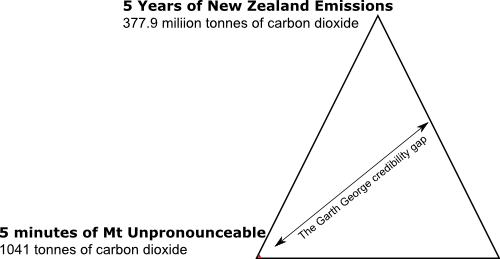
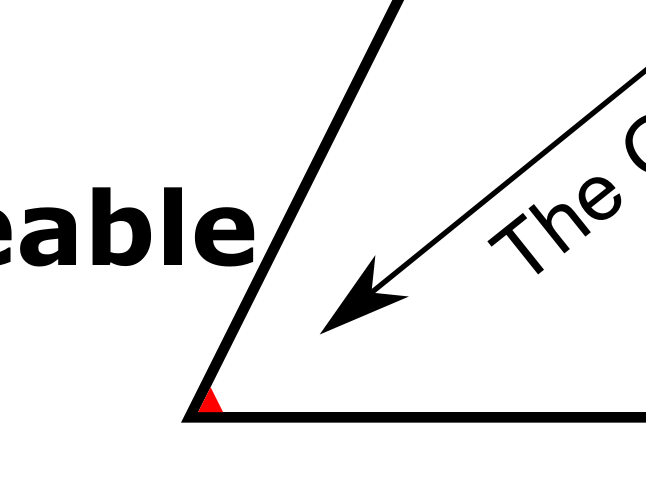
And, because it's pretty hard to see those few red pixels, a close up:
I've just spent a lunch break trying think of any one who has ever made a larger error of estimation. I couldn't come up with one, but here, to provide some context, is George's error against some of history's more famous mis-measurements (if you have some more to add I'd be happy to hear them, especially if you can beat George's effort):

Labels: climate change, environment and ecology, media, pretty data, sci-blogs

All content not otherwise marked is licensed under a Creative Commons Attribution-ShareAlike 3.0 Unported License.


