
Thursday, May 10, 2012
An object lesson in the danger of poor science reporting
The thousands of viewers who found themselves reading the front page of stuff this afternoon would have been met by a giant graphic of a blue sun and a headline claiming
'Solar minimum' could trigger Ice Age

The world could be heading for a new 'solar minimum' period, possibly plummeting the planet into an Ice Age, scientists say.
That's a nice result, but how does it relate to "ice ages" (presumably meaning glacial periods that last for tens of thousands of years and cover most of the globe in ice, not the regional pattern lasting 200 years studied here) let alone an imminent one? Even if the sun were to enter a prolonged solar minimum, Martin-Puertas et al. are explicit in their paper, and the press release that got someone at the Fairfax office excited, that the results they report can't be directly used to predict future events. From the paper:
However, a direct comparison to the Homeric minimum, which was a very deep and persistent minimum with very different orbital parameters when compared with recent solar minima and probably a larger climate response, is not possibleAnd the press release
Albeit those findings cannot be directly transferred to future projections because the current climate is additionally affected by anthropogenic forcing.The language in the original version of the article (now edited, but recorded by from the morgue) gives away the motivation of the article's author:
The period would see a cooling of the planet, refuting predictions of global-warming alarmists.You can decide if the author of this article is in a place to call anyone else an alarmist.
The comments that followed the article are a perfect illustration of why it's worth getting upset about this sort of reporting. The vast majority of them are from people who don't believe the evidence that recent global warming is the result of our burning of fossil fuels, the rest are from people just generally being confused or disappointed by the lack of clarity on climate change in the media. I've plucked a commentator calling himself James as an example:
Global warming, global cooling, another ice age ? Let's face it, there is "evidence" to support all of these theories. There was also good evidence to support the theory that the world was flat. Science is simply the opinion of a group of intellectuals at any given moment. The mix of the group changes with each new piece of "evidence". Everyone, including the intellectuals should understand that science and their own theories are just that, not indisputable facts.
James is wrong, the evidence that emitting greenhouse gases makes the world warmer is overwhelming and in no way comparable to the idea there will be a new glacial period any time soon. But can we blame him for being wrong when the major sources of news in this country are so willing to publish such rubbish?
As much as I love science blogs and specialist magazines like New Scientist and Scientific American it's important to realise that for that the people that get their science news from these sources are science fans. For most people, mainstream sources like stuff, the Herald and TV news are going to be the main source of scientific information, and when it's as bad as this article is it any wonder that large sections of our society are left behind by science?
*How amazing is geography - you can reconstruct the windiness of a site 3 000 years ago!
Labels: climate change, media, sci-blogs

Wednesday, May 5, 2010
Memorialising my own folly
I'm usually a pretty cautious kind of a guy. I might be physically incapable of proofreading but I at least think these posts through and make sure I'm not committing any grave errors of science before I hit the publish button. Usually.
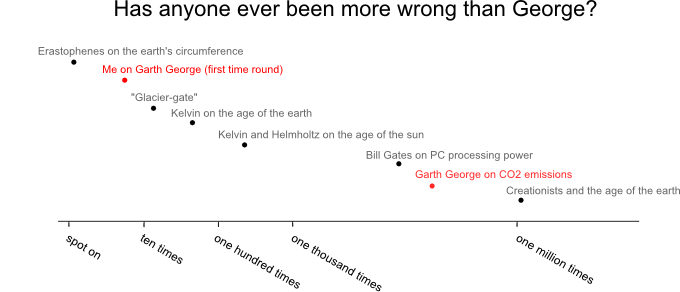
A couple of weeks ago I made fun of Garth George because he underestimated New Zealand's carbon emissions by some staggering amount. It turns I overestimated the degree of Garth George's underestimate. Or to put it another way, I screwed up that maths. Garth George is still spectacularly wrong, out by a factor of 375 000, but I had said he was out by about eight times more than that. In putting the graphics together I'd written down the inverse of George's error (about 2.75 millionths, or 2.75 x 10⁻⁶) to help me calculate the sizes for each triangle and when it came time to write up the post I mistook my notes, reading 2.75 x 10⁶ or 2.75 million.
That's not an excuse, it should have been obvious to me, as someone who passed 3rd from maths, that 3.7 x10⁸ couldn't be millions of times bigger than 1 x10³ and in writing the post I should have caught it. It's all very embarrassing, but if you are going to make fun of people you have to be prepared to be treated in the same way. So, in that spirit, here's the magnitude of my error plotted for all to see:

And the worst bit, Garth George is still among the wrongest people in history but not quite on the same level as the Young Earth Creationists (and will no doubt be overtaken by Bill Gates at some stage, if he really said that thing they say he said):
Any physical science types reading this post might want to make a joke at the expense of biologists now, can I suggest this one:
A group of biologists and a group of mathematicians meet each other at a train station on their way to a conference on ecological modeling. The biologists each line up to buy a ticket, while a single mathematician collects a few coins from each his colleagues and buys a single ticket. Both groups board the train and before the biologists can ask what the mathematicians are up to one of them yells out that the conductor is on his way. The mathematicians leave on mass, cramming into one bathroom. The conductor arrives and clips the ticket of each biologist before knocking on the bathroom door and asking “tickets please”. The mathematicians slide their single ticket under the door, it gets clipped and the mathematicians get their train journey at a fraction of the cost the biologists paid.The two groups run into each other again on the way home from the conference. This time the biologists are on to the game, so after exchanging a knowing wink with the mathematicians they send a representative off to get one ticket. But they are amazed to see the mathematicians don’t even bother with the single ticket that bought for the first journey. The biologists want to know what’s going on by the mathematicians stay tight lipped until their spy announces “conductor on his way”. The biologist scramble just as they’d seen the mathematicians do on the last trip, squeezing into a bathroom. In contrast, all but one of the mathematicians strolls down to the other bathroom in the train while the other approaches the biologists’ room, knocks on the door and asks “tickets please”.
(The moral of the story, biologists should think carefully before applying mathematical methods)
Labels: blerg, blog blogging, climate change, might interest someone, sci-blogs
Friday, April 23, 2010
Garth George: wrong, wrong, 2.75 million times wrong.
Urrrgh, I screwed up the maths here. Garth George is really, really wrong. But sadly he's not the wrongest person ever. A post showing the error of my own ways can be found here and the last graph now includes my own error.
Garth George has this climate science stuff sorted out, it's a scam you see. And even if it weren't, New Zealand's emissions make such a tiny proportion of the worlds carbon dioxide we should just do nothing. You want evidence or New Zealand's tiny carbon footprint? Well, George doesn't need evidence because he has his suspicions:
I suspect that the eruption of Mt Eyjafjallajokull in Iceland shot more gases into the atmosphere in five minutes than New Zealand would in five years.
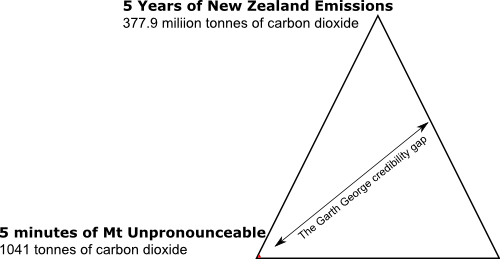
But, as Gareth Renowden points out at Hot Topic, George's suspicions don't match the data. In order to work out how much carbon dioxide Mt Unpronounceable (Paul Litterick's joke, not mine) was shooting into the atmosphere the Guardian took the surprising step of asking some scientists. The upper bound of their estimates is 300 000 tonnes of carbon dioxide per day (or about 1040 tonnes in 5 minutes). Impressive, but not much when compared with the 377 million tonnes New Zealanders managed between 2004 and 2008.
Amazingly, Garth George's estimate is out by a factor of 2.75 million 375 000 [damn!]. That's equivalent to estimating the driving distance between Dunedin and Auckland as being 3.7 metres. I couldn't let a week that combined such breathtaking stupidity with this nice infographic go without memorialising George's folly:
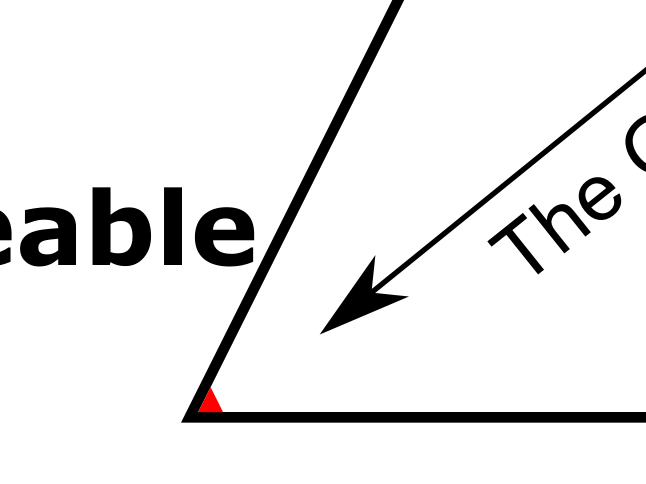
And, because it's pretty hard to see those few red pixels, a close up:
I've just spent a lunch break trying think of any one who has ever made a larger error of estimation. I couldn't come up with one, but here, to provide some context, is George's error against some of history's more famous mis-measurements (if you have some more to add I'd be happy to hear them, especially if you can beat George's effort):

Labels: climate change, environment and ecology, media, pretty data, sci-blogs
Wednesday, March 17, 2010
Lawrence Krauss on a bad day
Dunedin got to see Lawrence Krauss on a good day and a bad day this week, but that’s not to say one of his presentations was better than the other. Yesterday the award winning physicist and scientific communicator revealed to his audience that his outlook on life changes from day to day. On good days he can revel in the wonder of a universe that could come to know itself due to a series of accidents that started 10-31 seconds after the big bang and allowed the creation of first matter then atoms, stars and planets and finally astronomers. On bad days he despairs at the lack of scientific thinking in journalism and politics and thinks these problems, and the anti-scientific forces that fuel them, will probably prevent us from doing anything meaningful about climate change.
Krauss' awe inspiring story of an atom's journey from the birth of the universe to its death will gain nothing from my retelling it. If you weren't able to see it then you'l be glad to know his talk was a précis of his excellent book ATOM: An Odyssey from the Big Bang to Life on Earth...and Beyondand covers similar ground to this recored lecture. Perhaps I'm a masochist and a pessimist, but I'm going to skip the awe inspiring story to focus on what Lawrence Krauss thinks about on a bad day. His talk on "Science, Non-Science and Nonsense" described the sources of scientific confusion in society and the tactics used by those groups that seek to take advantage of it.
Krauss argued that the goal of science education and science communication should be to make sure everyone develops a functioning bullshit filter. He didn't express his thesis quite as bluntly as that, but his core idea is that spreading a scientific mindset would allow us to short circuit needless debates (is global warming real?) and let us get on to the important ones (what are we going to do about it?). He used a neat example to illustrate how this sort of scientific common sense could stop nutty ideas before they get started. UFO enthusiasts often cite the ability of the lights they observe to perform right angle turns at speed as evidence of their otherworldliness. In fact, Krauss pointed out, common sense should tell us that these apparently amazing maneuvers are evidence that the lights in question are not being emitted by a massive object moving through the sky. The only way to turn at a right angle is to stop then change direction, for a UFO to do all its slowing down and stopping so quickly a human observer couldn't perceive it would generate G-forces with a strength about 2000 times greater than earth's gravity. And quite a mess.
If the evidence used by UFO junkies is so silly then why do continue prosper? Why aren't people already filtering this sort of nonsense? The standard of scientific reporting in the media certainly has a lot to answer for. Krauss cited the normal concerns, a fractionated media market means viewers can choose a source of news that confirms their biases and the innate need of journalists to present balance is misplaced in science stories when, in almost every case, one side is wrong and we usually know which side that is. He also mentioned something I hadn't thought about before. According to Krauss, part of the problem with science coverage in mainstream reporting is that journalists don't feel qualified to make scientific pronouncements. Writers and broadcasters are happy to make bold statements on politics, financial markets and sports but will shy away from even a scientifically uncontroversial statement like "evolution is a fact."
Scientific understanding might not be helped by meek journalists and the false equality of balance but most journalists aren't setting out to deliberately mislead the public on science. Unfortunately, there are forces at work that are doing just that. Krauss had a tonne of examples from the culture wars in his native USA to draw on but he also took the time reminded us of our home grown cranks, citing the New Zealand Climate "Science" Coalition and Ray Comfort (The Apologists Nightmare [youtube video]) as evidence we aren't immune to anti-science in New Zealand. As you'd expect Krauss exposed just how vacuous the claims of intelligent design creationism and the objections of climate change denialists are, but he also attempted to deconstruct the PR strategies each group use. Both campaigns seek to take advantage of the public's sense of fairness and journalists' willingness to provide balance to any point of view. The Discovery Institute would have you believe their goal is simply to get their science a fair hearing in the classroom. But they don't have a science. For normal science, theories only make it into the school curriculum after they've been proposed, tested, retested and confirmed. The ID crowd don't want fair treatment, they want special treatment, to avoid that boring scientific process and start in the classroom!
Krauss could hardly have known this, but our own climate cranks play the same game. I hate to make an example of this article because the author usually covers science well, nevertheless it highlights the point. In an effort to provide balance to a story on how the IPCC might be made better the author contacted Vincent Gray for comment, here's the paragraph
Wellington scientist and climate change sceptic Vincent Gray said the researchers were continually coming up with "new models" but they were still "fiddling the figures" and were unlikely to restore public confidence in their work until their projections were proven
That sounds pretty fair doesn't it? Climate scientists can run their model forward in time and if their projections match observations we'll take action. Actually, it's absurd. As Krauss emphasised in his talk, the evidence for climate change doesn't only come from models, we have tonnes of data that tell us the earth is warming and the seas are rising. Combine those data with the fact recent temperature records are within the uncertainties of the IPCC's projections and sea levels are near to the upper bound of those projections and Gray's sound bite seem less fair.
Krauss had more problems than solutions in his hour long presentation. In fact, it's a testament to the passion he has for his science and skill he has as a scientific communicator that he managed make a talk made almost entirely of depressing facts seem invigorating. The only ray of hope Krauss offered us was that when people's backs are to the wall they abandon their their preconceptions and to turn to science. In 2003 George W. Bush said that he believed "both sides" of the "evolution debate" should be taught in schools. In 2005 Bush was faced with the prospect of Avian flu becoming able infect humans. Confronted with threat of a flu pandemic the Bush administration dispensed with its evolutionary agnosticism and planned for the possibility of genetic mutations allowing viruses to pass from human to human. That sort of infectivity requires conformational changes in surface proteins which create a new function, exactly the sort of phenomenon the ID crowd think is so improbable as to be effectively impossible.
Krauss will be presenting something very similar to his Dunedin talk in Auckland next week. I'd encourage anyone who has the chance to get out and seem him, he's a very chrasmatic and interesting speaker. You might even ask the question I really wish I did now- how are we going to fix all these problems?
Labels: climate change, evolution, Lawrence Krauss, might interest someone, sci-blogs, science and society, science communication, skepticism
Sunday, December 13, 2009
Peer Review for the Climate "Science" Coalition
A couple of weeks ago it got a bit more serious. The New Zealand Climate "Science" Coalition (C"S"C) put out a press release [PDF] that accused NIWA of scientific fraud. If you missed the story my sciblings Gareth and Ken have covered it in detail. The short version is the C"S"C collated temperature records for each of the regions that contributed to NIWA's national long term climate data series and found no significant trend in the raw data despite the fact NIWA's series has New Zealand warming by almost a degree in the last century. So, presumably in an attempt to put a local angle on the "climategate" story they released that extraordinary press release. I reproduce some of the highlights below.
... the station histories are unremarkable. There are no reasons for any large corrections. But we were astonished to find that strong adjustments have indeed been made.
The shocking truth is that the oldest readings have been cranked way down and later readings artificially lifted to give a false impression of warming, as documented below. There is nothing in the station histories to warrant these adjustments and to date Dr Salinger and NIWA have not revealed why they did this.
We have discovered that the warming in New Zealand over the past 156 years was indeed man-made, but it had nothing to do with emissions of CO2 it was created by man-made adjustments of the temperature. It's a disgrace.
New Zealand's contribution to the global statistics is now under a shadow, so there could be regional or even global implications of these disgraceful adjustments which should be investigated.
Now we must ask: do we really need an ETS? For, if all that nasty carbon dioxide and methane we are pumping into the atmosphere has utterly failed to increase our temperature until now, why ever should it do so in the future?
Got that? There has been no warming in New Zealand, NIWA scientists purposefully changed the data to fit their agenda, this is a disgrace (and indeed shocking, disgraceful and astonishing) now that we know that there has been no warming in New Zealand we can dump the ETS. Since that release they've walked their claims back somewhat, in that annoying "oh, we were just putting it out there" way people that say outrageous things usually fall back to but it was the claims in their press release that started the story. The basis of all those fervid claims, that the adjustments made to the NIWA data were arbitrary, can only be described as a lie. Since the C"S"C stitched together the data for each region from multiple stations they knew very well that the some of NIWA's adjustments were made to take into account the change in recording station used to take the region's temperature. Moreover, as Ken has pointed out, if the C"S"C really wanted earn the "S" in their name they could have looked at the "flat" data they were presenting to see if stitching together data from those different stations without accounting for the change was more or less "shocking" then NIWA's adjustments.
Since the Wellington series has the simplest station history let's use that as an example. Before 1927 Wellington's temperature was recorded at Thorndon, just above sea level. In 1928 the station was moved to Kelburn about 120m above sea level. It will be news to no-one that as you get higher is gets cooler and, in fact, the C"S"C found a cooling trend in the Wellington of 0.7° per century. But even without knowing about the alititude of each station we can test for an effect of the station move in the raw data. Statistical tests have a horrible way of boiling down to a series of p-values - when you run tests on the raw data it turns out that the change of station has a significant effect on the temperature recorded but what does that mean? Perhaps the easiest way to understand just how wrong it would be to draw conclusions from the raw data without including a station effect is to compare how well each of a set of different models explain the raw data.
The C"S"C's -0.7°C trend comes from a simple model - a single linear trend over the length of observation. You could also imagine a model, lets call it the "altitude effect" model , in which a single linear trend applies over the length of observation but temperatures at the Kelburn station are offset by some factor (also estimated as a best fit) as a result of that stations elevation. You might even imagine another model "two slopes" in which as well as being offset by some factor temperatures at Kelburn were following a different trend than those down at sea level. I ran those regressions and got a bunch of numbers:
| Comparing our models | ||||
|---|---|---|---|---|
| Model | Rate (95% CI) | Variance explained | AIC | |
| C"S"C | -0.21 (-0.43 — -0.02) | 3% | 213.18 | |
| Altitude Effect | 0.72 (0.37 — 1.07) | 25% | 179.82 | |
| Two Slopes | Before move | 0.11 (-0.50 — 0.72) | ||
| After move | 1.01 (0.27 — 1.75) | 28% | 175.80 |
And indeed some pretty graphs:

The first thing that you note when you look at the table above is I didn't reproduce that -0.7°C trend even after going to *shudder* excel to check - I'm sure there is nothing untoward but going on but it is strange. For our purposes the values in "variance explained" and "AIC" are more important. The first of those is fairly self explanatory - how much of the total variance in the dataset is explained by the given model, AIC is a measure of how well the model fits scaled for the number of parameters used in the model ( which is a good thing to check because you can almost always explain some of the variance in dataset by adding another variable whether its meaningful or not) lower numbers represent a better fit. Between the table and the graphs we can see what it means when I say the station move has a significant effect on the temperature recorded - not including it in our estimate of the trend ignores a major source of variation in the data. When the move is incorporated we estimate a trend of 0.72°C per century ( and we can be 95% sure that value falls between 0.37°C — 1.07°C ) over the length of observation. Interestingly our third model is actually the best of the bunch. This is likely an artefact of trying to put a straight line through a trend that really isn't linear. Warming in the second half of the 20th Century was about twice as fast as earlier warming, since only the Kelburn observations include this accelerated warning fitting a line through that section separately fits the data better (though the uncertainty in our estimate of the trend is much larger since their are less data points making it up)
In reply to comments from Ken the C"S"C, who had called their press release a "research paper", claimed that a process equivalent to peer review would not have invalidated any of scientific claims that they made. In fact, even a very simple look at their data have shown that drawing conclusions of the sort the C"S"C did from the raw data would be terrible science and accusing NIWA scientists of fraud on that basis really is disgraceful.Labels: climate change, environment and ecology, sci-blogs, stats
Wednesday, May 20, 2009
Can we stop hearing from these people now?
Recent Increases in CO2 are Quite Closely Correlated to Human Emissions
 In fact, by moving away from Intelligent Design Ian has entered the uncomfortable zone of testable predictions. When CO2dissolves in sea water it reacts and makes, among other products, carbonic acid. If the sea really has been loosing carbon dioxide to the atmosphere we'd expect to the ocean to be getting less acidic. In fact, it's getting more acidic. Over all the ocean is absorbing more carbon dioxide that it emits and we know that it's fossil fuels that are making the difference because plant-captured carbon has an isotopic signature. That's before you even have to account for where all the human emissions, which thanks to that absorbing ocean other sinks amount to more than the recent rise in atmospheric carbon dioxide, have gone if they have not turned up in the atmosphere or the sea. Ian's idea is not simply on the fringes of climate science, it's entirely removed from it.
You might, like me, find it hard to care what Ian thinks about climate. Much more interesting is the team he's got to write in support of his nutty ideas, Bob Carter and Vincent Gray, both frequently cited as well credentialed climate skeptics, have written glowing reviews of the book and its bizarre thesis. How are we meant to take articles, submissions and press releases from these people seriously after such a demonstration of their ability to set their critical faculties aside? How can the seriously demand they be consulted every time that someone wants to talk about climate?
(Gareth of the Hot Topic book and blog has a more detailed post on Ian's central thesis)
In fact, by moving away from Intelligent Design Ian has entered the uncomfortable zone of testable predictions. When CO2dissolves in sea water it reacts and makes, among other products, carbonic acid. If the sea really has been loosing carbon dioxide to the atmosphere we'd expect to the ocean to be getting less acidic. In fact, it's getting more acidic. Over all the ocean is absorbing more carbon dioxide that it emits and we know that it's fossil fuels that are making the difference because plant-captured carbon has an isotopic signature. That's before you even have to account for where all the human emissions, which thanks to that absorbing ocean other sinks amount to more than the recent rise in atmospheric carbon dioxide, have gone if they have not turned up in the atmosphere or the sea. Ian's idea is not simply on the fringes of climate science, it's entirely removed from it.
You might, like me, find it hard to care what Ian thinks about climate. Much more interesting is the team he's got to write in support of his nutty ideas, Bob Carter and Vincent Gray, both frequently cited as well credentialed climate skeptics, have written glowing reviews of the book and its bizarre thesis. How are we meant to take articles, submissions and press releases from these people seriously after such a demonstration of their ability to set their critical faculties aside? How can the seriously demand they be consulted every time that someone wants to talk about climate?
(Gareth of the Hot Topic book and blog has a more detailed post on Ian's central thesis)Labels: climate change, denialism, sci-blogs

All content not otherwise marked is licensed under a Creative Commons Attribution-ShareAlike 3.0 Unported License.


