
Friday, May 25, 2012
Selling out to the mainstream media
They also asked me if I'd consider offering my on analysis of science in the news from time to time. Being of the opinion that its always better to do something about a problem rather than simply complain about it, I happily agreed. Here's the first piece to appear, a quick summary of the recent result that coffee isn't killing you and might even be prolonging your life.
I was prepared for a barrage of comments amounting "what does some evolutionary biologist/bug nerd know about medicine", but so far everyone that's taken the time to write something has been very supportive!
Labels: me elsewhere, sci-blogs, science and society, science communication, stuff

Thursday, July 7, 2011
Our greatest journey
The Symphony of Science series of videos is probably the best justification for the continued existence of auto-tune. The latest of these videos, which put various scientists and science communicator's words to music, deals with the history of our species - the fact we all descend from African ancestors and that all populations outside Africa are the result of migrations that started around 150 000 ago:
It's a matter of continual disappointment and annoyance to me that most New Zealanders don't know that the person most responsible for finding our place in the biological world and locating the base of our family tree in Africa was a kiwi. Allan Wilson was a graduate of Otago University who went to Berkeley to use the new technologies that were developed for medical genetics to answer some of the oldest questions in biology. By sequencing DNA and looking at the cross-reactivity of immune system proteins, Wilson and his students established that humans only separated from other apes about 6 million years ago (as opposed to conformable distance of 25 million years paleontologists had favoured) and coined the term "Mitochondrial Eve" for one of the ancestors all modern humans can trace their origin to. This 'Eve' lived 150 000 years ago in Africa, so, just as Alice Roberts says in the video, we are all children of Africa.
These findings absolutely changed the way we think of ourselves as a species, and New Zealanders should know a kiwi was behind them! Thankfully the Royal Society has just announced one of Wilson's students, and a co-author on the most important papers, Rebbecca Cann is coming to New Zealand to talk about Wilson and his legacy. If you get a chance, I really encourage you to get along and hear her talk.
Labels: allan wilson, sci-blogs, science, science and society, science communication, video
Friday, May 20, 2011
3 tweets
Labels: evolution, genetics, sci-blogs, science, science communication, speciation, species, twitter
Wednesday, April 6, 2011
What makes a great scientific talk?
Genetics Otago (the group behind the Southern Genes blog at sciblogs) runs a bi-weekly meeting for postgrads to catch up, find out about each others work and perhaps even learn something about life as a budding academic. Next week I'm going to present a short talk on... how to present a short talk.
Looking about for some resources around the web, it seems most just reinforce the preferences of the author. To try and be a little more representative in my approach I'm going to present the notes I've written for my talk so anyone with an opinion can tell me what I've missed and what they think I've got wrong. This is going to be presented to postgraduate genetics students, but most of the skills that go into making a good presentation apply beyond genetics and even science, so I'd welcome feedback from anyone.
(As new tips come in, I'm adding them in italics)
Think about your audience, then tell them a story
You might know all there is to know about the protein family you study, the amazing new phylogenetic methods you used or why finding the mutation that underlies the phenotype you are studying will change the world - but does your audience? As a postgrad you've become an expert in a very narrow field, but you'll hardly ever talk to an audience in which everyone is as clued up as you are. Be generous and share some of your knowledge, think about who comes to the sort of talk you're presenting (you lab? your department? an inter-department program? the public?) and think about what they already know, what terms they'll be familiar with, and what sorts of data and results they're used to interpreting.
It seems bizarre that I should have to mention this, but you should also think about what sort of thing the members of your audience care about. You hardly ever get a chance to talk about all of your research at once, so when you prepare a talk you are always making a decision about which details to include. Think about your audience when you decide the 'angle' you want to take in your talk; are they specialist your area will be interested in how you applied a bleeding edge technology to your problem? Or are they wider audience, who are more interested in how your results will be translated into practical benefits? (That last angle is a little harder to work if you study speciation in land snails).
Once you have your angle, and you know the level at which you will pitch your work, you're well on the way to the single most important tip for any presentation: tell us a story. A week after you've given your talk, no one is going to remember the degree to which transcript NM_091299.1 was over-represented in your second experiment, but if you told them a really good story about how you found out how a certain gene plays a role in a disease it will stick with them. So how do you tell the story...
Whatever you do, don't open powerpoint now
I couldn't care less what software you use to present your story, you can make awful presentations in prezi and you can make wonderfully clear ones in powerpoint, but the worst thing you can do is start writing you presentation in powerpoint. As soon as you sit down in front of that program you're sucked into making those bullet point lists:
- Capulets and Montagues
- Alike in dignity
- In Verona
- Ancient grudges
- led to new mutiny
- Romeo and Juiet
- From these loins (C&M)
- Star cross'd lovers
- death marked love
- buried their parents' strife
There might be some sorts of information that are best presented in this way, but certainly not the whole talk. More to the point, most people use these lists to mark out the structure of their talk. That's not what slides are for. The slides are their to illustrate, back up and reinforce the things that you are saying and to present your results once you've prepared your audience for them. At the moment you should be worrying about the story you're going to tell.
Stories have structures, and almost all good scientific talks follow a similar structure. They start with a broad outline of the field you studied (tailored, of course, for the audience you are talking to) which narrows in on the one bit that you are working on. It's nice to end this introduction with a clear statement of the questions you're asking: "what genes get turned on in queen bees but not workers", "what, if anything, is a rabbit?", "Why are some sheep more resistant to parasites than others?". Then you present the results that hopefully answer the question, before finally stepping back and showing how those results have changed the big picture you presented to begin with. It goes without saying that you need to be careful and precise when you are describing your results, "telling a story" is not another way of saying that you are free to throw in wild speculations or ease over wrinkles in the data.
Take some time to design your slides
You could spend a whole session on information-design and scientific data (I contributed to one last week!), but the most important points are pretty obvious. Make all your slides clear. Don't spend hours worrying about the particular font or colour combo you use (light on dark is fine, as is the opposite) just make sure everything you present is legible and nice to look at. Don't use esoteric fonts, because they probably won't be on the computer you use to present your talk. Do proof read your slides (I'm terrible at this, and really should get other people to do it for me).
Often, cartoon style diagrams or illustrations help you explain complex ideas quickly. When it comes to graphs and data, you should really think about each element of the figure and decide whether it needs to be there to convey the point you are making: does anyone care about the precise value of the probabilities on your giant phylogenetic tree? Do you need a legend for your bar chart, or can you directly label the bars? You don't want to end up saying "I know this is hard to see but..." at any stage (that includes pie-charts of your 154 GO terms, use an ordered dot plot or bar chart instead). If you use colour, be aware about 7% of the males in your audience will be red-green colour blind, you can use one of these palettes and check your resulting graphics here.
If you are presenting the same comparison in multiple slides (wild type against mutant, or one species against another) keep the colours consistent from slide to slide. There's a lot more that could be said about this, I'll add links to some great resources on information design below.
Give you slides decent, descriptive titles ("Mutant is 100x less effective than wild-type", not "Alleles compared")
Practice your talk
Another one firmly from the "I shouldn't have to say this" category, but how many times have you been to a seminar that ran 20 minutes over time? Despite anything else, it's incredibly rude to turn up to a presentation without having rehearsed it, especially if you're at a conference in which your overflow eats into someone's time.
Rehearse your talk out loud, and preferable to a test audience.
You should consider your notes and your first set of slides as a first draft - something to be pared down into a tight presentation that you know inside-out by the time you present it. The challenge here is how to do that and still sound fresh when you present...
Be an incredibly charismatic and dynamic presenter (or just yourself, actually)
Everyone will have their own presentation style. I'm one of those people that talks a thousand miles per hour, walks about the stage and waves his hands. Some people think that's a presentation skill, but, really, I'm just a big science fan-boy and I can't stop myself. If you're not that sort of person, then there's no point pretending to be, and you can present a great talk without running around like a fool. But there are a few things you can do to to keep an audience interested in what you're saying.
Don't rote learn every line of your talk
It's much better to have a few key points or phrases you want to get to and a good idea of how you'll navigate between them that to present a dreary mantra. Knowing where each passage is headed also prevents that very kiwi trait of adding an upward inflection to each sentence, which doesn't fill anyone with confidence! You'll likely be nervous when you start your talk, knowing exactly what you'll say in the first few minutes will let you ease into the talk and feel confident once you move into the body of the talk.
Know what's on your next slide
This is a really easy and effective one, if you start talking about the next piece of data in your talk before you actually present it you are able to prepare your audience for what they're going to see, and you don't take their attention away from what you are saying. The "Presenter tools" feature in later versions of powerpoint lets you see the next slide (and a timer) on your screen.
Take a breath either side of presenting something cool/weird/important
Just like it says, use a little bit of silence to underline the things you really want people to remember. If you have a really controversial or counter intuitive point to make, think of a short sharp sentence that describes it, take a second to let it sink in then start explaining why you think it's true.
A pointer on pointers
A nervous presented makes for shaky hands, and shaky hands and laser points really don't go together. I personally like the big-pointy-stick method (as displayed by the wonderful Hans Rosling in his TED talk) if the screen your presenting on is small enough. Alternatively, you can rest your 'pointing hand' on the dais, or use the mouse to highlight sections or even draw on your slides during your talk.Be confident
You know what your talking about, really, you've done a literature review and you've collected all this data. A lot of younger postgrads suffer from a sort of imposter syndrome: they think they've somehow snuck their way through an undergrad course and into a scholarship and PhD program without anyone noticing they don't have a clue about what they're doing. This lack of confidence is manifested in two ways: people either present their data apologetically ("I think...", "...or something", "but I don't know") or they go to the other extreme and drown their message in jargon, as if they were proving they too can wield these words, just like a real scientist. Neither of these are approachs are a good idea; if you don't believe your conclusions why will anyone else, and too much jargon will leave half the audience behind.
Leave time for questions, and be honest in answering them
Of course, you should leave time for questions and of course it's much, much better to say "I hadn't considered that, do you want to talk about it later" than to extemporise a wild and whirling answer to that guy that just has to ask the really mean question.
In powerpoint, typing the number of a slide then pressing 'enter' lets you jump to that slide. If you remember the number of "the big data slide" in your presentation (or write it on a post-it), you can skip write to it when you are asked a question about it and look like a pro.
Have fun, and ignore what I said
Don't get too worried about all these rules. If you understand why they might be helpful in some cases, then use a little judgment and decide if they work for you. It would be great to see a talk that doesn't start with a broad introduction, but instead a single slide showing the most important result to come out of your work. From there you could work back, and try and convince your audience that the slide really was worth it's place at the start of the talk. Presenting is an important skill for a scientist, and if should be one you try and develop through you career. When you go along to departmental seminars and conferences, take note of the way people present their work. Learn what works and what doesn't (especially note things that annoy you or waste your time, and try and avoid those!)Remember, I want your ideas on how to make my advice better!
Here are some links with tips on designing charts/diagrams/illustrations (feel free to suggest more):
- Mike Dickison from Canterbury runs an information design consultancy and has some useful tips on his blog. Mike also runs a short course on presenting, you can download the notes from his class [pdf] and see a whole slew of useful links here.
- Elf Elridge porvided a link to some tips put together by the postgrads at the MacDiarmid Institute
- Edward Tufte is kind of the grandfather of information design, lots of great stuff (but be aware his followers can be a little... fanatical)
- A recent workshop entirely devoted to visualising biological data (with speaker's slides available)
- Check out David Lubinkski's advice and links in the comments at sciblogs, lots of good stuff
Labels: sci-blogs, science communication
Tuesday, August 24, 2010
Sensitivity, specificity and predictive power
There was quite a buzz last week about a study showing a 15 minute brain scan could diagnose autism with "an accuracy rate of 90%" (1,2,3,4 ...). Almost every news outlet that ran with the story seemed to think this new test would pave the way for a quick and efficient screening program for autism. But, as Carl Heneghan at the Guardian pointed out, the ability of a test to correctly diagnose someone with a condition is only one factor that contributes to how useful a test will be. The maths underlying the difference between the accuracy of a test and it's predictive power is famously difficult to grasp, so I thought pretty pictures might do the trick.
50% of the participants of the study that spawned all the fuss had autism, the rest did not. The 90% figure that made the headlines is ability of the brain scan to corroborate the autism diagnosis among the 50% of participants already diagnosed with autism. In other words, the test has a 10% false negative rate. The ability of a test to correctly assign someone with a condition to that condition is called the sensitivity. All of the headlines, and most of the stories, that reported the story failed to mention that the test is worse at picking non-autistic brains from scans. It has an 80% chance of correctly identifying someone as non-autistic (a 20% false positive rate), we call that measure the specificity . So, what do those two rates mean when we run the tests on the study participants? If there were 50 autists and 50 non-autitsts you end up with results like this:
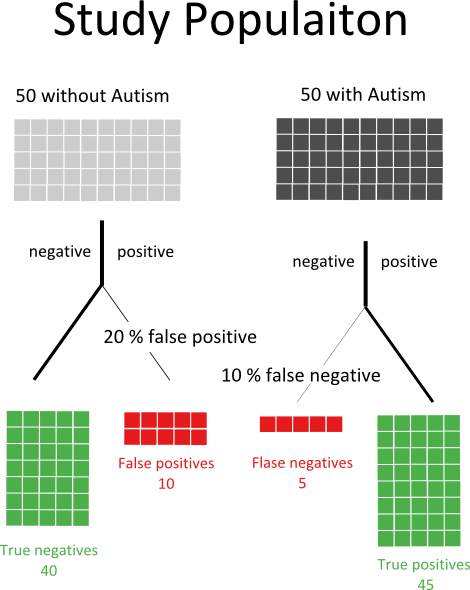
Now, imagine you were in this study population, you didn't know if you were autistic or not, and you got a positive result. How sure could you be that you actually had autism? You might think the answer was 90%, afterall the test is 90% accurate right? In fact, you have to consider the possibility you are one of the ten people we expect to get a false positive result. The probability of having autism if you have a positive test is actually the number of true postives divided by the total number of positives:
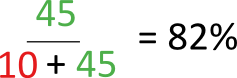
So, the test is pretty good but once you include the chance that you have a false-positive the predictive power of the test goes to about 82% . It get's much worse. In the example above we started with autism rate of 50%, in the real world it's something closer to 1%. Let's presume that we aren't going to start a massive screening program for autism, and instead say that 10% of the people referred to doctors for perceived problems in social and educational development actually have autism. How would out test work on that patient population?
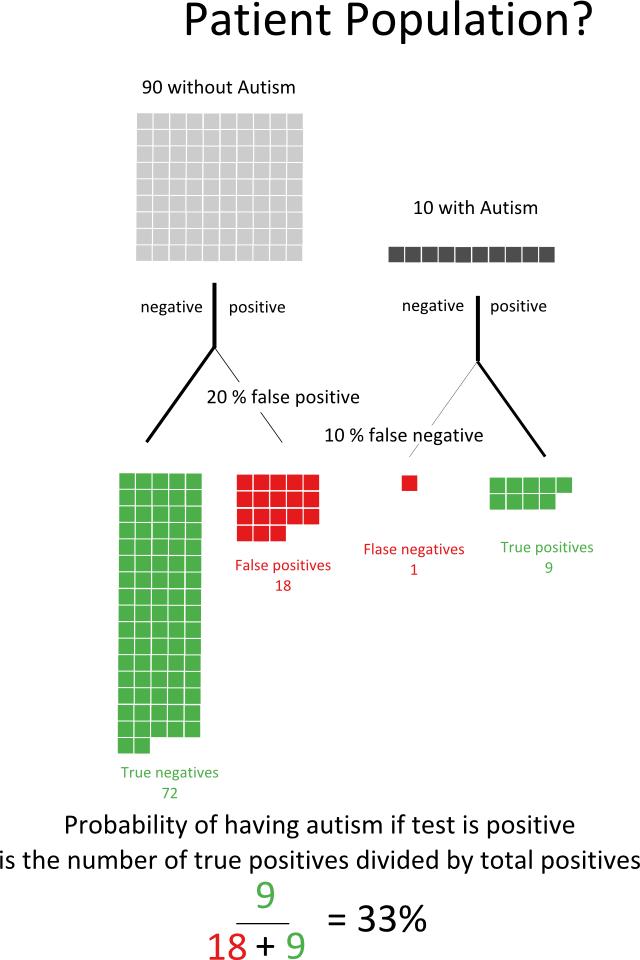
Now if you got a positive result you could still say you probably don't have autism! The predictive power of the test has fallen to 33%. It get's even worse when you think of actually screening the whole population - if 1% of people tested for autism actually had autism then the predictive power of this test would fall to 4.5%.
This problem isn't limited to the new autism scan - any test for a disease which is rare will need to have a very high sensitivity and especially specificity for it to be useful. You sometimes hear people complain that the like of a prostrate cancer screening program using the Prostate Specific Antigen (PSA) test is part of the medical professions attempt to alienate men. In fact, the PSA test has a low specificity. If you were to screen all men for PSA you would get a lot of false positive results, which would lead to a lot of unnecessary biopsies. That's not just an expensive problem, any medical intervention carries a risk so those biopsies would be placing large numbers of men at risk for no good reason. That's not to say the PSA test doesn't have it's uses, if instead of screening all men you only test those who already have a higher risk of prostate cancer you will descrease the number of false positives and the test's predictive power will increase.
Labels: pretty data, sci-blogs, science, science communication, statistics
Wednesday, March 17, 2010
Lawrence Krauss on a bad day
Dunedin got to see Lawrence Krauss on a good day and a bad day this week, but that’s not to say one of his presentations was better than the other. Yesterday the award winning physicist and scientific communicator revealed to his audience that his outlook on life changes from day to day. On good days he can revel in the wonder of a universe that could come to know itself due to a series of accidents that started 10-31 seconds after the big bang and allowed the creation of first matter then atoms, stars and planets and finally astronomers. On bad days he despairs at the lack of scientific thinking in journalism and politics and thinks these problems, and the anti-scientific forces that fuel them, will probably prevent us from doing anything meaningful about climate change.
Krauss' awe inspiring story of an atom's journey from the birth of the universe to its death will gain nothing from my retelling it. If you weren't able to see it then you'l be glad to know his talk was a précis of his excellent book ATOM: An Odyssey from the Big Bang to Life on Earth...and Beyondand covers similar ground to this recored lecture. Perhaps I'm a masochist and a pessimist, but I'm going to skip the awe inspiring story to focus on what Lawrence Krauss thinks about on a bad day. His talk on "Science, Non-Science and Nonsense" described the sources of scientific confusion in society and the tactics used by those groups that seek to take advantage of it.
Krauss argued that the goal of science education and science communication should be to make sure everyone develops a functioning bullshit filter. He didn't express his thesis quite as bluntly as that, but his core idea is that spreading a scientific mindset would allow us to short circuit needless debates (is global warming real?) and let us get on to the important ones (what are we going to do about it?). He used a neat example to illustrate how this sort of scientific common sense could stop nutty ideas before they get started. UFO enthusiasts often cite the ability of the lights they observe to perform right angle turns at speed as evidence of their otherworldliness. In fact, Krauss pointed out, common sense should tell us that these apparently amazing maneuvers are evidence that the lights in question are not being emitted by a massive object moving through the sky. The only way to turn at a right angle is to stop then change direction, for a UFO to do all its slowing down and stopping so quickly a human observer couldn't perceive it would generate G-forces with a strength about 2000 times greater than earth's gravity. And quite a mess.
If the evidence used by UFO junkies is so silly then why do continue prosper? Why aren't people already filtering this sort of nonsense? The standard of scientific reporting in the media certainly has a lot to answer for. Krauss cited the normal concerns, a fractionated media market means viewers can choose a source of news that confirms their biases and the innate need of journalists to present balance is misplaced in science stories when, in almost every case, one side is wrong and we usually know which side that is. He also mentioned something I hadn't thought about before. According to Krauss, part of the problem with science coverage in mainstream reporting is that journalists don't feel qualified to make scientific pronouncements. Writers and broadcasters are happy to make bold statements on politics, financial markets and sports but will shy away from even a scientifically uncontroversial statement like "evolution is a fact."
Scientific understanding might not be helped by meek journalists and the false equality of balance but most journalists aren't setting out to deliberately mislead the public on science. Unfortunately, there are forces at work that are doing just that. Krauss had a tonne of examples from the culture wars in his native USA to draw on but he also took the time reminded us of our home grown cranks, citing the New Zealand Climate "Science" Coalition and Ray Comfort (The Apologists Nightmare [youtube video]) as evidence we aren't immune to anti-science in New Zealand. As you'd expect Krauss exposed just how vacuous the claims of intelligent design creationism and the objections of climate change denialists are, but he also attempted to deconstruct the PR strategies each group use. Both campaigns seek to take advantage of the public's sense of fairness and journalists' willingness to provide balance to any point of view. The Discovery Institute would have you believe their goal is simply to get their science a fair hearing in the classroom. But they don't have a science. For normal science, theories only make it into the school curriculum after they've been proposed, tested, retested and confirmed. The ID crowd don't want fair treatment, they want special treatment, to avoid that boring scientific process and start in the classroom!
Krauss could hardly have known this, but our own climate cranks play the same game. I hate to make an example of this article because the author usually covers science well, nevertheless it highlights the point. In an effort to provide balance to a story on how the IPCC might be made better the author contacted Vincent Gray for comment, here's the paragraph
Wellington scientist and climate change sceptic Vincent Gray said the researchers were continually coming up with "new models" but they were still "fiddling the figures" and were unlikely to restore public confidence in their work until their projections were proven
That sounds pretty fair doesn't it? Climate scientists can run their model forward in time and if their projections match observations we'll take action. Actually, it's absurd. As Krauss emphasised in his talk, the evidence for climate change doesn't only come from models, we have tonnes of data that tell us the earth is warming and the seas are rising. Combine those data with the fact recent temperature records are within the uncertainties of the IPCC's projections and sea levels are near to the upper bound of those projections and Gray's sound bite seem less fair.
Krauss had more problems than solutions in his hour long presentation. In fact, it's a testament to the passion he has for his science and skill he has as a scientific communicator that he managed make a talk made almost entirely of depressing facts seem invigorating. The only ray of hope Krauss offered us was that when people's backs are to the wall they abandon their their preconceptions and to turn to science. In 2003 George W. Bush said that he believed "both sides" of the "evolution debate" should be taught in schools. In 2005 Bush was faced with the prospect of Avian flu becoming able infect humans. Confronted with threat of a flu pandemic the Bush administration dispensed with its evolutionary agnosticism and planned for the possibility of genetic mutations allowing viruses to pass from human to human. That sort of infectivity requires conformational changes in surface proteins which create a new function, exactly the sort of phenomenon the ID crowd think is so improbable as to be effectively impossible.
Krauss will be presenting something very similar to his Dunedin talk in Auckland next week. I'd encourage anyone who has the chance to get out and seem him, he's a very chrasmatic and interesting speaker. You might even ask the question I really wish I did now- how are we going to fix all these problems?
Labels: climate change, evolution, Lawrence Krauss, might interest someone, sci-blogs, science and society, science communication, skepticism
Wednesday, March 10, 2010
Talking about talking about science
I've been swamped by the requirements of my real work for the last couple of weeks which has meant I've more or less neglected The Atavism just when a set of new scientific posts might have impressed voters in the Research Blogging Awards with this blog's vitality. I do have a couple of substantive posts on the boil but for now I'm going to resort to flinging out a few links and half digested ideas on science communication
***
Let's start at sciblogs where Ken Perrot has a review of Cornelia Dean's guide for scientists Am I making myself clear? It's particularly interesting to read that Dean urges scientists to write for newspapers in the same week that Grant Guilford publihsed some clear thinking in response to nonsense about climate science. The nonsense was in The Herald and no doubt read by thousands, the sensible reply is on some obscure piece of the University of Auckland's website...
***
***
I don't think I'll be writing a pop-sci book anytime soon but, obviousy, I do think science blogs have a place in getting science out to the public so I don't quite know what to make of this very odd paper on scientific blogging. The authors take a set of posts from 11 widely read science blogs and draw the following conclusions
Science blogs are a virtual water cooler for graduate students, postdoctoral associates, faculty, and researchers from a variety of disciplines and areas of inquiry. The conversations in science blogs are also of “water cooler” quality ...
To become a tool for non-scientist participation, science blogs need to stabilize as a genre or as a set of subgenres where smaller conversations may facilitate more meaningful participation from members of the public. Science bloggers need to become more aware of their audience, welcome non-scientists, and focus on explanatory, interpretative, and critical modes of communication rather than on reporting and opinionating.
Which is what happens when you presume 11 blogs is a representative sample of the thousands of people who are writing about science on the net. Of course there are blogs that are pitched at other experts and other blogs that deal mainly in links but presumably that's because that's what the authors want to do with their blogs!
If the authors of the paper wanted to see how blogging fits in to describing scientific ideas and news to non-scientists then they might have started, not with 11 blogs plucked from google, but by selecting blogs that are aimed at a lay audience . If you want interpretation and explanation of the day's science news there are superb writers like Carl Zimmer and Ed Yong to help you out. If you want a scientist to bring their expertise to bear on some topic then there's a whole mess of blogs (1, 2 3, 4, 5... and another thousand or so here) that do just that (and I like to think The Atavism fills one small niche in that sprawling ecosystem). A thoughtful review of those blogs would have served a real purpose, it's hard to see that the published paper does. One good thing came from that paper though, I now know there is a Journal of Science Communication, I trust some of the other papers will be more useful. (If you are interested The Panda's Thumb and Blog around the Clock have more detailed reviews of the paper)
***
Finally, congratulations to Elizabeth Connor who has won the inaugural Prime Minster's Science Media Communication Prize (really, that's the flowing title given to a prize for communicating difficult ideas...) which gives her $150 000 to undertake a program that focuses on "the mystery intrigue and uncertainty of science."
Labels: sci-blogs, science and society, science communication
Wednesday, January 20, 2010
Doing Science in Public
- Fabiana Kubke has heard something strange about Tui and wants your help to check it out. She's not telling us exactly what it is that she's testing just yet but to get involved all you have to do is drop her a line with a few details when you see a Tui. Fabiana described the project and the idea of citizen science to Noelle McCarthy on National Radio so I'll let her provide the details [streaming audio]
- A group of scientists from the Univeristy of Canterbury have been documenting their work on the Chatham Islands with a blog, Life on the Edge of the World.
- The people that brought you Science Creative Quarterly have a sneaky plan: to hijack kids' freakish ability to recall details about hundreds of Pokemon "species"and use it to teach them a few things about real animals. You can read about the phylomon project here - it's brand new and looking for input from graphic artists, photographers, science geeks, gaming geeks and really anyone that's interested.
- Finally, go over and welcome another Otago geneticists to the blogosphere. Tamsin is a PhD student working on the genetics of embryonic development which means she has tonnes of stunning images to blog about.
Labels: citizen science, might interest someone, sci-blogs, science and society, science communication

All content not otherwise marked is licensed under a Creative Commons Attribution-ShareAlike 3.0 Unported License.


