
Sunday, January 20, 2013
Sunday Spinelessness - 5 down.... quite a few to go
Biology is about diversity. I know I always go on about this, and end up affecting the overly-enthusiastic style of the guide in Douglas Adams's Hitchiker's Guide to the Universe:
Biological is diverse. You just won't believe how vastly, hugely, mind- bogglingly diverse it is. I mean, you might think there are lot of creatures in your average David Attenborough documentary, but that's just peanuts to the true diversity of biological systems, listen...Well, I don't know to put in words, so let's try a picture. All that biological diversity got here because life evolves. When populations break up they are free to evolve apart from each other and develop entirely new functions or features and so become different. In this way, life is a tree, forming new branches as populations split. When we come to deal with the diversity of life, biologists try to reconstruct that tree, giving names to those tips and twigs which belong to a particular branch. In that system of classification the phylum (plura phyla) is the one of the deepest divisions.
Creatures in separate phyla have usually been evolving apart from each other for 600 million years or more, and represent entirely different ways to deal with the trials of life. The annelid paper will mean I've published on 5 different phyla. That's exciting for me - it's nice to think I've added a little to our knowledge of decent sampling of the tree of life. But the truth is, biology is just so diverse that I've not even made a dent the tree of life. Here's a picture of all the Eukaryotic phyla (that is, creatures with cells like ours, but not bacteria and archaea) with only those I've published at least one paper on labeled:

Labels: my research, phylogenetics, sci-blogs, science, sunday spinelessness

Thursday, August 9, 2012
Measuring population differentiation in R

Biologists often want to be able to measure the degree to which a population is divided into smaller sub-populations. This can be an important thing to quantify, because sub-populations within highly structured populations are, to some extent, genetically distinct from other sub-populations and therefore have their own evolutionary histories (and perhaps futures).
To illustrate this point I've run some simulations. Imagine if we had 5 subpopulations, each with a thousand individuals. In each population we will follow the fate of a locus with two alleles, R and r that have no effect on survival or reproduction and start with frequencies 0.8 and 0.2 respectively (these numbers motivated by this post). In the absence of gene flow between these populations (Panel 1) the frequency of the r allele bounces around due to genetetic drift (evolutionary change, after all, is inevitable). Crucially though, changes in one population can't effect other populations so we end up with substantial among-population differences in allele frequency. In the next two panels, in each generation a proportion of each population's individuals (0.001 and 0.01 respectively) are drawn from the other populations in the simulation. Now that the populations are sharing genes the lines that represent their allele frequencies pull together (that is, the among-population variation is reduced).

One way to quantify the among-population variation displayed in these simulations is to look at the number of heterozygotes you expect to observe across the entire population. The final values for P(r) in the first simulation were {0.33, 0.47. 0.88. 0.10. 0.33} with a mean frequency of 0.42 (so the frequency of the R allele would be 0.58). Knowing our Hardy Weinberg, if we had one big population with two alleles, one being at a frequency of 0.42 we'd expect to get 2pq = 2 * 0.42 * 0.58 = 0.40 heterozygotes. We can call that number HT for expected total heterozygosity. But thats not what we'd actually see in this case. The sub-populations that make up this larger population have their own allele frequencies, when we calculate the expected proportion of heterozygotes for each of these populations by themselves we end up with {0.44, 0.49, 0.21, 0.18, 0.44} for a within-population expected heterozygosity (HS) of 0.35*. This lack of heterozygotes within sub-populations compared with the total population expectation will always arise when genetic drift makes sub-populations distinct from each other. Masatoshi Nei used this pattern to propose a statistic to quantify population divergence called GST, which he defined like this:
Although the problem of GST's dependence on HS has been known for a while, it's taken some time for new statistics that get around this problem to be developed. Philip Hedrick (doi: 10.1554/05-076.1) along with Patrick Meirmans (doi: 10.1111/j.1755-0998.2010.02927.x) introduced G''ST - a version of GST that is corrected for the observed value of HS as well as the number of sub-populations being considered. Meirmans used a similar trick to define φ'ST (doi: 10.1111/j.0014-3820.2006.tb01874.x), another FST analogue that partitions genetic distances into within- and between-population components. Most recently, Lou Joust introduced an entirely separate statistic, D, that directly measures allelic divergence (doi 10.1111/j.1365-294X.2008.03887.x).
The statistical programming language R is becoming increasingly popular among biologists. Although there is a strong suite of tools for performing population genetic analyses in R, code to calculate these "new" measures of population divergence have not been available. My package, mmod, fills this gap. I won't give too many details of the package here, as that's detailed in the paper and the package is will documented. Briefly, mmod has functions to calculate the three statistics described above (and Nei's GST ), as well as pairwise versions of each statistic for every population in a datastet. It also allows users to perform bootstrap and jacknife re-sampling of datasets, the results of which are returned as user-accessable objects which can be examined with any R function (there is also a helper function to easily apply differentiation statistics to bootstrap sample and summarise the results) . The library is on CRAN, so installation is as easy as typing "install.pacakge("mmod")", the source code is up on github. If want to use the package I'd suggest reading the vignette ("mmod-demo") before you dive in.
I'm keen to hear about bugs or feature requests from users, just email them to david.winter@gmail.com
Reference:
Winter, D.J. (in press). MMOD: an R library for the calculation of population differentiation statisticsMolecular Ecology Resources : dx.doi.org/10.1111/j.1755-0998.2012.03174.x
Labels: my research, population genetics, sci-blogs, science
Sunday, March 11, 2012
Sunday Spinelessness - Libera fratercula


It's not really possible to write about Pacific land snail faunas in the present tense - it's quite likely most of the species Solem described are now extinct as the result of habitat destruction and introduced pests. In the Cooks there were two major radiations, the Sinployea and Minidonta of Rarotonga, both now severaly eroded. The Cook's Libera are less diverse, but also have an interesting evolutionary history. There are forest-dwelling Libera species in many islands in the SW Pacific, and Rarotonga was no different with one species L. cavernula making its living in the vegetation. Libera fratercula (the handsome species photographed above) appears to be the closest relative of L. cavernula (that is, the two species arose within Rarotonga) but at some stage this lineage gave up on forest and started living on the beach. Specifically, L. fratercula lives in the piles coral rubble that accumulate on Rarotonga's beaches, having been broken away from the island's fringing reef. This is a harsh environment, with changes in temperature, saltiness and moisture occuring all the time - but the switch appears to have worked out for L. fratercula, which still has quite large populations around island whereas L. cavernula is now missing presumed extinct.
Rarotonga has plenty of coral rubble, but the other islands in the Southern Cook Islands are basically made of coral rubble. Mitiaro, Mangia, Atiu and Mauke are all small islands that have already gone through the all the steps of the typical life cycle of a pacific island: a fiery birth as a volcano; subsequent erosion into an ever smaller, flatter island; treading water as an atoll and finally dipping below the surface for ever. The islands of the Southern Cooks got another shot at life when, about 2 million years ago, fresh volcanic activity lifted the crust on which they sit and thrust the fossilsed remains of their coral reefs above the surface. These so-called makatea islands have no shortage of coral rubble and the Rarotongan L. fratercula populations live in just the right place to be swept out to sea. It seems that, among the thousands of snails that must have died having been washed out to sea, at least a few washed ashore on the makatea islands and took advantage of all that coral. Libera fratercula has made it to each of these smaller islands and they each have (or at least have had) populations of this species.
There's on more really cool think about about L. fratercula - but I'll have to wait until I take a few more photos (sadlt no field work required) to talk about that one. Here's a close up for the mean time:

*Hey, I can dream....
Labels: Cook Islands, endodontidae, Libera fratercula, my research, sci-blogs, snails, sunday spinelessness
Wednesday, February 29, 2012
A talk
It's going to be at 12 noon, Friday in the Benham Seminar Room (2nd floor of the "new" part of the Zoology building) . If you are around campus and have nothing to do over your lunch break you are most welcome to come along.
Of course, the slides aren't the talk...
Labels: my research, sci-blogs
Sunday, August 29, 2010
Sunday Spinelessness - New Zealand's GIANT Sprintgtails
I know, a couple of week it was multiple exclamation points, then a reference to lyrics from a band anyone who is remotely cool is trying to forget they ever liked and this week it's all caps all the way. Hopefully, by the end of this post you'll agree that, this time at least, the subject left me with no option.
I missed out a little fact about peripatus when I wrote about them the other day: Dunedin is full of them. There is even a local endemic species which appears to be restricted to one patch of "bush" which is little more than a road-side paddock. So, before I wrote that post I went on a little excursion to another reserve that I know has peripatus in the hope I'd find something to illustrate my ravings. I didn't uncover any of those wonderful animals, but what I did find was every bit as cool:
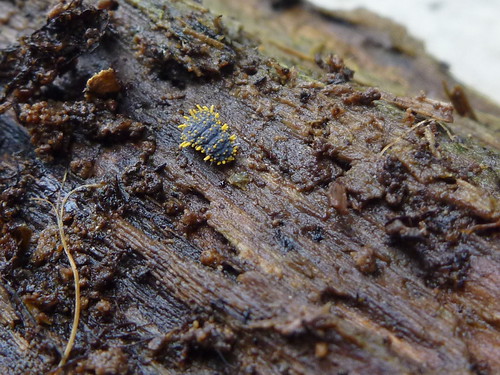
The little grey-blue thing with the bright yellow spikes is Holacanthella paucispinosa, one of New Zealand's giant springtails. Are you amazed yet? Perhaps you need to know a little more about normal springails before you can appreciate the quiet grandeur of the giants.
I've writen about springtails (also known as Collembola) before, but they're animals that are worth two takes. Springtails are small, six legged arthropods which live mainly in the soil and leaf litter and such moist habitats. This might be the first time you've heard of them, but they've been around you for your whole life. They live on every continent (including Antarctica) and there are as many as 100 000 of them in your average square metre of soil. If you were to go outisde now and pick up a clump of soil from your garden or your lawn you'd almost certainly see a bunch of tiny elongate or globular creatures crawling around and, a few seconds later, vaulting off into the air. That bouncy behavior is achieved with an organ that is neither a spring nor a tail. It's called the furcula (meaning "little fork") an it is held under tension under the abdomen. When a springtail senses danger it can release the furcula, driving it into the ground and flinging the animal away from the threat.
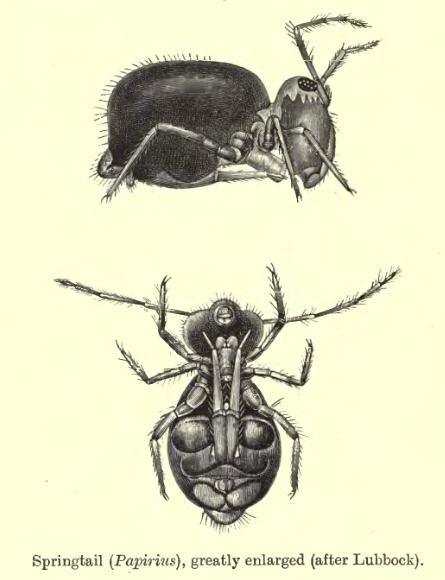
Drawing of a springtail from a British National History Museum display, the furcula is the fork-like organ on the underside of the animal
When they aren't flinging themselves around at random, springtails are playing an important role in the health of the soil. They contribute to the breaking down of organic matter themselves, and, at least as importantly, they move spores from mycorrhizal fungi from plant to plant. Mycorrhza are among the most important organisms on earth. They live on the roots of plants, where they help process soil minerals for their host in exchange for a more or less constant flow of sugars for the plant's photosysthesis. Almost all plant species have Mycorrhzal relationships, and the fungi are key players of the productivity of ecological and agricultural plantations. These two important jobs make springtails a major contributor to nutrient cycling in the soil. Given their enormous abundance and important jobs you might wonder why you don't hear a bit more about springtails. Well, most springtails are really, really small. To prove the point, I've just popped outside and pulled a brick from a retaining wall in our garden (it's OK, the giant clay back stayed up):
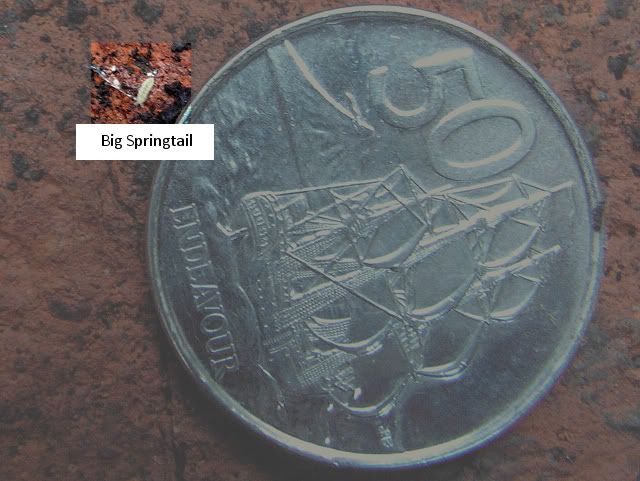
The tiny white thing in the upper left is a pretty big springtail (for North American readers, a New Zealand 50 cent coin is almost exactly the same size as a quarter). I didn't think to add something to provide scale in the H. paucispinosa photos, but that springtail would happily cover the "50" on the coin. H. paucispinosa's big cousin from up north, H. duospinosa, would cover a good deal more than half the diameter of the coin.
New Zealand has a fair few giant invertebrates. Every time I introduce myself as someone who studies snails I get asked about the giant carnivorous Powelliphanta (I study small snails that eat plants and are generally considered less cool). Then there's flax snails, weta, the glorious giant bush dragonfly (kapokapowai) and a one and a half metre long long earthworm. The Holacanthella usually get missed off the list of New Zealand giant invertebrates, even though they are many times larger than most of their relatives. I've done my bit in trying to fix that. These are the springtails I mentioned spending a summer looking for in my previous post. I did a summer studentship with Mark Stevens from Allan Wlison Centre in which we collected new samples from all over the country to get a gauge on just where they live and how they are doing. We published some of our results in the New Zealand Journal of Zoology .

As you might have guessed from our paper's venue, we didn't present any earth shattering new results. Instead, we laid the ground for anyone that wanted to do some more detailed studies of these creatures. We looked at all the currently described species in museum collections (Te Papa has pictures of two of the type specimens online) and in our new specimens and found that the existing key, the algorithm by which someone can identify a specimen to a species, didn't quite work. Some of the characters that were meant to diagnose species were found in some individuals of all species So we updated the keys, and presented updated data on the distribution of each species (there were only 18 locality records published when we started). Together, these results might form the basis of further studies.
The distirbution of giant springtail species and populations might be particularly interesting, since they are reliant on rotting hardwood logs for life and don't appear to able to disperse over any great distance. This lack of dispersal ability might mean that genetic relationships between Holacanthella populations might bare the mark of ancient geological and climatic events which have been overwritten in more dispersive animals. The Holacanthella's Australian cousin, the Acanthanura (which it's my patriotic duty to point our aren't quite as big as our giants.) have been used to infer small patches of forest that survived the last ice age. Their reliance on hardwood also makes the New Zealand's giant springtails interesting from a conservation point of view. We spent a lot of the summer in Wellington's hills looking for H. spinosa which was recorded all around the city at the turn of the 20th century. Most of those forests have been logged, and, though there is plenty of regenerating native bush around Wellington, H. spinosa didn't seem to survive the logging. By contrast, managed forests around Nelson and the Tongariro National Park had species-rich and dense population. It seems the giant springtails are particularly susceptible to changes in their forests. In fact, we even suggested that the presence of giant sprintails in a forest patch can be used as a marker for forest health ("canaries in the undergrowth"), in which case the City Council should be pleased to learn they are living in the little forest fragment I found these guys in!
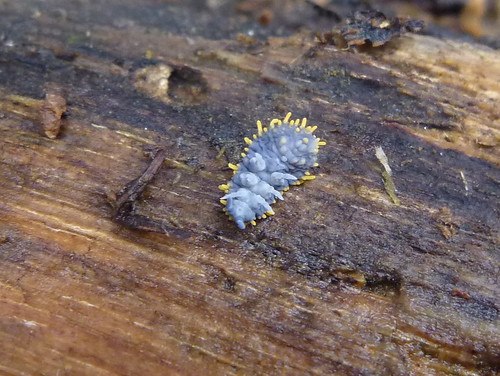
Too big to flail: Giant springtails are too massive to fling themselves about, so they've lost their furcula
I'm sure there are people think that our little paper on these creatures forms part of the "avalanche of low quality research" that is ruining everything for everyone. But, I can't tell you how many fascinating talks I heard at the Evolution meetings about the apple maggot fly, the three spined stickleback and the wild monkey flower. None of those creatures are any more likely an imoprtant model for evolutoinary biology than there names suggest, the only reason it became apparent that they represent important natural experiments is because people did the ground work, worked out a little about these species and published it in a small journal. There will probably never be a Nature paper out New Zealand's GIANT springtails, but you can't know that before you do the research!
Oh, I guess I should answer the most common question I get about these guys: I have no idea why they are covered in spikes.
Steens, M., Winter, D., Morris, R., McCartney, J., & Greenslade, P. (2007). New Zealand's giant Collembola: New information on distribution and morphology for Holacanthella Borner, 1906 (Neanuridae: Uchidanurinae) New Zealand Journal of Zoology, 34 (1), 63-78 DOI: 10.1080/03014220709510065
Labels: collembola, environment and ecology, Holacanthella, my research, photos, research blogging, sci-blogs, sunday spinelessness

All content not otherwise marked is licensed under a Creative Commons Attribution-ShareAlike 3.0 Unported License.


