
Sunday, May 6, 2012
Sunday Spinelessness - Each thing by its right name
For a moment she rediscovered the purpose of her life. She was here on earth to grasp the meaning of its wild enchantment and to call each thing by its right name...
I've recently learned the name of two species that turned up on these pages unnamed. So, let me introdue you to Thalassohelix igniflua (last seen in "they're alive!"):


Labels: Dunedin, sci-blogs, snails, sunday spinelessness, taxonomy

Sunday, April 8, 2012
Sunday Spinelessness - Molluscan mausoleum

This is from the high tide mark at Aramoana, and the shells that dominate the little assemblage are Zethalia zelandica - the New Zealand wheel shell. I don't have anything particularly important or meaningful to say about these shells. I was just struck by the diversity of the patterns and colours that they bear, and the concentration of shells into a relatively small stretch of a relatively large beach. Zethalia live in sandy conditions and somewhat deep water, so the shells presumably washed in from the harbour and had collected over time at a point at which the waves and currents coalesce.
Labels: Dunedin, environment and ecology, photos, sunday spinelessness, zethalia
Sunday, February 26, 2012
Sunday Spinelessness - They're alive!
It would take the most dedicated reader of The Atavism to remember the empty snail shell I wrote about last year. I'll admit even I'd mainly forgotten about myself, but this weekend I went on a little mini-field trip to collect a few samples for a colleague's ongoing project. In planning that trip I did remember the slightly mysterious shells I found last winter, and so decided to head back and see if I could get a few more to send along an an expert who might be able to put a name to them.
Sure enough, I found plenty more empty shells in different states of aging , but deep within the leaf litter I also uncovered one shell that was still playing house to an animal. I couldn't quite be sure there was a healthy animal in the shell when I first picked it up, since the snail was already retracted inside. Thhe easiest way to encourage a sleeping snail out from its shell is to warm in up, so I clasped it in my palm for about a minute and, well, here's the result:
Obviously, having taken the photographs I put this snail back under the nice moist leaf litter from which I'd taken it. Since then I've done a bit of research and I'm fairly confident that I've now identified this population down to genus level. But I've wrong about these things before (most recently by en entire superfamily...) so I'm still going to send the empty shells I collected from the same site to someone who has much more expertise than I do. I'll keep you updated on just exactly what these creatures are.
Labels: Dunedin, environment and ecology, molluscs, native snails, photo, sci-blogs, snails, sunday spinelessness
Thursday, May 24, 2007
Autumn in Dunedin
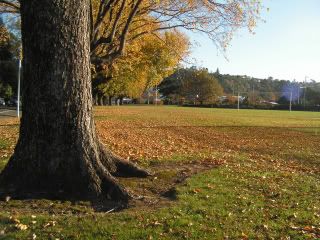
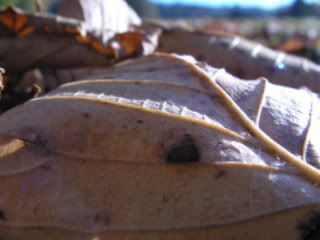 Dunedin’s all too short a lease on summer is running out. The bare chested, beer guzzling boys that made Castle Street their cricket pitch have found hoodies, high school leavers jerseys and rugby balls. Students they have been around Dunedin long enough to know are reconciling themselves with the city’s slide into a winter of cold dark mornings followed quickly by cold dark evenings. Even the trees around campus are hunkering down. . The chemical cascades that ran wild in leaves through the summer to capture the sun’s energy are grinding to a halt. Keeping these reactions going through the winter would cost more energy than they could generate so the leaves, like middle management closing down an unprofitable branch, let the leaves fade and fall.
The autumn displays that deciduous trees put on are rightly held up as an example of the great beauty in the natural world. Until recently the scientific understanding of these displays has been entirely more prosaic. The green, light catching pigment chlorophyll is hard to make and as such a valuable resource for a tree. Before the tree cuts its leaves free it strips their assets - taking all the chlorophyll out to reinvest it in the next season’s crop. With the very green chlorophyll removed red and brown pigments (always present but previously swamped by the chlorophyll) shine through and you get autumn colours. However, over the last few years another theory has challenged this idea and enlivened scientific interest in the phenomena occurring around Dunedin at the moment.
The new theory is among the very last from W. D. Hamilton, one of the 20th century’s greatest biologists. When Hamilton died in 2000 he was eulogised as “the most distinguished Darwinian since Darwin” and generally lauded for the way his insightful, almost whimsical (he once proposed clouds were generated by bacteria as a way of spreading themselves) ideas revolutionized biology. Hamilton was a key figure in a generation of English biologists that sought to describe almost everything in nature, including humans and our behaviour, as the result of evolution by natural selection and in so doing formed the ‘adaptationist school’ of evolutionary theory. Hamilton’s greatest contribution to this effort was to show that seemingly altruistic behaviour by an organism towards its relatives (including parental care) can be explained in terms of natural selection acting at the level of genes. This theory formed an important part of Richard Dawkins’ bestselling popularisation The Selfish Gene
Later in life Hamilton focused on another evolutionary mystery. Sexual reproduction seemed counterproductive in the genetic understanding of evolution he had helped to usher in. If each individual is acting to maximise the amount of genetic material it passes to the next generation then putting only half of your genes into each child and having half of those offspring themselves unable to bear more young (that is to say being male) seems a silly idea. As Hamilton’s colleague John Maynard Smith pointed out sexually reproducing organisms must reap some evolutionary advantage over asexually reproducing ones or evolution would favour a return to asexuality (as has happened in many lineages). Hamilton believed that sexual reproducing organisms may be reaping that reward in the constant and expensive wars they wage with parasites. By mixing their genes with each other organisms may be able to make novel weapons in that fight that asexual clones couldn’t arrive at. The first support for this idea from nature came from lakes right here in New Zealand’s South Island. The tiny snails you find clinging to rocks in our lakes are a perfect model in which test Hamilton’s ideas because they are heavily parasitized in some areas and not in others and because some lineages reproduce sexually and others have given up on that idea and reproduce by cloning. In 1987 Curt Lively showed that sexually reproducing snails occurred where parasitisation was at its densest while asexual ones survived in higher numbers where parasitism was low. This is exactly what Hamilton’s theory predicts – sexually reproducing lineages are gaining an edge in parasite heavy lakes while asexual lineages prosper when they don’t have to fight many parasites
Much of Hamilton’s later worked centred on important the role of parasites in evolution, he went so far as to suggest they may explain the peacock’s ostentatious tail. He theorised that only males that were free of parasites and by extension healthy could invest in such elaborate displays. Shrewd peahens would therefore select partners with the most over-the-top tails to ensure their offspring got the best parasite fighting genes. In other words, to Hamilton a peacock’s tail was a gawdy advertisement for its owner’s genes.
He even thought parasites might explain autumn colouration. In a paper published posthumously in the Proceedings of the Royal Society of London Hamilton argued that deciduous tree’s autumn displays might represent an advertisement similar to a peacock’s. In his theory autumn colours are actually a tree’s way of telling parasitic insects that the tree is so healthy it can stop photosynthesising early and invest in bright red and yellow colouration as a warning. A tree that is strong enough to give up it’s energy making process early must surely be strong enough to invest in the many measures trees take against their parasites so a prudent insect will stay well clear of such a tree when it some time to lay its eggs.
One of the hallmarks of a good scientific theory is testable predictions. Hamilton’s signalling hypothesis makes several predictions, many of which are gaining experimental support. First, if the yellow and red leaves are indeed a signal to be taken seriously by potential parasites then we would expect only healthy trees could invest in colouring their leaves at the time the parasites arrive. One good marker for the health of a tree is how symmetrical that tree’s leaves are – healthy trees produce nice symmetrical leaves while trees under stress make more irregular ones. In 2003 Norwegian researchers took yellow and green leaves from birch trees in early autumn. According to Hamilton’s theory only the healthy trees will be investing in yellow leaves so, on average, the yellow leaves will be more symmetrical. When the researchers measured the leaves this is exactly what they found.
If autumn colours are a signal for insects and they would need to be made when infection by parasitic insects was likely. Swiss researchers confirmed in 2004 that deciduous trees in that country change colour when aphids start to lay eggs (which will hatch in spring when the trees produce sugar rich sap) Thirdly, if the signal is actually heeded by insects we would presume those aphids in fact steered clear of the trees making the strongest displays and picked the ones that were still green. The same Swiss team and a number of other investigators have reported that aphids show a strong preference to laying their eggs on green leaved trees. Finally, and most obviously, Hamilton’s theory also suggests that the healthy trees that invest in signals suffer less at the hands of parasites in the following spring. This prediction was born out in 2003 Norwegian study.
All this speaks strongly for the veracity of Hamilton’s signalling hypothesis. Still, a great number of scientists remain sceptical and number of related and unrelated theories has been proposed in response to Hamilton’s. Which ever theory turns out to be true Hamilton’s signalling hypothesis is one of the last gives from one of the greatest minds in biology. He took one of the most mundane stories in biology – fiscal dowdiness on the part of trees – and enlivened it. In Hamilton’s view the hills around Dunedin are on fire with warning shots from and evolutionary cold war, a fine example of how a little insight to the workings of biology can add yet more beauty to the natural world.
Sadly, it seems Hamilton's theory may be, in the word of TH Huxely, "that great tragedy of Science - the slaying of a beautiful hypothesis by an ugly fact". Check out what Carl Zimmer (whose blog put me on to this story in the first place) has to say on it.
Dunedin’s all too short a lease on summer is running out. The bare chested, beer guzzling boys that made Castle Street their cricket pitch have found hoodies, high school leavers jerseys and rugby balls. Students they have been around Dunedin long enough to know are reconciling themselves with the city’s slide into a winter of cold dark mornings followed quickly by cold dark evenings. Even the trees around campus are hunkering down. . The chemical cascades that ran wild in leaves through the summer to capture the sun’s energy are grinding to a halt. Keeping these reactions going through the winter would cost more energy than they could generate so the leaves, like middle management closing down an unprofitable branch, let the leaves fade and fall.
The autumn displays that deciduous trees put on are rightly held up as an example of the great beauty in the natural world. Until recently the scientific understanding of these displays has been entirely more prosaic. The green, light catching pigment chlorophyll is hard to make and as such a valuable resource for a tree. Before the tree cuts its leaves free it strips their assets - taking all the chlorophyll out to reinvest it in the next season’s crop. With the very green chlorophyll removed red and brown pigments (always present but previously swamped by the chlorophyll) shine through and you get autumn colours. However, over the last few years another theory has challenged this idea and enlivened scientific interest in the phenomena occurring around Dunedin at the moment.
The new theory is among the very last from W. D. Hamilton, one of the 20th century’s greatest biologists. When Hamilton died in 2000 he was eulogised as “the most distinguished Darwinian since Darwin” and generally lauded for the way his insightful, almost whimsical (he once proposed clouds were generated by bacteria as a way of spreading themselves) ideas revolutionized biology. Hamilton was a key figure in a generation of English biologists that sought to describe almost everything in nature, including humans and our behaviour, as the result of evolution by natural selection and in so doing formed the ‘adaptationist school’ of evolutionary theory. Hamilton’s greatest contribution to this effort was to show that seemingly altruistic behaviour by an organism towards its relatives (including parental care) can be explained in terms of natural selection acting at the level of genes. This theory formed an important part of Richard Dawkins’ bestselling popularisation The Selfish Gene
Later in life Hamilton focused on another evolutionary mystery. Sexual reproduction seemed counterproductive in the genetic understanding of evolution he had helped to usher in. If each individual is acting to maximise the amount of genetic material it passes to the next generation then putting only half of your genes into each child and having half of those offspring themselves unable to bear more young (that is to say being male) seems a silly idea. As Hamilton’s colleague John Maynard Smith pointed out sexually reproducing organisms must reap some evolutionary advantage over asexually reproducing ones or evolution would favour a return to asexuality (as has happened in many lineages). Hamilton believed that sexual reproducing organisms may be reaping that reward in the constant and expensive wars they wage with parasites. By mixing their genes with each other organisms may be able to make novel weapons in that fight that asexual clones couldn’t arrive at. The first support for this idea from nature came from lakes right here in New Zealand’s South Island. The tiny snails you find clinging to rocks in our lakes are a perfect model in which test Hamilton’s ideas because they are heavily parasitized in some areas and not in others and because some lineages reproduce sexually and others have given up on that idea and reproduce by cloning. In 1987 Curt Lively showed that sexually reproducing snails occurred where parasitisation was at its densest while asexual ones survived in higher numbers where parasitism was low. This is exactly what Hamilton’s theory predicts – sexually reproducing lineages are gaining an edge in parasite heavy lakes while asexual lineages prosper when they don’t have to fight many parasites
Much of Hamilton’s later worked centred on important the role of parasites in evolution, he went so far as to suggest they may explain the peacock’s ostentatious tail. He theorised that only males that were free of parasites and by extension healthy could invest in such elaborate displays. Shrewd peahens would therefore select partners with the most over-the-top tails to ensure their offspring got the best parasite fighting genes. In other words, to Hamilton a peacock’s tail was a gawdy advertisement for its owner’s genes.
He even thought parasites might explain autumn colouration. In a paper published posthumously in the Proceedings of the Royal Society of London Hamilton argued that deciduous tree’s autumn displays might represent an advertisement similar to a peacock’s. In his theory autumn colours are actually a tree’s way of telling parasitic insects that the tree is so healthy it can stop photosynthesising early and invest in bright red and yellow colouration as a warning. A tree that is strong enough to give up it’s energy making process early must surely be strong enough to invest in the many measures trees take against their parasites so a prudent insect will stay well clear of such a tree when it some time to lay its eggs.
One of the hallmarks of a good scientific theory is testable predictions. Hamilton’s signalling hypothesis makes several predictions, many of which are gaining experimental support. First, if the yellow and red leaves are indeed a signal to be taken seriously by potential parasites then we would expect only healthy trees could invest in colouring their leaves at the time the parasites arrive. One good marker for the health of a tree is how symmetrical that tree’s leaves are – healthy trees produce nice symmetrical leaves while trees under stress make more irregular ones. In 2003 Norwegian researchers took yellow and green leaves from birch trees in early autumn. According to Hamilton’s theory only the healthy trees will be investing in yellow leaves so, on average, the yellow leaves will be more symmetrical. When the researchers measured the leaves this is exactly what they found.
If autumn colours are a signal for insects and they would need to be made when infection by parasitic insects was likely. Swiss researchers confirmed in 2004 that deciduous trees in that country change colour when aphids start to lay eggs (which will hatch in spring when the trees produce sugar rich sap) Thirdly, if the signal is actually heeded by insects we would presume those aphids in fact steered clear of the trees making the strongest displays and picked the ones that were still green. The same Swiss team and a number of other investigators have reported that aphids show a strong preference to laying their eggs on green leaved trees. Finally, and most obviously, Hamilton’s theory also suggests that the healthy trees that invest in signals suffer less at the hands of parasites in the following spring. This prediction was born out in 2003 Norwegian study.
All this speaks strongly for the veracity of Hamilton’s signalling hypothesis. Still, a great number of scientists remain sceptical and number of related and unrelated theories has been proposed in response to Hamilton’s. Which ever theory turns out to be true Hamilton’s signalling hypothesis is one of the last gives from one of the greatest minds in biology. He took one of the most mundane stories in biology – fiscal dowdiness on the part of trees – and enlivened it. In Hamilton’s view the hills around Dunedin are on fire with warning shots from and evolutionary cold war, a fine example of how a little insight to the workings of biology can add yet more beauty to the natural world.
Sadly, it seems Hamilton's theory may be, in the word of TH Huxely, "that great tragedy of Science - the slaying of a beautiful hypothesis by an ugly fact". Check out what Carl Zimmer (whose blog put me on to this story in the first place) has to say on it.

All content not otherwise marked is licensed under a Creative Commons Attribution-ShareAlike 3.0 Unported License.


