
Tuesday, September 29, 2009
Where did you get that preposterous hypothesis

From time to time you find yourself disagreeing with something you read in a scientific paper. Perhaps you don't think the authors have applied a method correctly or ,more often, you don't think that the results they present are enough to justify the claims made in the their discussion or their university PR department's breathless press release. You don't often end up wondering if the third most prestigious journal in the world might have an April Fool's day issue. But what else is one to think when confronted with an opening paragraph like this one from a recent paper [1]:
I reject the Darwinian assumption that larvae and their adults evolved from a single common ancestor. Rather I posit that, in animals that metamorphose, the basic types of larvae originated as adults of different lineages, i.e., larvae were transferred when, through hybridization, their genomes were acquired by distantly related animals.
Got that? The author thinks that animals with distinctly different larval forms (caterpillars and butterflies, tadpoles and frogs, veligers and marine snails...) don't descend from a single ancestor that had a simple life history and later developed a two-stage strategy. Rather, Donald Williamson thinks that metamorphosing organisms are chimeras - hybrids between two distinct lineages in which the two parental genomes have reached a compromise such that one parent gets to run what we call the larval form and the other oversees the adult.
This is certainly not a mainstream idea, but the paper I'm talking about was published in the Proceedings on the National Academy of Science (PNAS), one of the most prestigious scientific journals that there is, Williamson must have some good data to support his idea right? Well, no. Williamson's entire case appears is that he finds it really really hard to imagine metamorphosis evolving in gradual steps and, besides, some larval forms look quite a lot some other organisms. Williamson does distinguish himself from other pedlars of what Richard Dawkins has named the "argument from personal incredulity" by at least providing a specific hypothesis to test: modern insects with 'caterpillar' larvae (butterflies, beetles, ants, wasps, bees, files...) descend from an 'accidental' mating between a flying insect and an onychophran (no illustration of this process is provided).
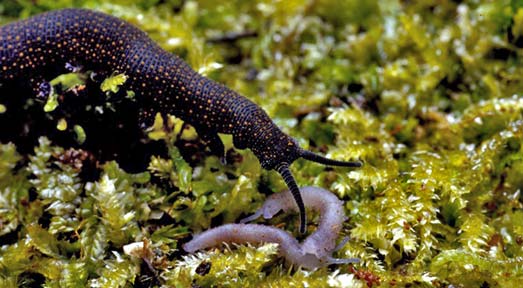 Peripatoides novaezealandiae, a wide spread New Zealand endemic onychophoran and young, photo © Te Ara
Onychophorans (which we usually call 'peripatus' in New Zealand) are part of that admittedly large list of creatures that can be called "David's favourite animals" so before we hang Williamson's preposterous hypothesis out to dry I'm going to have to subject you to a little bit of cheer-leading. This is not the first time that onychophorans have been the subject of woolly evolutionary thinking. Since they are likely related to some of the most spectacular cambrian fossils people have called them "living fossils" and you'll even sometimes hear it proposed they represent a *shudder* "missing link" between arthropods (insects, crustaceans, spiders...) and annelids (earthworms and their kin). Which is all a great shame because it diverts attention from the fact the onychophorans are nocturnal hunters which crawl through the leaf litter on hydro-statically inflated legs in pursuit of small invertebrates which they immobilise with a sticky glue they spray from their mouths in order to let them inject digestive enzymes into their stricken prey and suck the resulting soup from its lifeless body. That's the sort of thing people ought to know about it.
What about Williamson's "larval transfer" idea? Is this a case, like Wegner and continental drift or Bretz on ice ages, in which science needs some outré thinking to get itself out of a rut that is holding it back? Hardly.
Insect metamorphisms isn't that hard a problem
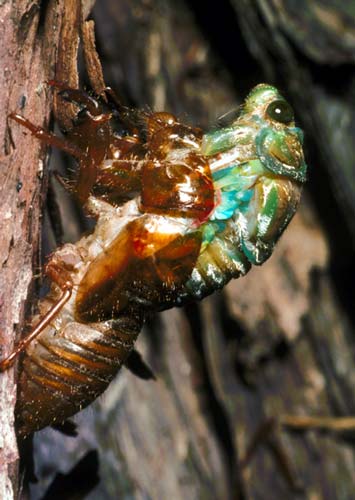
An adult cicada emerging from its last nymphal molt © Te Ara
.Just how complete metamorphosis of the sort you see in butterflies evolved is a genuinely difficult and, as such, interesting question. But it's one that Williamson clearly hasn't bothered to read about. If he had he would've found a lovely review from Deniz Ereyilmaz2 who traces the history of the problem and makes a case that larvae are effectively free living embryos (an idea that was articulated by Harvey (of the circulatory system) and later used by Darwin in the 6th edition of The Origin to reply to contemporary criticism that his theory couldn't explain metamorphosis). Specifically, the idea is that the holometabolous insects (the ones that undergo complete metamorphosis) evolved from direct developing insects like cicadas and grasshoppers. In these insects the final stage of embryonic development is called a pronymph, in most species the pronymph molts into a mini-adult (called a nymph) before it hatches but a few species actually hatch as pronymphs. Ereyilmaz and the few entomologists that have tackled this question in recent years think holometabolous insects descend from species in which the pronymph hatched and then became able to feed. From there the development of the pronymph stage was extended while nymphal development (which usually proceeds as small changes accrued in each of several molts) was progressively squeezed into one step, which we now call pupation (like a caterpillar's cocoon).
There is some nice genetic evidence that something like that process has happened. One of the genes required to start the metamorphosis process is called broad, mutants that can't produce functional broad protein fail to pupate. Insects like cicadas and grasshopers that don't undergo complete metamorphosis also have copies of broad but in these insects broad is expressed at each nymphal molt - consistent with the idea pupation in holometabolic insects corresponds to nymphal molt in direct developing insects.
The evolution of complete metamorphosis remains an interesting question (if you are want to learn more Christopher Taylor has deeper look at it than I've given here) but the sort of path laid out above - the gradual addition of multiple, relatively small changes to the existing insect life cycle is surely orders of magnitude more likely than two genomes being thrown together and, somehow, deciding to regulate two complete separate developmental programmes as well as the entirely new process of breaking down the first genomes animal before development of the second one can begin?
Complete metamorphosis doesn't use two sets of genes
Williamson also asks 'genomocists' to search for distinct genomes within the DNA sequence of holometabolous insects. We don't need a complete genome to know that the same genes are being used in the development of adults and larvae. People have been studying the genetic basis of development in Drosophila (which my taxonomic pedantry won't allow me to call fruit-flies) for at least 20 years - all Williamson needed to do to check his hypothesis against the evidence was open an undergraduate textbook. Had he done that he would have seen, in one tirivial example, that the that patterning of the adult wing in Drosphila requires the genes hedgehog and wingless (geneticists usually name genes after what loss of function mutants look like ) both of which are also vital to defining the polarity of the segments formed in embryonic development. We've also know since at 1997 [3] than oncychophorans and insects inherited their hox genes, (the genes that lay out the basic body plan in animals) from a common ancestor that lived before the two groups split up - and the holometabolic insects we've looked at only have one set of hox genes.So why is this in PNAS?
OK, so Williamson has his answer to the problem of metamorphosis and no evidence is about to sway him from it. But he's not asking for his nonsense to be taught in public schools or anything - he's just a harmless crank. The question is why was his idea afforded space in one of the most prominent scientific journals instead of being expressed in the standard media for cranks - self published pamphlets or a huge single page website made with Mircrosoft FrontPage and featuring five different colours of text interspersed with clip-art and presented on a yellow background. Well, until very recently there where two ways to be published in PNAS, you could submit an article to the editorial office in the normal way or you could have a member of the National Academy of Sciences 'communicate' your article - which still required peer review but the whole process, including picking the reviewers, was overseen by the communicating member. In this case the communicating member was Lyn Margulis who richly deserves to be a member of the academy for providing the evidence then championing the very unorthodox idea that mitochondria (of which I've spoken before) descend from free living bacteria that long ago formalised a symbiotic union they'd fallen into with an ancestor of us Eukaryotes. That very strange idea has now been accepted by pretty much everyone that has an opinion on the matter but since that triumph Margulis has fallen into what Jerry Coyne( world famous geneticist, new atheist and cat blogger) calls Big Idea Syndrome. A lot of people who discover some interesting and important wrinkle in a prevailing theory get it into their minds that their discovery is actually driving force behind an entire field of study. In Margulis's case this syndrome manifests itself in an unwavering belief that all the interesting questions in biology can be answered with symbiosis and "acquired genomes" while modern evolutionary biology and its fascination with competition as a driver of change is "a minor twentieth-century religious sect within the sprawling religious persuasion of Anglo-Saxon Biology."
PNAS is ending the peculiar institution that saw Williamson's paper published, probably in part because papers appearing in the journal are treated with a degree of scepticism by at least some readers. I actually think that's a shame, the communicated papers had the potential to give a platform for important ideas that might otherwise be too unorthodox to appear in widely read journals - Margulis' original paper was rejected 7 times before the Journal of Theoretical Biology published it. It's a great pity a person whose work makes one of the best cases for the need for original thinking in science has has helped to highlight what happens when such creativity isn't met with a more critical mindset.
[comments are closed for obvious reasons, if you have something to say try the sciblogs version of this post] [1] Williamson, D. (2009). Caterpillars evolved from onychophorans by hybridogenesis Proceedings of the National Academy of Sciences DOI: 10.1073/pnas.0908357106 [2] Erezyilmaz, D. (2006). Imperfect eggs and oviform nymphs: a history of ideas about the origins of insect metamorphosis Integrative and Comparative Biology, 46 (6), 795-807 DOI: 10.1093/icb/icl033 [3]Grenier, J., Garber, T., Warren, R., Whitington, P., & Carroll, S. (1997). Evolution of the entire arthropod Hox gene set predated the origin and radiation of the onychophoran/arthropod clade Current Biology, 7 (8), 547-553 DOI: 10.1016/S0960-9822(06)00253-3
Labels: developmental biology, Evoution, genetics, might interest someone, sci-blogs

Thursday, March 26, 2009
One last bit of weasling...
So, this weasel thing is actually quite a nice little toy for showing a few truths about how selection works in real populations. The latest complaint from the people that seek to bury evolutionary biology by attacking this toy is that it's not really an example of "cumulative selection" because it's possible for some letters that are already matching the target sequence to revert to a non-matching letter. If a letter can go 'backwards' then how can we say selection on the string is cumulative? Because in most populations most of the time most selection is "purifying"selection, holding on to the advances that have been made in past generations. It's easy enough to use the functions defined in the first post to simulate what would happen if selection stopped half-way through a run:
Removing selection pressure rapidly destroys strings

By choosing a random string in each generation after the 100th we soon loose all the ground we made. We also now that selection is a strong force in large populations and a relatively weak one in small populations.(The large difference in the variance in the n=1000 and n=100 treatments in yesterday's post is a result of this) So lowering the population size to 10 after 100 generations should weaken (but not destroy) the power of purifying selection:
Lowering population size weakens the power of selection

Which is what we see, even in this situation where selection is very weak and strings can actually loose ground in their road to the target string each new generation retains the effects of past generations positive selection (to get the fitness high int he first place) and purifying selection (to retain much more of that fitness in the face of mutation that we could expect by chance). So, each new generation starts with benefits of previous rounds of selection, selection is cumulative.
Monday, March 23, 2009
Another Weasel
I know picking on creationists isn't clever or grown-up and posting notes to mock people so confused as to believe that the bible is a biology text book to a blog that has been left vacant for years borders on churlishness but this is just too cool not to contribute to.
As you may creationists having transitioned through cdesign proponentsism have recently evolved changed into Intelligent Design theorists. The unsophisticated of the past "it's all just too complex to have happened without god" have been replaced with sciency-sounding objections like "you can't get that much information by chance" or "you can't get that much complexity by chance". There are even whole labs devoted to proving this headed up by people with PhDs in maths!
It seems the leading lights of this new movement have spend the last several years worrying about a computer program that Richard Dawkins wrote on a a first generation Apple Mac in the 1980s. Dawkins' program is a toy aimed at showing just how powerful selection is as a force when compared to the blind "chance" that creationists often talk about. Dawkins showed that a room full of monkeys bashing keyboards (or a computer randomly choosing letters) would not merely fail to write Shakespeare's complete works in the lifetime of the universe - they'd be hard pressed to hit upon Hamlet's description of a cloud - "Methinks it is like a weasel". On the other hand, altering letters to a random sequence then selecting those most like a target to serve as the template for more rounds of variation and section can get you the phrase in a few minutes.
Ian Musgrave can tell you just how confused the creationists are by this program and provide details of their latest bizarre ideas. But the most interesting bit of all of this was the last line on a post from William Dembski the intellectual leader of the IDers:
In any case, our chief programmer at the Evolutionary Informatics Lab (www.evoinfo.org) is expanding our WEASEL WARE software to model both these possibilities. Stay tuned.
So the ID movement, which is a real and viable scientific objection to mainstream science and should be taught in higshchool and has "information science" labs and everything is working on recreating a program than an ethologist created in BASIC in the 1980s! Just for fun I wrote my own weasel program in python this morning (I was away for the weekend so only caught up with this on my return) which I share with you below. Keep in mind here I am not a real programmer, i have learnt to write a few scripts in BioPython for a research project but my skills are really very lacking. If the "chief programmer at the Evolutionary Informatics Lab" can't do this then what are they doing?
(You should also check out this completely different Pythonic weasel program from Anders Gorm)
*edited to intigrate the locked/unlocked bit Dembski et al have been talking about as an optional argument to make_gen() and add a bit to the comments
# -*- coding: utf-8 -*-
# Dawkins' weasel algorithm from /The Blind Watchmaker/ wrought in python

import string
from random import Random

def make_initial(target):
  '''Make a random string, containing upper and lower case letters
  and the same length as the target sequence for the run
  '''
  return ''.join(Random().sample(string.letters + ' ', len(target)))

def mutate(template, mutationrate):
  '''Mutate a string at given rate without locking in chars that match the
  target. The arguments are the template string followed by the probability
  that each char is changed (there is a ~1/50 mutated character will actually
  remain the same since the replacement is selected from the same pool of
  characters)
  '''
  l = list(template)
  for i in range(len(l)):
    if Random().random() <= mutationrate:
      l[i] = Random().sample(string.letters + " ", 1)[0]
    else:
      continue
  return ''.join(l)

def mutate_locked(template, mutationrate, target):
  '''Mutate a string but if any any chars already match the target sequence
  leave them alone. Arguments are the template string, probability
  that each char is changed and the target string
  '''
  l = list(template)
  for i in range(len(l)):
    if l[i] == target[i]:
      continue
    elif Random().random() <= mutationrate:
      l[i] = Random().sample(string.letters + " ", 1)[0]
    else:
      continue
  return ''.join(l)

def make_gen(template, target, popsize, mutationrate, locked = False):
  '''Makes a new generation from a template string by adding new
  mutants (from mutate() above) then scores each against the target string
  and returns WeaselGen instance (defined above)

  The arguments are the template string to base the new genetation, the
  target string (to score offspring), the size of the population to make,
  the rate of mutation at each char and whether or not characters are
  locked in place once they match the target (a boolean defaulted to
  false)
  '''
  generation = []
  genscores = []
  if locked == True:
    for i in range(int(popsize)):
      generation.append(mutate_locked(template, mutationrate, target))
  elif locked == False :
    for i in range(int(popsize)):
      generation.append(mutate(template, mutationrate))
  for string in generation:
    score = 0
    for i in range(len(string)):
      if string[i] == target[i]:
 score = score + 1
      else:
 continue
    stringscore = score, string
    genscores.append(stringscore)
  return sorted(genscores, reverse = True)


target = "Methinks it is like a weasel"
survivor = make_initial(target)
print "evolving ", target, " from ", survivor
generation  = 0
fitness = 0
while fitness != len(target):
  generation = generation + 1
  nextgen = make_gen(survivor, target, 100, 0.1, True)
  fitness, survivor = nextgen[0]
  print "Generation %i: %s %i matches" % (fitness, survivor, generation)
print "Target evolved in", generation, "generations"
Labels: Dawkins, Evoution, mutation, python, sci-blogs, weasel
Thursday, May 24, 2007
Autumn in Dunedin
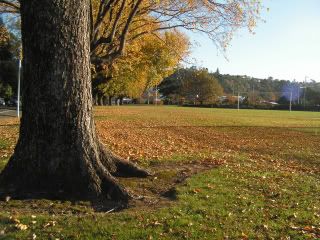
 Dunedin’s all too short a lease on summer is running out. The bare chested, beer guzzling boys that made Castle Street their cricket pitch have found hoodies, high school leavers jerseys and rugby balls. Students they have been around Dunedin long enough to know are reconciling themselves with the city’s slide into a winter of cold dark mornings followed quickly by cold dark evenings. Even the trees around campus are hunkering down. . The chemical cascades that ran wild in leaves through the summer to capture the sun’s energy are grinding to a halt. Keeping these reactions going through the winter would cost more energy than they could generate so the leaves, like middle management closing down an unprofitable branch, let the leaves fade and fall.
The autumn displays that deciduous trees put on are rightly held up as an example of the great beauty in the natural world. Until recently the scientific understanding of these displays has been entirely more prosaic. The green, light catching pigment chlorophyll is hard to make and as such a valuable resource for a tree. Before the tree cuts its leaves free it strips their assets - taking all the chlorophyll out to reinvest it in the next season’s crop. With the very green chlorophyll removed red and brown pigments (always present but previously swamped by the chlorophyll) shine through and you get autumn colours. However, over the last few years another theory has challenged this idea and enlivened scientific interest in the phenomena occurring around Dunedin at the moment.
The new theory is among the very last from W. D. Hamilton, one of the 20th century’s greatest biologists. When Hamilton died in 2000 he was eulogised as “the most distinguished Darwinian since Darwin” and generally lauded for the way his insightful, almost whimsical (he once proposed clouds were generated by bacteria as a way of spreading themselves) ideas revolutionized biology. Hamilton was a key figure in a generation of English biologists that sought to describe almost everything in nature, including humans and our behaviour, as the result of evolution by natural selection and in so doing formed the ‘adaptationist school’ of evolutionary theory. Hamilton’s greatest contribution to this effort was to show that seemingly altruistic behaviour by an organism towards its relatives (including parental care) can be explained in terms of natural selection acting at the level of genes. This theory formed an important part of Richard Dawkins’ bestselling popularisation The Selfish Gene
Later in life Hamilton focused on another evolutionary mystery. Sexual reproduction seemed counterproductive in the genetic understanding of evolution he had helped to usher in. If each individual is acting to maximise the amount of genetic material it passes to the next generation then putting only half of your genes into each child and having half of those offspring themselves unable to bear more young (that is to say being male) seems a silly idea. As Hamilton’s colleague John Maynard Smith pointed out sexually reproducing organisms must reap some evolutionary advantage over asexually reproducing ones or evolution would favour a return to asexuality (as has happened in many lineages). Hamilton believed that sexual reproducing organisms may be reaping that reward in the constant and expensive wars they wage with parasites. By mixing their genes with each other organisms may be able to make novel weapons in that fight that asexual clones couldn’t arrive at. The first support for this idea from nature came from lakes right here in New Zealand’s South Island. The tiny snails you find clinging to rocks in our lakes are a perfect model in which test Hamilton’s ideas because they are heavily parasitized in some areas and not in others and because some lineages reproduce sexually and others have given up on that idea and reproduce by cloning. In 1987 Curt Lively showed that sexually reproducing snails occurred where parasitisation was at its densest while asexual ones survived in higher numbers where parasitism was low. This is exactly what Hamilton’s theory predicts – sexually reproducing lineages are gaining an edge in parasite heavy lakes while asexual lineages prosper when they don’t have to fight many parasites
Much of Hamilton’s later worked centred on important the role of parasites in evolution, he went so far as to suggest they may explain the peacock’s ostentatious tail. He theorised that only males that were free of parasites and by extension healthy could invest in such elaborate displays. Shrewd peahens would therefore select partners with the most over-the-top tails to ensure their offspring got the best parasite fighting genes. In other words, to Hamilton a peacock’s tail was a gawdy advertisement for its owner’s genes.
He even thought parasites might explain autumn colouration. In a paper published posthumously in the Proceedings of the Royal Society of London Hamilton argued that deciduous tree’s autumn displays might represent an advertisement similar to a peacock’s. In his theory autumn colours are actually a tree’s way of telling parasitic insects that the tree is so healthy it can stop photosynthesising early and invest in bright red and yellow colouration as a warning. A tree that is strong enough to give up it’s energy making process early must surely be strong enough to invest in the many measures trees take against their parasites so a prudent insect will stay well clear of such a tree when it some time to lay its eggs.
One of the hallmarks of a good scientific theory is testable predictions. Hamilton’s signalling hypothesis makes several predictions, many of which are gaining experimental support. First, if the yellow and red leaves are indeed a signal to be taken seriously by potential parasites then we would expect only healthy trees could invest in colouring their leaves at the time the parasites arrive. One good marker for the health of a tree is how symmetrical that tree’s leaves are – healthy trees produce nice symmetrical leaves while trees under stress make more irregular ones. In 2003 Norwegian researchers took yellow and green leaves from birch trees in early autumn. According to Hamilton’s theory only the healthy trees will be investing in yellow leaves so, on average, the yellow leaves will be more symmetrical. When the researchers measured the leaves this is exactly what they found.
If autumn colours are a signal for insects and they would need to be made when infection by parasitic insects was likely. Swiss researchers confirmed in 2004 that deciduous trees in that country change colour when aphids start to lay eggs (which will hatch in spring when the trees produce sugar rich sap) Thirdly, if the signal is actually heeded by insects we would presume those aphids in fact steered clear of the trees making the strongest displays and picked the ones that were still green. The same Swiss team and a number of other investigators have reported that aphids show a strong preference to laying their eggs on green leaved trees. Finally, and most obviously, Hamilton’s theory also suggests that the healthy trees that invest in signals suffer less at the hands of parasites in the following spring. This prediction was born out in 2003 Norwegian study.
All this speaks strongly for the veracity of Hamilton’s signalling hypothesis. Still, a great number of scientists remain sceptical and number of related and unrelated theories has been proposed in response to Hamilton’s. Which ever theory turns out to be true Hamilton’s signalling hypothesis is one of the last gives from one of the greatest minds in biology. He took one of the most mundane stories in biology – fiscal dowdiness on the part of trees – and enlivened it. In Hamilton’s view the hills around Dunedin are on fire with warning shots from and evolutionary cold war, a fine example of how a little insight to the workings of biology can add yet more beauty to the natural world.
Sadly, it seems Hamilton's theory may be, in the word of TH Huxely, "that great tragedy of Science - the slaying of a beautiful hypothesis by an ugly fact". Check out what Carl Zimmer (whose blog put me on to this story in the first place) has to say on it.

All content not otherwise marked is licensed under a Creative Commons Attribution-ShareAlike 3.0 Unported License.


