
Sunday, August 28, 2011
Sunday Spinelessness - Little creatures that make a world
E.O. Wilson once described insects as "the little creatures that run the world". Wilson was presumably referring to the huge amounts of energy and mass that pass through insect bodies in terrestial ecosystems. There are, slightly puzzlingly, almost no insects in the sea but invertebrates still run marine ecosystems. In fact, invertebrates even create habitats in what would otherwise be unproductive waters.
We tend to think of the tropics as areas of great biological diversity - that's true for the land but less so in the ocean. The beautiful clear waters you see in tropical seas indicate a lack of nutrients and a corresponding lack of plankton. Without plankton, the normal marine food webs don't develop and, as a result, tropical seas are generally not very productive. But if you've been snorkling around a tropical island you'll know coral reefs are explosions of biolgical diversity. That's all because some coral animals can take advantage of the marginal conditions in tropical waters. These corals supplement the meager pickings that can filter from the water with energy trapped by a type of photosynthetic protozoa called zooxanthellae. In time these corals, with their protozoan helpers, can put down acres of calcium carbonate and create food and habitat for more and more animals. When those animals are anenomes, they can themselves form habitat for another animal. Like this anemone fish (or, as most people call them, NEMOS!!!) filmed earleir this year at Hideaway Island in Efate, Vanuatu:
Labels: anemone, coral, environment and ecology, sci-blogs, sunday spinelessness, vanuatu, video

Sunday, March 27, 2011
Sunday Spinelessness - The rest of Vanuatu
It's about time I stopped drip-feeding these Vanuatu photos and presented the "best of the rest".
I've had a very tough time trying to identify most of the bugs that I came across in Vanuatu - there aren't really any resources dedicated to invertebrates in Vanuatu or even Melanesia in general so it's a matter of trying to ID each creature as far down the taxonomic scale as possible then hope there is something recorded for that taxon in Vanuatu. Thankfully, I got a helping hand in idenfying this odd looking fly:

Ted MacRae encountered a similar looking fly in his travels through Brazil (and took a much better photo, you shold check it out) and he had the skill and the perserverance to work out his fly was from the family Neriidae (sometimes called cactus flies or stalk legged flies).
Evidently, the feature that seperates Neriids from realted families is the bristle like "arista" on the top of the antennae which is nice and clear in this photo. Neriid species from the genus Telostylinus have been recorded from New Caledonia (which is adjacent to Efate, the island on which were staying in Vanutatu) and the black and white stripes on this fly suggest its from this genus. If you look at Ted's photos, you can see the forelimbs of male Neriids are spiked, a feature you usually see in predators like crab spiders and robber flies which need to grab and hold their prey. Neriids eat rotting plant material, which is unlikely to escape their grip. It seems the spikes are used when males wrestle and strike each other in the hope of gaining access to females.
Here's the first invertebrate I saw after landing in Vanutatu:

You'd have to try very hard to miss these massive orb web spiders, in the fifteen minute drive from the airport to house at which we stayed I spotted five or six. In town, they tend to set up their webs on power lines and between houses. I gather they are Nephila plumipes, one of the golden silk orb weavers. Unfortunately, becuase they weave their webs at such great heights and I couldn't get close enough to them, these photos don't really show how massive these spiders are.

Female Nephilla are the largest of the web building spiders, their bodies alone are about 50 mm long and their webs span 2 metres. If you look closley at the photos above you'll see some much smaller spiders in the same web as the massive one. The smaller spiders could very well be 'kleoptoparasites', species that live within the webs of larger spiders and steal their host's prey. But, it's also quite possible some of the smaller spiders are males of N. plumipes, eyeing up the much larger female as a potential mate.
It seems the evolutionary process that made Nephilla females so large left the males of the genus behind. In fact, small males are probably less likely to mistaken for food by the large females, so it's even possible that males of these species got smaller at the same time as the females grew. Whatever the reason, Nephilla males are often ten times smaller than their mates. This is the bit where I would have tried to explain some of the mechanics of spider sex, but, rather wonderfully, Isabella Rosellini, has already done that:
Thanks to Alex Wild for finding that video, his post presenting includes a great photo of the difference between a male and a female Nephilla.
I think there's room for one more spider from Vanuatu as the last of terrestrial invertebrates from my trip. An unidentified orb weaver in the sun at the Mele Cascades waterfall:

Labels: diptera, environment and ecology, fly, nephilla, nerridae, photos, sci-blogs, spider, vanuatu
Sunday, March 20, 2011
Sunday Spinelessness - Dragonfly
I appear to have run out of Sunday in which to write about bugs. No matter, I think I have a photo that'll more than make up for a lack of words on my part.
Face to to face with one of the orange dragonflies that spent their days zooming over (and, in this case, falling into) the swimming pool at our house in Vanuatu.

and the close up

That's all from me today (I have to get back to writing about statistics and land snail gut contents, which is actually surprisingly interesting),if you're a fan of these beautiful bugs theres a couple of posts about dragonfly's closest cousins the damselflies here.
Labels: Anisoptera, dragonfly, environment and ecology, Odonata, photos, sci-blogs, vanuatu
Sunday, March 6, 2011
Sunday Spinelessness - Vanuatu jumping spiders
So, last week my little old blog found itself in the middle of a national discussion abuot Ken Ring and his claimed ability to predict earthquakes. In this space of two days that post recieved a good deal more than a year's worth of The Atavism's normal traffic.
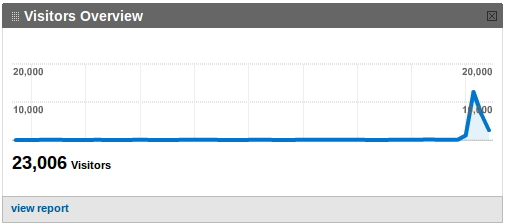
And now I have to tell anyone that subscribed to this blog in the wake of that article, hoping perhaps that I'd follow the news of the day and provide analysis of the key claims, that I mainly blog about bugs. I'm an invertebrate fan boy, and dedicate a post a week here to celebrating some creature from that ignored majority. Ninety five precent of animal species don't have a backbone, and the spineless multitude contains some of the most amazing creatures on earth.
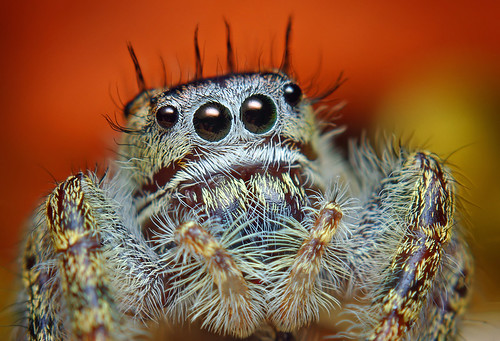
Today, I'm going back to photos I took in Vanuatu over christmas and looking at my very favourite group of spiders - the jumping spiders (family Salticidae). Spiders get a bad rap generally, almost none of them pose any threat to us*, and absolutely none of them are going to go out of their way to get us. Some spiders, like the long-legged big-fanged Cambridgea in this post, seem to set of a revuslion somwhere deep within our brains, but others are just down right charasmatic. Jumping spiders are the puppies of the arachnid world: cute inquisitive and apparently unaware of how small they are. I've written about the group before, so lets skip right to the photos:

The big round forward-facing eyes are one of the charactersitc traits of the jumpers, because they are active hunters these spiders need to be able to cast a finely-focused image of their prey. Obviously, this one has used its eyes to good effect, I can't tell what it has clamped between its jaws (or chelicerae, if you want to be accurate). It has eight legs, which makes it a fellow arachnid, the body looks a little mite-like but the legs seem too long for that identification so I'm afraid I can't tell you anything more.
As much as it pains me to put up photos with zero taxonomic information, here's a another jumping spider of unknown affinity. This one was truly tiny, perhaps 3mm across the body, but quite happy to have it's host plant bent out of shape to allow a camera to intrude

That's it from me today. You should know that people much more skilled than I am have taken some terrific photos of jumping spiders. Alex Wild has a stunning ant-mimicking spider here, and Thomas Shahan is the acknowledged master in this field. Here's one example of his focus stacked images:
*In New Zealand it's only the katipo and the (introduced) redback
Labels: arachnophilia, environment and ecology, jumping spiders, photos, Salticidae, sci-blogs, vanuatu
Sunday, February 6, 2011
Sunday Spinelessness - Hadda beetle
Time for another tropical beetle from Vanuatu, and what could be more charming than a ladybird*?

Or its absurdy spikey larvae?


This ladybird is probably a bit larger, a bit rounder and a bit oranger than the ones you are used to seeing in your garden. The more familiar ladybirds are more that just a pretty set of elytra, they're a force for good. Both the larvae and the adults of most of the familiar red and black ladybirds eat aphids, so having a few around in your garden saves on insecticide:
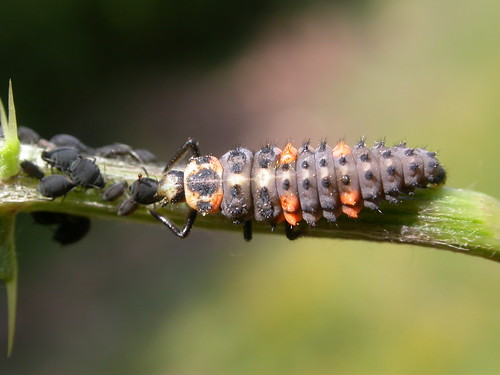
Ladybird larvae 'controlling' aphids, thanks to Gilles San Martin for making this image CC 2.0
The big orange ladybird in that first photo is not nearly so helpful. It's Henosepilachna vigintioctopunctata**, commonly known as the 28 spotted ladybird or the hadda beetle. The hadda beetle is a major agricultural best, because both the adult and larval stages are herbivorous and have a patricular liking plants of the family Solanaceae. That means potatoes, tomatoes, eggplants and (worst of all?) chilies can have their leaves skeletonised by beetles, and a beetle infestation can reduce a year's crop by up to 25% if not controlled.

You might note that this is the third post I've written about invertebrates from Vanuatu, and it's the third time I've written about an introduced pest. That's not by chance. Islands are hugely interesting for evolutionary biologists, but human introductions have seriously changed island ecosystems.
Take another look at that chewed-over leaf. Now imagine that each of those small white sections to the left of the photograph is a brand new island in a green ocean. In almost no time at all, winds would carry seeds to our little archipelago and life would start to claim the bare rocks. But we don't know which plants would make it. Dispersal and colonisation are random events, each island would collect its own subset of the seeds drifting past , and so start to develop its own flora. Once those plants have taken hold, the rain of wayward and drifting insects (and even snails) that fall everywhere on earth would have a chance to establish themselves. Again, the isolation of our islands means different species will fall on each one, and different ecological relationships will start to form. Our islands might survive for 20 million years before they're reclaimed by the sea, and in that time the unique beginnings of each island's ecosystem will mean a different evolutionary history will play out. In this way islands are evolutionary experiments, and island ecosystems have given risr to some of evolution's weirdest creations - isolation from the mainland has let iguanas become marine animals, finches become vampires and pigeons give up on flying.
But islands are no longer isolated from the rest of the world. The hadda beetle is probably native to Russia and, without humans moving plants around, would never have had a chance of making it to a Pacific islands. Now it lives in almost all the way across the tropical Pacific (here's a terrible photo of one I took in Rarotonga, 3000km away from Vanuatu):

In fact, there is an entire "tramp" assemblage including, but hardly limited to, big-headed ants, mynas, land snails, centipedes, paper wasps and mile-a-minute weed that can be found almost everywhere you find people in the tropical Pacific. These Pacific-wide introductions have pushed out native species, and together they have replaced some of evolutions most exuberant expressions with a bland mono-culture. The problem is not quite as bad as it might seem. The tramp species are mainly moved about by commerce, so many of the introduced species are associated with agriculture or at least lowland environments. In most islands, as you climb higher you find a more 'native' flora and fauna (for instance, all the partulid species left in the Society Islands are restricted to mountain tops).
By the way, the hadda beetle's bid for world domination continues: last year it was recorded in New Zealand for the first time. It's known to have set up shop in Auckland, but if you find hadda beetles somewhere else MAF might want to know about the invasion's spread.
*That's "ladybug" in American English, coccinellid or "lady beetle" among scientists and "ngoikura" in Māori
** That name might seem like a mouthful, but the species epithet at least makes sense, viginti-octo-punctatameans "twenty-eight-spotted". Most ladybird species names follow this rule
Labels: beetle, coccinellidae, Cook Islands, environment and ecology, island biogeography, photos, sci-blogs, snails, sunday spinelessness, vanuatu
Sunday, January 30, 2011
Sunday Spinelessness - Vanuatu scarab beetles
As promised, it's time to add a few tropical invertebrates to the mix of more temperate bugs I usually talk about here. Let's start by redressing a bit of an imbalance in these Sunday Spinelessness posts. Up until now I've only written two posts about beetles, which something of an under-representation since about a quarter of all described species are beetles. I see plenty of beetles around our garden and in my travels around Dunedin, but few of them are large enough, or sufficiently cooperative, for me to get decent photographs. I had no such problem in Vanuatu.
For a start, there was the daily invasion of giant scarab beetles. Around 6 o'clock each morning a wave of massive bumbling beetles would arrive at one of the coconut betel nut palms surrounding the house at which we were staying. If you stood under the tree and looked up all you could see was the yellow-bodied beetles moving about and a rain of white stamens falling down from the flowers they were busy destroying. The beetles that came late for the feast set themselves up in the shrubs underneath the palm to scavenge what they could, and were quite happy to pose for photographs:

A few of the latecomers even got a whole flower for their patience:

I can't identify these beetles to species. Their stout bodies and legs and their particular 'clubbed' antennae mark them out as scarab beetles (family Scarabaeidae). That's the same group as most well known of our native beetles the excitingly named "brown beetle" more famous for its larvae which we call grass grubs. The only extra bit of information I have on them is from this post summarising a discussion on a mailing list that deals with emerging crop pests. It seems they're a known problem in Vanuatu, and taxonomists have at least got as far as placing them in the subfamily Cetoniinae, which are sometimes called "flower chafers". From the point of view of a snail geneticist (and not a beetle taxonomist) they actually look very similar to an Australian Cetoniine species, Eupoecila australasiae.
Had I known they were such a problem for commerical coconut growers I might have spent less time rescuing these beetles from the swimming pool. Their attraction to the bright-blue sheet of water proved lethal more than a few times, but it did make for some great photo opportunities:


Labels: beetle, Cetoniinae, environment and ecology, photos, scarab, Scarabaeidae, sci-blogs, sunday spinelessness, vanuatu
Sunday, January 23, 2011
Sunday Spinelessness - Return of the spineless
It seems all the cool bug bloggers have escaped to the tropics just at the time I've got back to more temperate climes. I spent a couple of weeks in Vanuatu over the Christmas and New Year break and have a couple of memory cards full of Melanesian wildlife to share here over the next few weeks. I have another post based on life in Vanuatu I really want to finish editing before I talk about those bugs, and no shortage of real work to do before I can get to that. So, let's kick of a new year of spinelessness with a lame joke:
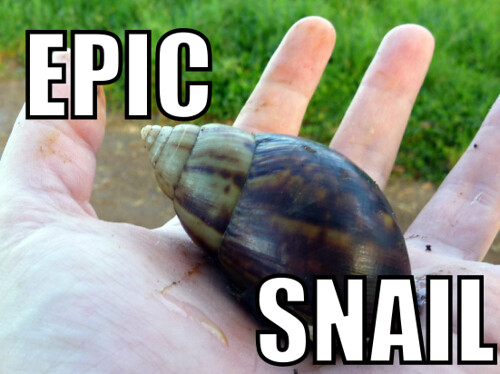
(That's a very sick Achatina fulica, one of the villains in this story and pretty common snail in and around Efate, the most populous island in Vanuatu. You can bet this very picture is going to show up as a slide is all my talks about Pacfic Island snails.)
Labels: environment and ecology, molluscs, Pacific, sci-blogs, snails, sunday spinelessness, vanuatu

All content not otherwise marked is licensed under a Creative Commons Attribution-ShareAlike 3.0 Unported License.


