
Sunday, August 28, 2011
Sunday Spinelessness - Little creatures that make a world
E.O. Wilson once described insects as "the little creatures that run the world". Wilson was presumably referring to the huge amounts of energy and mass that pass through insect bodies in terrestial ecosystems. There are, slightly puzzlingly, almost no insects in the sea but invertebrates still run marine ecosystems. In fact, invertebrates even create habitats in what would otherwise be unproductive waters.
We tend to think of the tropics as areas of great biological diversity - that's true for the land but less so in the ocean. The beautiful clear waters you see in tropical seas indicate a lack of nutrients and a corresponding lack of plankton. Without plankton, the normal marine food webs don't develop and, as a result, tropical seas are generally not very productive. But if you've been snorkling around a tropical island you'll know coral reefs are explosions of biolgical diversity. That's all because some coral animals can take advantage of the marginal conditions in tropical waters. These corals supplement the meager pickings that can filter from the water with energy trapped by a type of photosynthetic protozoa called zooxanthellae. In time these corals, with their protozoan helpers, can put down acres of calcium carbonate and create food and habitat for more and more animals. When those animals are anenomes, they can themselves form habitat for another animal. Like this anemone fish (or, as most people call them, NEMOS!!!) filmed earleir this year at Hideaway Island in Efate, Vanuatu:
Labels: anemone, coral, environment and ecology, sci-blogs, sunday spinelessness, vanuatu, video

Saturday, February 20, 2010
Sunday Spinelessness - Animals that don't move
There aren't many universal laws in biology. Snails proved Dollo wrong, retorviruses did for Crick's Central Dogma of Molecular Biology and every lesson on Mendel's Laws of Inheritance includes a section of the exceptions to those rules. Biology's disregard of human laws notwithstanding, you might think, at least as far as macro-organisms are concerned, you could safely generalise that animals move and plants stay still. But once you consider the ocean even that generalisation can't be supported; corals, bryozoans, sea squirts, anemones and sponges are all animals that spend their adult life in one spot.
While I was in Masterton for christmas my girlfriend went to Vanuatu (no, you're right, that doesn't quite seem fair...) with a waterproof camera so I've stolen a few of her photos of coral to illustrate todays sunday spinelessness.
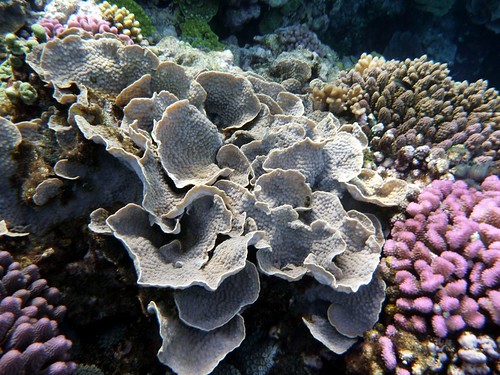
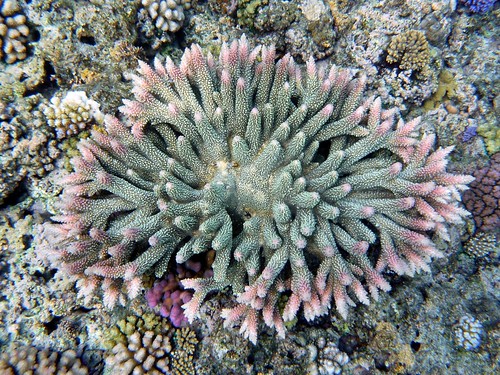
It's easy to see why early naturalist thought corals were plants but what you are looking at in those photos is not a single organism, rather it's a colony of tiny genetically identical animals. Corals are members of the phylum Cnidaria (the 'c' is silent) which includes corals, anemones and a diverse bunch of animals we call jellyfish. Such a diverse collection of animals are united under the name Cnidaria because they all employ the impressive nematocyst, a barbed harpoon like cell, to catch and deliver toxin to their prey. Cnidarians have two distinct life stages - a swimming "medusa" (adult jellyfish being the classic example) and a sessile polyp (like the sea anemones familiar to rock pool fossickers the world over). Individual coral colonies (termed "heads") are made entirely of polyps which reproduce asexually depositing a calcium carbonate base as they grow - the exact pattern in which polyps bud from their parents determines the shape a coral head takes.
Many tropical corals supplement their diets by forging a symbiotic relationship with swimming algae (arguably plants that move...) called zooxanthella, the algae get carbon dioxide from the coral's respiration while the coral gets energy from the algae. This relationship is of huge importance in the tropics because it allows corals to grow in those region's warm, nutrient poor waters. Without coral reefs, made from thousands of years of calcification from corals, tropical waters would be nowhere near as biodiverse as they are now and people whose love of animals only goes as far as that peculiar phylum Chordata should care about that:
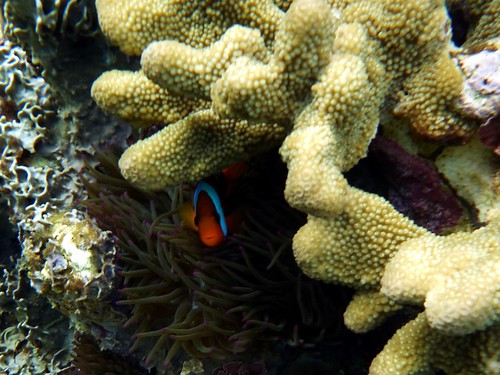
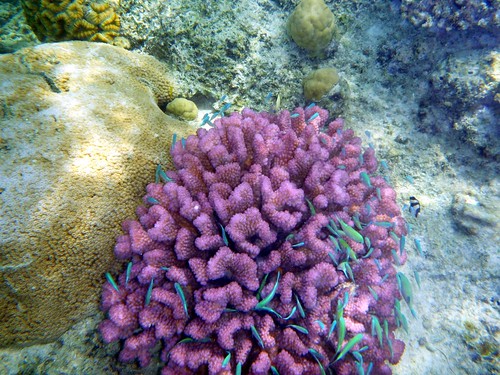
Labels: anthozoa, cindaria, coral, environment and ecology, might interest someone, sci-blogs, sunday spinelessness

All content not otherwise marked is licensed under a Creative Commons Attribution-ShareAlike 3.0 Unported License.


