
Sunday, August 1, 2010
Sunday Spineless - Looking into jellyfish eyes
Eyes evolved once. That's the headline conclusion from a recent study of the genetic basis of the development of eyes in jellyfish. If you want the details the ever-awesome Ed Yong has them, so I'll just offer a précis here.
Building an eye is a complex business. Developmental biologists have uncovered a whole series of interacting networks of genes that work in concert to turn a piece of neural tube into your peepers. In just about all bilaterians (that is, animals other than cindarians, ctenophores and sponges) the whole process has one master switch - a gene called PAX6. The pax genes are a family of transcription factors(genes that drive the expression of other genes) that act to define regions on the animal body during early devlopment. The eye-establishing function of PAX6 is so strongly conserved that you express the mouse version of this gene in a Drosophila larvae and set off the eye-building networka(leading to the development of ectopic eyes). In the recent paper researchers went looking for PAX genes in one of the deeper branches of the animal tree, the Cnidaria (comprising corals, anemones and a diverse collection of creatures we usually call jellyfish).
On my recent visit to Vancouver I made it to that city's impressive aquarium (tourist tip: go early or line up for a long time). They have sea otters and dolphins and beluga whales but, true to form, I was most taken by the jellies:


Above you have sea nettles (Chrysaorasp sp.) and below the moon jelly (Aurelia aurita) and my photos hardly do them justice. They were just stunning. My photos also fail to record and important detail, jellies and other cnidarians have eyes. Or at least tiny "eye spots" which are capable of detecting light, if not casting a focused picture of the outside. So,with the sequence of another cnidarian's genome (the starlet sea anenome, Nemaostella vectiniss) as a starting point researchers went looking for PAX genes in the development of that eye spot. They found them in the familiar role, the master switch, but interestingly it's not the PAX genes most closely related to PAX6 that are doing the work. In two different lineages of jellies, the Hydrozoa and the Cubazoa (neither represented above I'm afraid) two different PAX genes are setting the eye making machinery to work. The authors conclude that eye development was originally controlled by suite of PAX genes acting together with a degree of redundancy with each lineage - the Hydrozoa, the Cubazoa and the bilaterians - subsequently losing that redundancy and leaving just one of the PAX genes to act as the master switch. Sounds reasonable to me (but check out a criticism of the idea in comments to Ed Yong's post) but the diagram they use to illustrate that idea is awful :
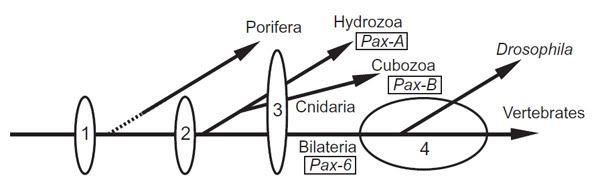 Who could imagine animals as wonderful as the cnidarian photographed above, or the sponges I wrote about here or Drosophila were side branches from evolution's mainstream. Yuck. Anyway, I fixed it:
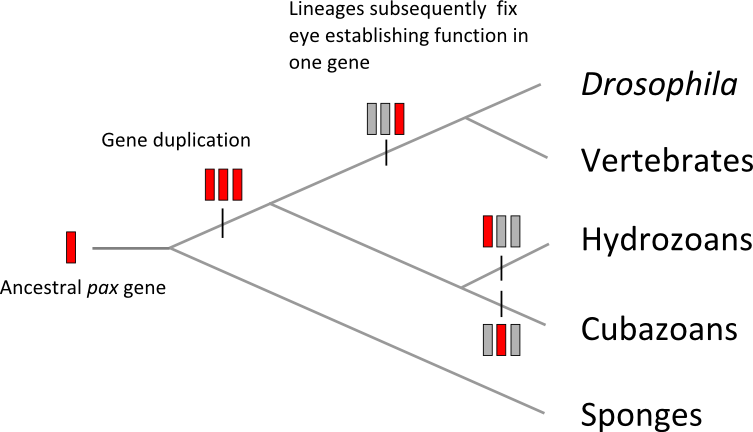
Labels: cindaria, developmental biology, sci-blogs, sunday spinelessness, Vancouver

Saturday, February 20, 2010
Sunday Spinelessness - Animals that don't move
There aren't many universal laws in biology. Snails proved Dollo wrong, retorviruses did for Crick's Central Dogma of Molecular Biology and every lesson on Mendel's Laws of Inheritance includes a section of the exceptions to those rules. Biology's disregard of human laws notwithstanding, you might think, at least as far as macro-organisms are concerned, you could safely generalise that animals move and plants stay still. But once you consider the ocean even that generalisation can't be supported; corals, bryozoans, sea squirts, anemones and sponges are all animals that spend their adult life in one spot.
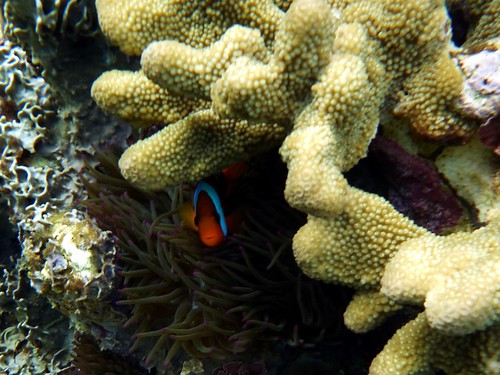
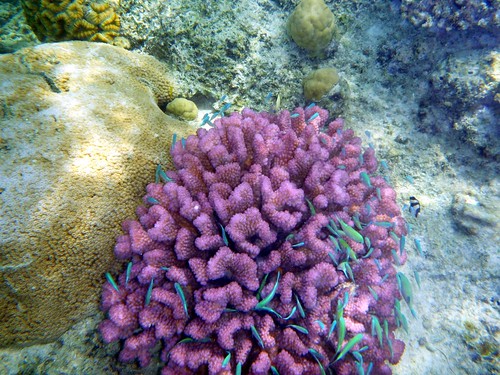
While I was in Masterton for christmas my girlfriend went to Vanuatu (no, you're right, that doesn't quite seem fair...) with a waterproof camera so I've stolen a few of her photos of coral to illustrate todays sunday spinelessness.
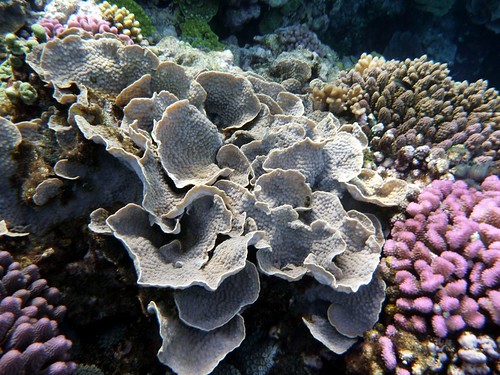
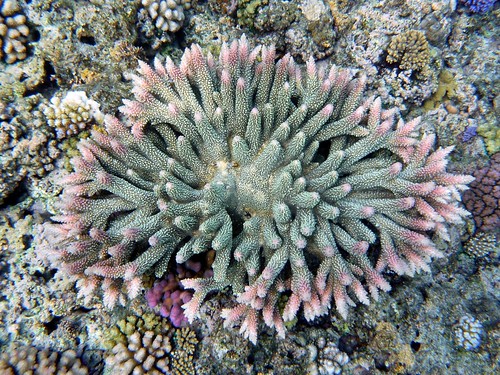
It's easy to see why early naturalist thought corals were plants but what you are looking at in those photos is not a single organism, rather it's a colony of tiny genetically identical animals. Corals are members of the phylum Cnidaria (the 'c' is silent) which includes corals, anemones and a diverse bunch of animals we call jellyfish. Such a diverse collection of animals are united under the name Cnidaria because they all employ the impressive nematocyst, a barbed harpoon like cell, to catch and deliver toxin to their prey. Cnidarians have two distinct life stages - a swimming "medusa" (adult jellyfish being the classic example) and a sessile polyp (like the sea anemones familiar to rock pool fossickers the world over). Individual coral colonies (termed "heads") are made entirely of polyps which reproduce asexually depositing a calcium carbonate base as they grow - the exact pattern in which polyps bud from their parents determines the shape a coral head takes.
Many tropical corals supplement their diets by forging a symbiotic relationship with swimming algae (arguably plants that move...) called zooxanthella, the algae get carbon dioxide from the coral's respiration while the coral gets energy from the algae. This relationship is of huge importance in the tropics because it allows corals to grow in those region's warm, nutrient poor waters. Without coral reefs, made from thousands of years of calcification from corals, tropical waters would be nowhere near as biodiverse as they are now and people whose love of animals only goes as far as that peculiar phylum Chordata should care about that:
Labels: anthozoa, cindaria, coral, environment and ecology, might interest someone, sci-blogs, sunday spinelessness

All content not otherwise marked is licensed under a Creative Commons Attribution-ShareAlike 3.0 Unported License.


