
Sunday, January 23, 2011
Sunday Spinelessness - Return of the spineless
It seems all the cool bug bloggers have escaped to the tropics just at the time I've got back to more temperate climes. I spent a couple of weeks in Vanuatu over the Christmas and New Year break and have a couple of memory cards full of Melanesian wildlife to share here over the next few weeks. I have another post based on life in Vanuatu I really want to finish editing before I talk about those bugs, and no shortage of real work to do before I can get to that. So, let's kick of a new year of spinelessness with a lame joke:
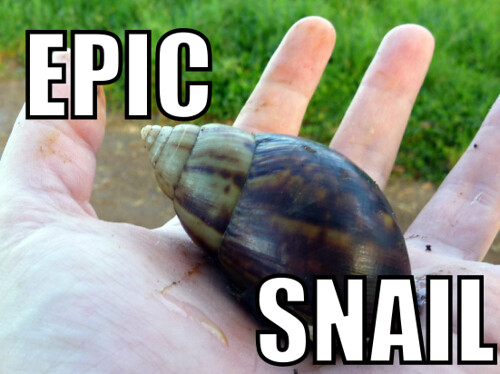
(That's a very sick Achatina fulica, one of the villains in this story and pretty common snail in and around Efate, the most populous island in Vanuatu. You can bet this very picture is going to show up as a slide is all my talks about Pacfic Island snails.)
Labels: environment and ecology, molluscs, Pacific, sci-blogs, snails, sunday spinelessness, vanuatu

Sunday, December 5, 2010
Sunday Spinelessness - The origin and extinction of species
I don't use these pages to write about my own work very much, partly because it's not yet published and partly because I write about that all day as it is. The shortest answer I can provide to the question "what do you do" is "I use genetic tools to study evolution" and I guess that makes me an evolutionary geneticist. You can split the people that work in our field into two groups: there are biologists that are really interested in a group of organisms and have learned some genetics to help their study of them, and there are people who are interested in a particular question and have chosen their study organisms to suit. I'm very much of the second sort, and like most people in that group I've caught myself saying "I'm interested in the questions, not the animals". Paraphrased, that becomes something like, "Oh sure, I study Pacific land snails, but for all I care they're just little bags of genes that help me answer questions". But that's a lie. You can't work on animals without having them effect you. When I started my PhD I had no particular love of snails, but now I'm a complete snail fan-boy and I frequently find myself preaching on the wonders of life as a terrestrial mollusc to people whose only mistake was to ask me what I do for a living. Did you know most slugs retain the remnants of their shells? Or that almost all snail shells coil to the right? Or that mating in many land snail species only proceeds after one snail has stabbed the other with a "love dart"? A couple of weeks ago I was recounting the the sad tale of The Society Islands partulids to someone I'd met three minutes earlier, and today I'm going to tell you that story (though, of course you have an advantage over the first recipient of the story, since you don't have to read this crap)
Believe it or not, land snails are one of the characteristic animals of Pacific Islands. Anak krakatau is so young it's still smoldering, and it has a native land snail species and Rapa nui (Easter Island), which is arguably the most isolated island in the Pacfic, had its own land snail fauna back when it had forests. It's not entirely clear how these unlikely colonists get to islands. Darwin was so interested in the question* he, ever the experimentalist, stuck snails to ducks' feet to see if they'd survive an inter-island journey. Birds have been shown to carry snails great distances, but wind blown leaves are probably a more common mode of conveyance. We might not know exactly how snails get to islands, but we know what happens once they establish themselves. The land snails of the Pacific include some of the most outrageous explosions of diversity in the biological world. Chief among these evolutionary radiations were the partulid snails of The Society Islands (the French Polynesian archipelago that includes Tahiti). Partulids are very elegant tree snails that form part of the land snail fauna across most of Polynesia, in the Societies they made up most of the land snail fauna. In total, the tiny islands had 58 species of these snails with each of the main islands have their own endemic forms.
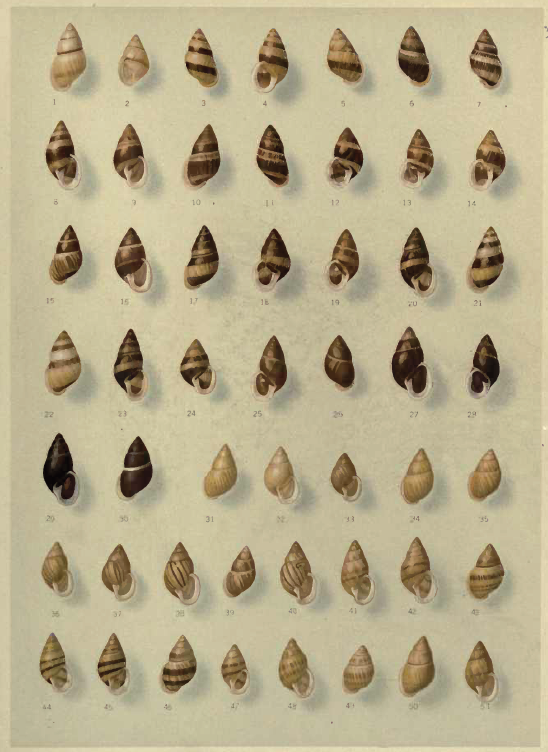
A plate from Crampton's monograph on the partulids of Moorea
The Society Islands' land snails were a marvel all by themselves, but they were also an extraordinary resource for scientists. The first person to seriously take up their study was the American embryologist and evolutionary biologist Henry Crampton. Crampton was working at the turn of the 20th century, a time in which the mechanisms underlying genetics and evolution were very much up for debate, and he hoped Tahitian and Moorean partulids could help set the story straight. Crampton's monogrpahs are famous (at least among people that spend thier lives thinking about snails) for their detail. He collected and measured over two hundred thousand shells, then calculated summary statistics for each species, each site and each measurement. By hand. To eight decimal places.
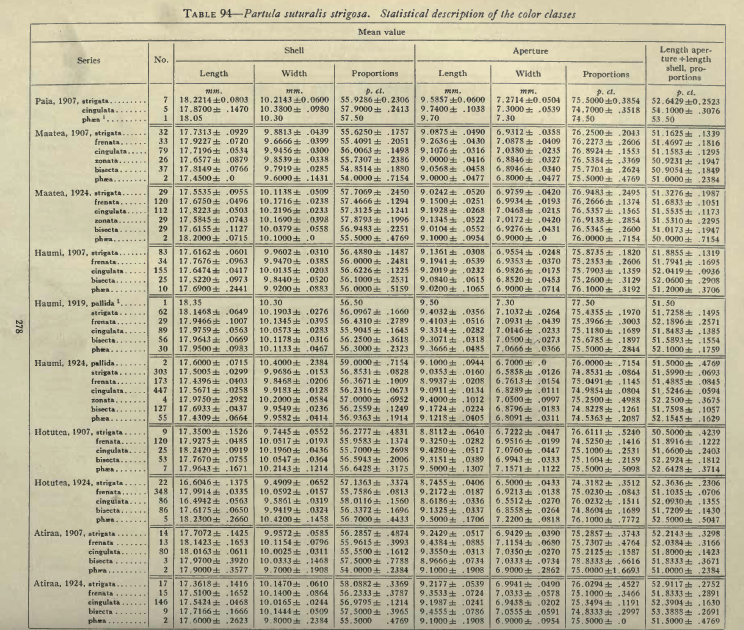
Those massive tables (there are more than 100 pages of them in the Moorean monograph) might seem like an old-fashioned, descriptive, way to do biology. But in many ways Crampton was ahead of his time. For one, he was a Darwinist when not every evolutionist was. By the end of the 19th century Darwin had convinced the world of the fact evolution had happened, but relatively few naturalist bought his theory of how evolutionary change happened. The anti-Darwinian theories that prospered during the so called "eclipse of Darwinism" placed very little importance on the variation within species. The orthogenesists and the lamarckians thought evolution had a driving force, pushing species towards perfection. In their scheme variation within a species was deviance from the mainstream of evolution and was quckly stamped out by natural selection (which they didn't deny, they just said it couldn't be a creative force). Similarly, saltationists thought large-scale evolutionary changes occurred in a single generation, and the small changes you see in populations were of no consequence in the grand scheme of evolution. Crampton realised that, in a Darwinian world, variation within populations was the raw material of evolution. He was obsessive about measuring his shells because he knew could use the data he was recording to understand where species came from. In particular, we was able to show that isolated populations of the same species varied from each other. That finding that makes sense in light of Darwin's theory, since species arise from populations evolving away from each other; but is harder to fit into progressive theories of evolution, in which you'd expect different populations of the same species to follow the same trajectory.
Crampton's results influenced people like Dobzhanky, Mayr and Huxley who helped to re-establish Darwinism as the principal theory of evolution in the Modern Evolutionary Synthesis. But Crampton also predicted arguably the most important development in evolutionary theory since the modern synthesis. In the middle of the 20th century evolutionary genetics was defined by a single debate. The "classical" school held that populations in the wild would have almost no genetic variation, because for every gene there would be one 'best' version and every member of the population would have two copies of that gene. Arguing against the classical school, the "balance" school argued that, quite often, there would be no single best gene and organisms would do better having two different versions of the same gene**. The ballancers thought natural selection would keep lots of different versions of maybe 10% of a species' genes. Both schools assumed natural selection was such a pervasive force that selection would dictate the way populations were made up, they just disagreed on what would result from it. Here's the funny thing, they were both spectacularly wrong. When scientists started being able to measure he genetic diversity of populations in the 1960s it became clear almost every single gene had multiple different versions. Now, in the post-genomic age there is a database with 30 million examples of one sort of genetic variant amongst humans.
Faced with the overwhelming variation he recorded in partulid shells, Crampton had argued natural selection didn't have a damn thing to do with it. Snails isolated from each other by a mountain weren't adapting to their local habitat, they just varied with respect to traits that had no influence on their survival. The fact two populations were isolated meant each would follow its own path and two populations could drift apart from each other. Faced with the overwhelming genetic variation coming from studies in the 1960s Motoo Kimura proposed the neurtral theory of molecualr evolution. Kimura's explanation was the same as Crampton's, almost all of the variation we see at genetic level has no bearing on the success or failure or organisms so the frequency of different variants drifts around at random. The neutral theory is at the heart of a lot of modern evolutionary genetics, and Crampton had understood the underlying principle 50 years before we knew we needed it!
At the end of his monograph on the partulids of Moorea, Crampton said he'd got as far as his measurements could take him, and it was time for someone to study their genetics. In took a bit longer than Crampton might have hoped, but in the 1960s two leading geneticists took up the study of his snails. James Murray from Virginia and Bryan Clarke from Nottingham spent almost 20 years working in what they called, in more than one paper, the perfect "museum and laboratory" in which to study the origin of species. Their work helped scientists understand, among other things, how ecology can contribute the formation of new species and what happens to species when they hybridise with others from time to time. Then, in 1984, Murray and Clarke had to write the most heart-breaking scientific paper I've ever read. It's written in the careful prose scientists use to talk to each other, but the message it delivered was devestating:
In an attempt to control the numbers of the giant African snail, Achatina fulica, which is an agricultural pest, a carnivorous snail, Euglandina rosea; has been introduced into Moorea. It is spreading across the island at the rate of about 1.2 km per year, eliminating the endemic Partula. One species is aiready extinct in the wild ; and extrapolating the rate of spread of Euglandina , it is expected that all the remaining taxa (possibly excepting P. exigua) will be eliminated by 1986-1987.


The bad guys: Euglandina on the left, Achatina on the right.
Euglandina rosea is better known as the Rosy Wolf Snail. It senses the mucous trails of other snails, tracks them down and eats them. It's not clear if the wolf snail had any effect on the pest species it was introduced to control, but it had huge impact on the partulids. By the time Murray and Clarke wrote their paper, E. rosea had already done for one species and it was too well established to control. All they could do was watch as human stupidity and molluscan hunger slowly (1.2 km per year) destroyed the species they'd been studying for 20 years and Crampton had dedicated 50 years of his life to. The same slow torture played itself out in Tahiti and then the rest of the Society Islands. Where there were 58 named species, there are now 5 alive in the wild. Crampton's hundreds of pages of tables should have been the starting point from which the evolution of the partulids could have been tracked. Murray and Clarke's natural laboratory should still be open and be taking advantage of a new generation of technologies that might be able to reveal the genetic and genomic changes that occur when a new species arises. Extinction is a natural part of life, and the fate of all species eventually, but when it's driven by human short-sightedness and robs us of not just a wonderful product of nature but a window through which we might have understood nature's working it's very hard to write about.
I should end by saying there is just a tiny scrap of good news in this story. The partulids are no longer an iconic species in the study of evolution, but they have become the pandas of invertebrate conservation. Murray and Clarke were able to get 15 of the species of the islands and into zoos and labs across the Northern Hemisphere. Breeding programs have been succesful, and new lab-based studies come out form time to time. The relict populations back in the Societies don't have nearly the range they used to, but it appears they've held on to most of their original genetic variation. Perhaps, one day, Eulglandina can be taken care of and some of the partulids can have their islands back.
*Darwin had to be interested in dispersal. Before evolution was widely accepted naturalists thought creatures were created for their habitat (the modern creationist notion of a post-flood diaspora explaining the distribution of animals is almost entirely an invention of Seventh Day Adventists, no, really, it is), Darwin's theory did away with special creation but still needed to explain how life came to live everywhere
** A concept similar to "hybrid vigour", in which crosses between relatively unrelated strains/cultivar bring together different genes and do well as a result. You've seen evidence of this phenomenon any time you've eaten yellow and white "honey and pearl" corn. That corn is a hybrid between a white and yellow cultivar and if you count up the kernals you should get close to the 3:1 ratio Mendel preficts for a dihybrid cross.
Some further reading:
Stephen Jay Gould, who was a snail man himself, wrote and essay on Crampton and the Society Island partulids in which made a humanistic argument for the importance conservation. I resisted the urge to re-read it in researching this piece so anything I stole from him I stole sub-consciously!
- Gould, S.J., 1994. Unenchanted evening in Eight Little Piggies: Reflections in Natural History
Crampton's monograph on the Mooeran partulids (from which the figures above are taken) is available online
- Crampton, H.E., 1932. Studies on the variation, distribution, and evolution of the genusPartula. The species inhabiting Moorea. Carnegie Institution of Washington, 410, 1335.
Finally, the paper in which Clarke and Murray told the world about the demise of their snails:
- Clarke, B., Murray, J. & Johnson, M.S., 1984. The extinction of endemic species by a program of biological control. Pacific Science, 38(2), 97-104.
Labels: environment and ecology, molluscs, Pacific, partulids, sci-blogs, snails, sunday spinelessness
Thursday, July 29, 2010
The First New Zealanders and their rats

Crispin Jago has made a very cool thing, a periodic table of irrational nonsense. Rolling my eyes over the groups, wondering how people can believe some of these things, made me think about New Zealand's unique ecosystem of kooky ideas. We don't have to suffer creationists in any organised sense and I don't think anyone is too into ear candelling, but those TV psychics have found themselves a niche to exploit and most people seem think chiropratric and homeopathy are normal parts of medicine. Then I was reminded about our very own, home grown cranks. There are people who believe that New Zealand was settled by Celts several hundred years before it was discovered by the ancestors of modern Māori. It probably goes without saying that these people are nuts, but the idea of a pre-Māori civilization in New Zealand is one of our culture's enduring myths. It's worth talking about why people who are serious about studying our country's prehistory have discarded it.
People coming to this question for the first time my want a little bit of background. The settlement of the Pacific is one of the most interesting stories in our species' history. I did the field work for my PhD (on landsnails, and not people) in the Cook Islands and you get a feel for the enormity of that achievement when you travel around that group. To fly from one island to another you walk out across the tarmac and meet your pilot, who is almost invariably sitting on the steps to his 12 seater plane, reading the paper through massive aviator glasses. Once you're safetly stowed you get your safety briefing ("it's gonna be pretty fine all the way, should be a good flight") and you take off. The pilots don't close the door to the cockpit, so you can see out the windscreen, but all you see is ocean and sky. You can fly for an hour without seeing land in front of you or out your window. Then an island looms. A few minutes later you land, and, even among the Cook Islands, you're in a new culture. The Polynesian people who discovered and settled these tiny islands separated by such vast distances were master navigators. Without metal tools or written records, let alone maps and compasses, they very deliberately settled islands (taking livestock and crops with them), maintained trading relationships between island groups and almost certainly made it to South America (very likely beating Columbus in the process).
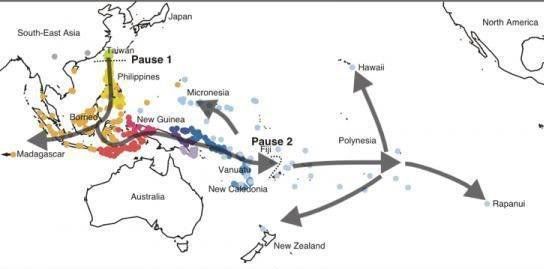
Schematic of the settlement of the Pacfic (this one is taken from a study of the evolution of Austronesian languages)
The "mainstream" view on the settlement of New Zealand fits nicely into what's known about the settlement of the Pacific. There is good evidence that the bulk of Polynesia was settled in a stepwise fashion, moving west to east with the prevailing winds. Eastern Polynesia was settled by about 800 AD. The far reaches reaches of Polynesian - Hawai'i, Rapanui and New Zealand would require a different pattern of migration (upwind, or over vast distances) and remained, with Antartica, as the last uninhabited lands on earth for hundreds of years.
The first evidence for humanity in the New Zealand archeological record comes from the Wairau bar, where artifacts similar to those from contemporaneous sites in the Society Islands and the Southern Cooks have been dated to about 1280 AD. At the same time the pollen record shows New Zealand's first wide scale deforestation, trees being replaced by bracken, scrub and charcoal. A few hundred years later the much sparser record of sub-fossil animals shows its first mega-faunal extinctions. Combined with evidence for "sattelite" settlements in the Kermadec islands (on the edge of the tropical Pacfic) you have exactly the pattern of evidence you'd expect to see with the settlement of islands as remote as Te Wai Pounamu and Te Ika a Māui - settlement as an extension of an ongoing process with clear evidence for human impacts starting from a date that makes sense in that framework
Compare that with the Celtic NZ people. The idea of Celts arriving in New Zealand without leaving any real evidence of their presence anywhere else outside of Europe hardly needs talking about. When we look within New Zealand, almost all the evidence supposed to support a pre-Maori celtic civilization amounts to big rocks that form, if you just imagine they used to be arranged slightly differently, a giant surveying network. Or astronomical observatories. Proponents of the Celtic NZ hypothesis spend very little time trying to find any evidence for the populations that must have lived, died, eaten, built, dug, farmed, and buried their dead in New Zealand to support these mad priests' plans to move megaliths across the country. And when they do the results are less are less than convincing
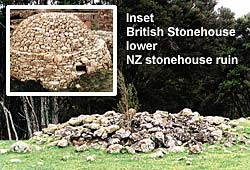
By all accounts they treat the historical method with about as much respect as the scientific one, so academics don't take them very seriously. In fact, you'd think these claims are so kooky that there was really no need to rebut them. Sadly, the Celtic NZ people seem to have convinced at least a few people that they are on to something. I'm sure part of the reason for that is New Zealanders were once taught that the ancestors of modern Māori did meet another people when they came to New Zealand.Up untill about the 1960s school textbooks said the Moriori were a Melanesian people that were driven off the New Zealand mainland by Māori, with a few survivors taking refuge on the Chatham Islands (called Rekohu in their language). That idea had been rejected by every scholar who's addressed it since the 1920s because it's clear that the Moriori descended from mainland Māori and the unique aspects of their culture were acquired during their subsequent isolation. Part of the reason the Moriori myth came about in the first place is that it fitted into a Victorian narritive view of history - a chain of never ending progress It was only right that Moriori hunter-gatherers were replaced my the adventurous and noble Māori, just as the advanced British settlers would in turn assimilate the Māori. We might have given up that story, but the Moriori myth is still tied to politics in New Zealand. For people who think the New Zealand government shouldn't make reparations for its breaches of the Treaty of Waitangi the idea that Maori themselves were once colonisers looks like a get out of jail free card. Russell Brown quoted one example in 2004:
Leaders and academics that hark back to the pre-European days of Maori domination of New Zealand have driven this opportunism. They appear to conveniently forget that Maori violently conquered the Moriori, the original settlers, and their claims of tangata whenua status and demands for compensation for historical grievances appear to many to be ill informed.
Archaeologists agree that humans first settled in New Zealand well over 1,000 years before the main Maori migration, which is estimated to have arrived around 1200 AD. Their evidence is based on the exhaustive forensic examination of historic plant and animal remains. They believe that the settlement of New Zealand was most likely a continuous process, a view that is certainly consistent with early settler journal accounts (from the proceedings of the Royal Society of New Zealand) which indicate that not only did Moriori precede Maori, but that when they arrived in the Chatham Islands, “they found the country in the possession of aboriginal natives called Hiti”- inhabitants of the “Flint age”, who used not stone, but “chips of obsidian as cutting implements.” There is also strong evidence of an early presence of people of Celtic and Chinese ancestry as well as Greek, French, Portuguese, Spanish and others - in addition to settlers of Polynesian descent.
Breathtaking. But perhaps the most amazing bit of that bizarre paragraph is that somewhere, deep under the layers of crazy, there is just a little science peaking through. We've already seen that archeologists don't agree that New Zealand was settled a thousand years before the Māori arrived. But there has been one little hint among the prehistoric "plant and animal remains" that humans might have got to New Zealand before the people that lived at Wairau Bar. Old Rat bones.
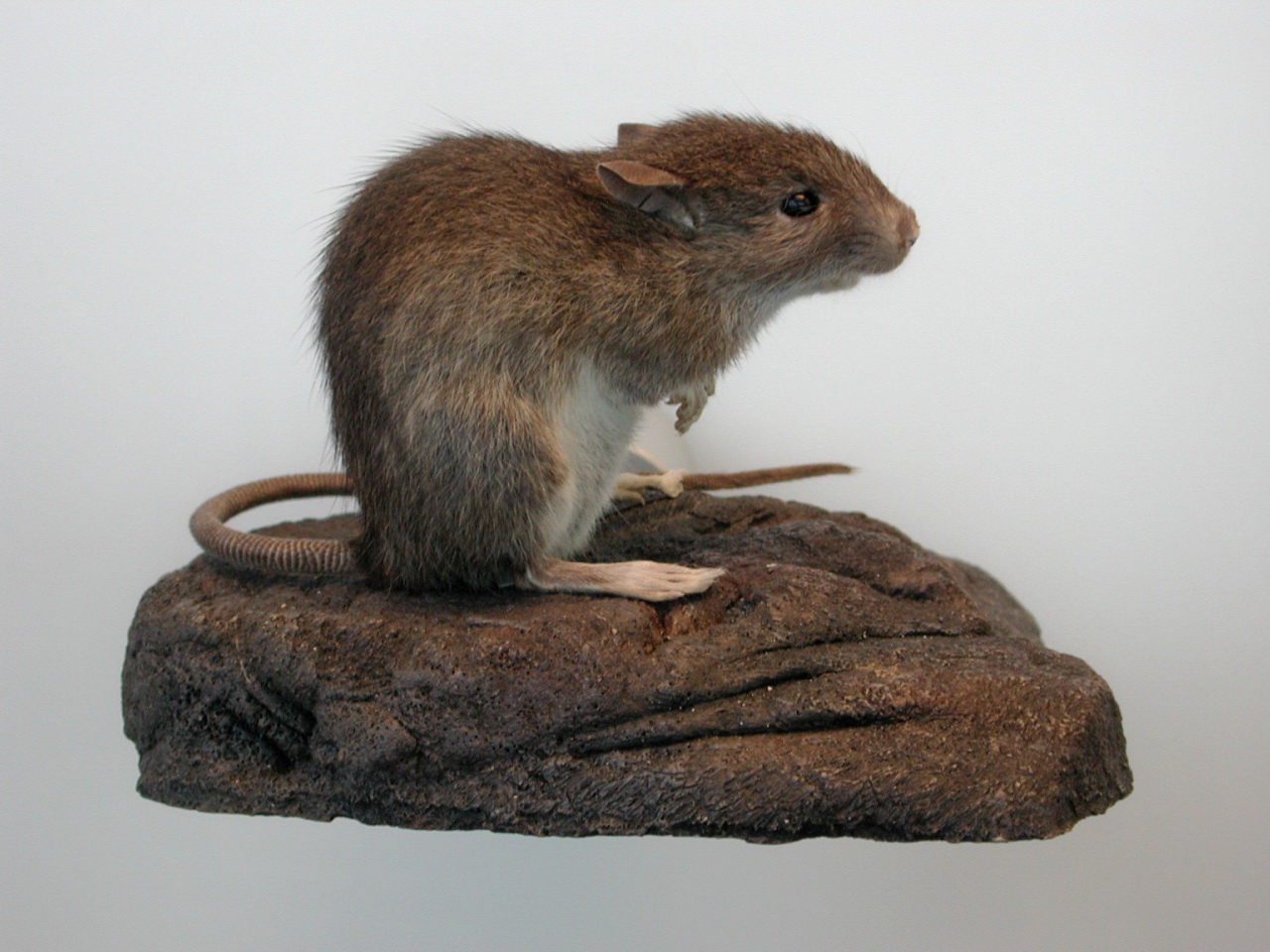
A Pacfic rat, image is CC 2.0 thanks to wikipedia user Tolter Alter Man
The Pacific rat (Rattus exulans or the kiore) is native to South East Asia and Melanesia, but it can be found everywhere Polynesian people visited. The kiore isn't much of a swimmer so the presence of R. exulans bones on an island is unambiguous evidence for human contact. In 1996 Richard Holdaway published the first radiocarbon dates for kiore bones in New Zealand, and they were surprising. Holdaway published dates for 18 bones and all but two of them were older that the first archeological evidence for humans (at 1280 AD) and some of them dated to around 10 AD. Quite how the presence of the Pacific rat in New Zealand in 10 AD gives support to the wild claims of people like Newman or the Celtic NZ crowd I can't imagine, but those results did fuel a genuine scientific controversy. Why were there rats in New Zealand almost a thousand years before there is any evidence for humans? At the time there were three answers; Holdaway himself argued that the bones were evidence that humans had visited New Zealand but either left immediately or failed to establish themselves, a few archeologists held that the bones were evidence the ancestors of Maori arrived in New Zealand a long time ago but didn't leave a mark until they adapted to the colder climate, and others said the dates must just be wrong.
Atholl Anderson dedicated a lot of time to testing the reliability of radiocarbon dates from kiore bones. The bones Holdaway had used to establish the antiquity of New Zealand's rats had come for so called "natural" sites, most notably laughing owl nests and caves, which offer little in the way of corroboratory evidence for the ages estimated from the rat bones. In contrast, Anderson focused on archeological sites (those associated with human habitation) which provide plenty of contemporaneous material to set the dates determined for rat bones in context. Anderson did indeed find the dates determined from rat bones often differed greatly to those determined from the contents of the same midden. They even found bones from well studied archeological sites that were estimated to be thousands of years older than the site! Clearly, there's something odd about those dates. The real smoking gun for the "old rats" hypothesis came when Anderson looked at the relationship between the age estimated for a bone and the date of the labwork done to determine that age. Almost all the bones measured before 1997 were older than that magic mark at 1280 AD, and every single bone measured at the same facility since 1997 was younger (or at least, the error bars cross that date):
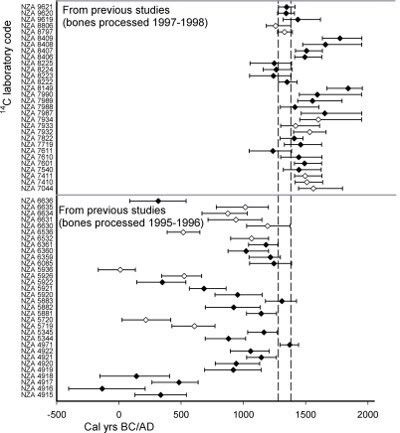
Dates estimated from rats fall into two distinct groups, depending on when they were analysed. From Wilmshust et al (2008) cited below
There is no reason to think the real age of the kiore bones sampled over time will fall into two such distinct classes (it's not as if the oldest bones will be the easiest to get to) and it's easy to bias the date estimated by carbon dating by failing to prepare the bones properly (or by introducing contamination in the lab) so it looks like the surprising results Holdaway reported where actually a lab error which has since been taken care of. It's (barely) conceivable that originally published dates were right, and that the Anderson's archeological sites were biased in some particular way, but that hypothesis really doesn't make sense given what we now know about the settlement of the Pacific. It's widely accepted that Eastern Polynesian wasn't settled until about 800 AD, meaning any earlier rats in New Zealand would have had to come from visitors from the Western Pacific. That's against the main direction of settlement, but, more tellingly, genetic evidence has established that modern kiore in New Zealand come from Eastern Polynesia. Kiore also make their first mark on New Zealand's faunal record around 1300 AD, when Plactostylus landsnails with gnawed shells show up for the first time. If you want to believe rats were in New Zealand 2000 years ago you also have to believe the first bones to be carbon dated were the oldest, dates estimated from archeological bones are more unreliable than those for bones sourced from "natural" sites and that those old rats left not descendants in modern New Zealand populations and left no mark on the New Zealand faunal record until just after Polyneisian settlement of New Zealand.
You might be wondering why someone hasn't just gone back an re-analysed the bones that made for Holdaway's original surprising results. Radiocarbon dating is a destructive process and rat bones are small, so, apparently there isn't enough bone from the original samples to re-determine their age. Recently, a team from Landcare Research and lead by Janet Wilmshurst did the next best thing, and went back to sites that gave up the apparently old rat bones and re-excavated them. I'm sure you can guess what they found, none of the bones had a pre-1280 AD date. But they didn't just look at rat bones. The subfossil record of plants is almost always more finely grained than animal records. Every year plants put out millions of seeds and pollen grains, some of which are recorded in pits and lake beds and soil horizons. The Landcare team took advantage of this high resolution record to look for the first appearance of distinctively rat-gnawed seeds, and they found them after 1280 AD, but earlier than the oldest rat bones. Importantly, some of the deposits with relatively old rat-gnawed seeds contain much older seeds, with no evidence of rats. The team plans to go on an use this high-resolution record to establish the dates of settlement for other Pacfic islands.
The sort of people who think the presence of the Pacific rat in New Zealand would be evidence for a pre-Maori Celtic population aren't likely to let evidence get in the way of their stories. They already think the entire New Zealand acadame is par of a grand conspiracty (they've apparently never tried to organise a meeting between three academics let alone pull of a conspiracy among them...). But hopefully the long story of the first New Zealanders and their rats, only summarised above, and the kinds of evidence scientists use to test their ideas will help to make it clear what such "alternative" archeologists lose when they turn their backs on established methods
This post got way longer than I thouhgt it would, and I'm emdebted to a lot of excellent source on the web to get me up to speed on the subject.
Scott Hamilton and Matthew Dentith have written extensively about the Celtic NZ crowd and Te Ara has a nice article on historical ideas on of the orign of Māori (check out the galleries in particular to get an idea of European attitudes at different times)
The orignal paper with the old dates is:
- Holdaway, R. (1996). Arrival of rats in New Zealand Nature, 384 (6606), 225-226 DOI: 10.1038/
- Anderson, A (2000). Differential reliability of 14C AMS ages of Rattus exulans bone gelatin in south Pacific prehistory Journal of the Royal Society of New Zealand, 30 (3)
- Wilmshurst, J., Anderson, A., Higham, T., & Worthy, T. (2008). Dating the late prehistoric dispersal of Polynesians to New Zealand using the commensal Pacific rat Proceedings of the National Academy of Sciences, 105 (22), 7676-7680 DOI: 10.1073/pnas.0801507105
Labels: Anthropology, Cook Islands, history of science, Maori, Pacific, Polynesia, research blogging, sci-blogs, science

All content not otherwise marked is licensed under a Creative Commons Attribution-ShareAlike 3.0 Unported License.


