
Sunday, February 12, 2012
Sunday Spinelessness - A fly in the bee garden
We planted a bee garden this year - Borage, Phacelia foxglove and a couple of other plants that are known to attract honey bees and and their bumbling cousins into the garden:

The "bee garden" has worked - there is hardly a moment during the day when there isn't at least one bee making it's way around the little patch of garden. I'll show you some photos of them soon, but today I wanted to share a much smaller creature. A tiny fly perched on the leaf of a chickweed (Stellaria):

I'm terrible with fly taxonomy (or flylogeny if you'd rather) - I like to think I can at least get most of the spiders and insects I encounter down to the family level (roughly equivalent to successfully identifying myself as a great ape). With the exception of a few groups - crane flies, robber flies and hover flies, I get nowhere with flies. And so it is with this one, all I can tell you is that it's small (~3mm) probably from group called Schizophora. And that I quite like this photo.
Labels: diptera, environment and ecology, photos, sci-blogs, sunday spinelessness

Sunday, March 27, 2011
Sunday Spinelessness - The rest of Vanuatu
It's about time I stopped drip-feeding these Vanuatu photos and presented the "best of the rest".
I've had a very tough time trying to identify most of the bugs that I came across in Vanuatu - there aren't really any resources dedicated to invertebrates in Vanuatu or even Melanesia in general so it's a matter of trying to ID each creature as far down the taxonomic scale as possible then hope there is something recorded for that taxon in Vanuatu. Thankfully, I got a helping hand in idenfying this odd looking fly:

Ted MacRae encountered a similar looking fly in his travels through Brazil (and took a much better photo, you shold check it out) and he had the skill and the perserverance to work out his fly was from the family Neriidae (sometimes called cactus flies or stalk legged flies).
Evidently, the feature that seperates Neriids from realted families is the bristle like "arista" on the top of the antennae which is nice and clear in this photo. Neriid species from the genus Telostylinus have been recorded from New Caledonia (which is adjacent to Efate, the island on which were staying in Vanutatu) and the black and white stripes on this fly suggest its from this genus. If you look at Ted's photos, you can see the forelimbs of male Neriids are spiked, a feature you usually see in predators like crab spiders and robber flies which need to grab and hold their prey. Neriids eat rotting plant material, which is unlikely to escape their grip. It seems the spikes are used when males wrestle and strike each other in the hope of gaining access to females.
Here's the first invertebrate I saw after landing in Vanutatu:

You'd have to try very hard to miss these massive orb web spiders, in the fifteen minute drive from the airport to house at which we stayed I spotted five or six. In town, they tend to set up their webs on power lines and between houses. I gather they are Nephila plumipes, one of the golden silk orb weavers. Unfortunately, becuase they weave their webs at such great heights and I couldn't get close enough to them, these photos don't really show how massive these spiders are.

Female Nephilla are the largest of the web building spiders, their bodies alone are about 50 mm long and their webs span 2 metres. If you look closley at the photos above you'll see some much smaller spiders in the same web as the massive one. The smaller spiders could very well be 'kleoptoparasites', species that live within the webs of larger spiders and steal their host's prey. But, it's also quite possible some of the smaller spiders are males of N. plumipes, eyeing up the much larger female as a potential mate.
It seems the evolutionary process that made Nephilla females so large left the males of the genus behind. In fact, small males are probably less likely to mistaken for food by the large females, so it's even possible that males of these species got smaller at the same time as the females grew. Whatever the reason, Nephilla males are often ten times smaller than their mates. This is the bit where I would have tried to explain some of the mechanics of spider sex, but, rather wonderfully, Isabella Rosellini, has already done that:
Thanks to Alex Wild for finding that video, his post presenting includes a great photo of the difference between a male and a female Nephilla.
I think there's room for one more spider from Vanuatu as the last of terrestrial invertebrates from my trip. An unidentified orb weaver in the sun at the Mele Cascades waterfall:

Labels: diptera, environment and ecology, fly, nephilla, nerridae, photos, sci-blogs, spider, vanuatu
Sunday, July 11, 2010
Sunday Spinelessness - Love and deception in Vancouver
I think I've finally got back into the rhythm of life in Dunedin after The Big Trip, so it must be time to get back to spending a little bit of my weekend documenting some of the goings on in the spineless world. Thankfully, having gone to visit the summer I've got quite a cache of bug photos to keep the series going
Let's start by interrupting this couple, who I found enjoying summer amongst the flowers on the University of British Columbia's very impressive campus:

At first glance I thought I'd stumbled across a pair of mating bumblebees. But it's really the wrong time of year, bumblebee mating is usually restricted to the end of summer. As the days get shorter and cooler the flowers that keep a bee hive become in short supply. Honeybees get through the winter by hunkering down, but bumblebees skip it altogether. The sisterhood that runs a bumblebee nest sends out queens and males (drones) towards the end of summer, once she's mated the queen hibernates and emerges in the spring ready to set up a new nest. So, not quite sure what I was looking at, I took a closer look.

Hmmm, thats odd. Those big eyes ...

... those little, hairy antennae ...

These are flies! I think, in fact, that they are hover-flies. The bee-like appearance is no coincidence, these flies are an example of something biologists call Batesian mimicry. Despite a widely held belief to the contrary, bumblebees pack a pretty mean sting and at least some would-be predators stay away from them as a result. By appearing enough like a bumblebee to fool birds these flies get the benefit of bumblebee's sting without having to pay the cost of making the venom. Hover-flies in particular make good mimics, there are species that specialise in aping wasps and honeybees and indeed there are other bumblebee mimics.
I'm afraid I can't say very much more about these particular flies, after all the Pacific North West's fauna is entirely new to me. Perhaps the dipterous and the British Columbian wings of the of the bug-blogosphere can at least give them a name. As always, the images link to higher resolution versions.
Labels: Canada, diptera, environment and ecology, hover-fly, insects, photos, sci-blogs, Vancouver
Sunday, April 25, 2010
Sunday Spinelessness - The end of Drosophila melanogaster?
It looks like Drosophila melanogaster, the subject of a recent Sunday Spinelessness post, is about to be lost the world. The species itself isn't under threat of extinction, you can still have them delivered to your door, it's the name that looks set to go the way of the Brontosaurus.
One of the goals of taxonomy is to give scientists a precise set of terms that refer to a mutually understood group of organisms. The name D. melanogaster is a case in point, geneticists frequently refer to that species as "the fruit fly" but the common name "fruit fly" could equally be applied to the whole genus Drosophila (more than 1400 species), the family Drosophilidae (containing another 50 or so genera) or the related family Tephritidae. Believe it or not, the lack of precision conveyed by the term fruit fly became part of the USA's 2008 presidential election. Sarah Palin made some snide and ignorant remarks about "fruit fly research" in one of her speeches which were interpreted by scientific types all over the world as a swipe at basic research. People wrote pieces on the importance of D. melanogaster research in understanding human disease and media picked up the story. But Palin wasn't talking about Drosophila, she was referring to a project on an economically important Tephritid. She was still being ignorant and playing the "aren't those scientists stupid" card, be she was doing it about a project that stood to help a multi-million dollar industry that employs thousands of people.
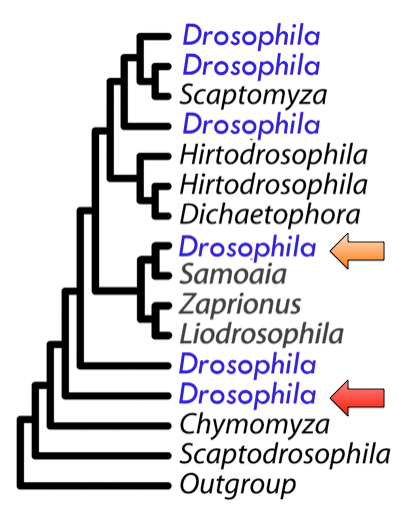 Combined phylogenetic tree ("supertree") stolen from Michael Bok, who redrew it from van der Linde and Houle (2008)
When we say D. melanogaster instead of fruit fly we all know what we're talking about, and in modern biology a species name can be a key to huge amounts of information. But there's a problem with Drosophila. The genus as it is currently prescribed is a mess, species currently included in the genus come out in disparate groups in phylogenetic analyses like the one one the left. The solution is obvious, break up the big malformed genus into a set of smaller ones, giving all but one a new name. Such a process is pretty common in taxonomy, and the code used to my animal taxonomists explains how to go about doing it. Each genus has a "type species" which acts as the name bearer and when a genus is split, it's the group with the type species that keeps the original name. In molecular biology D. melanogaster is very much the name bearing Drosophila (it's frequently referred to just by that name or even as "the fly") but the same isn't true in taxonomy. The type species is D. funebris and no matter how Drosophila is broken up D. funebris and D. melanogaster are going to end up in different genera so melanogaster will lose its forename. But D. melongaster isn't just any fly - changing that name would render thousands of textbooks, papers and databases out of date.
Kim van der Linde saw the coming of the Drospho-pocalypse, and applied to the International Committee of Zoological Nomenclature (ICZN) to have D. melanogaster installed as the type species, preventing any changes to the taxonomy of the group from changing the species name. A couple of weeks ago the ICZN made their decision: the application was turned down and D. melanogaster will almost certainly have it's name changed. You can read the decision online - the committee make arguments for their decision with varying degrees of credibility. Perhaps the weakest justification revolves around this mosquito (I couldn't have two Sunday Spinelessness posts in a row without one photo from me!):
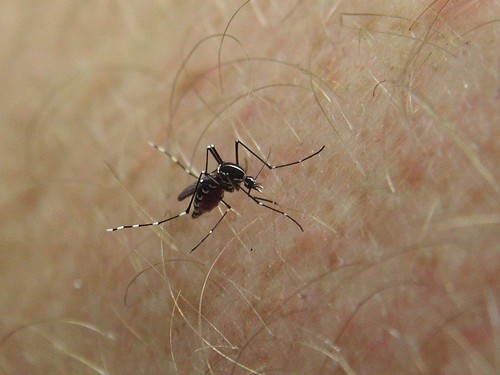
This photo was taken on Mitiaro in the Cook Islands, and at the time I took I knew for sure that those white striped legs marked it out as Aedes aegypti. If that species of mosquito had bitten me on any other island in the Cooks I wouldn't have calmly framed a photo, it's a vector for dengue fever which is, by all accounts, a horrible disease to have (Mitiaro's population of 200 people isn't enough to sustain Dengue, and since the main features of the island are two huge brackish lakes fill of mosquito larvae you soon give up on swatting bugs and spraying DEET). But the point of me showing you this photo now is to tell you that mosquito is no longer Aedes aegypti. Some ICZN committee members cited the fact this species has recently been renamed to Stegomyia aegypti as evidence that renaming a widely studied organism isn't the end of the world, which rather ignores that fact medical workers, ecologists, parasitologists and geneticists have ignored the reassignment entirely and some prominent journals have even issued editorials encouraging researchers to use the "old" name.
Surely in Aedes aegypti we have a model of what will happen when D. melnoagster gets its genus reassignment - taxonomists will refer to it by the new name and the rest of the world will cray on as if nothing had happened. By refusing to make a small change to the existing taxonomy of the group the ICZN runs the risk of driving a gap between the taxonomic community and other scientists. The only good thing to come from the whole ordeal is that "D. melanogaster" will almost certainly become Sophophora melanogaster which tranlates as "dark bodied bearer of knowledge", a fitting name for such an important fly.
Plenty of other bloggers have been talking about this story, some with quite different takes than mine. You should check out Kim van der Linde who made the the application to the ICZN and has been blogging the aftermarth as well as Micheal at Arthropoda, Chris at Catalogue of Organisms and Dave at Seed.
Labels: Cook Islands, diptera, drosophila, environment and ecology, Field Trip, photos, sci-blogs, sunday spinelessness, taxonomy
Sunday, April 11, 2010
Sunday Spinelessness - Hover-flies
We are starting to get that feeling in Dunedin, the days are getting shorter and cooler, and we can't enjoy a sunny weekend without wondering how long it will be until we see another one. So, to cheer me up, let's use this post to celebrate a group of very summery insects, the hover-flies (family Syrphidae) .
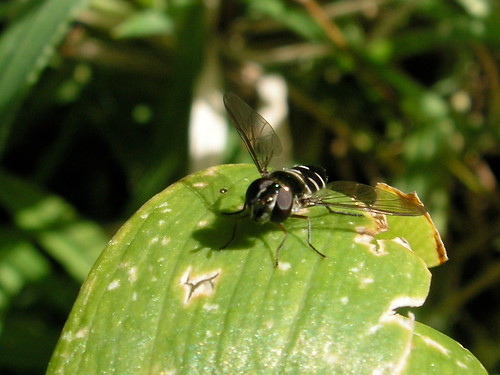
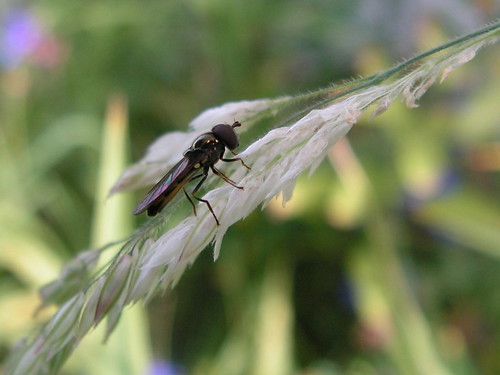
Hover-flies rank alongside bees, both honey and bumble, as the most frequent visitors to garden flowers during summer. Thankfully for me, hover-flies don't limit themselves to well tended gardens, they are just as likely to brighten up weed infested patches:
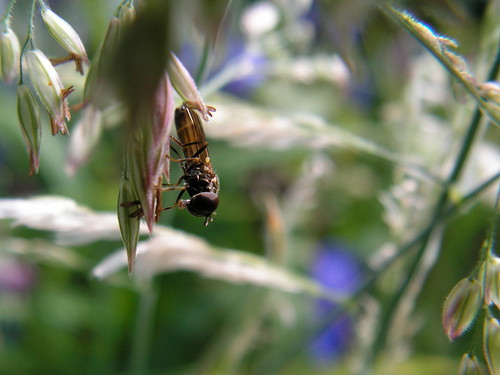
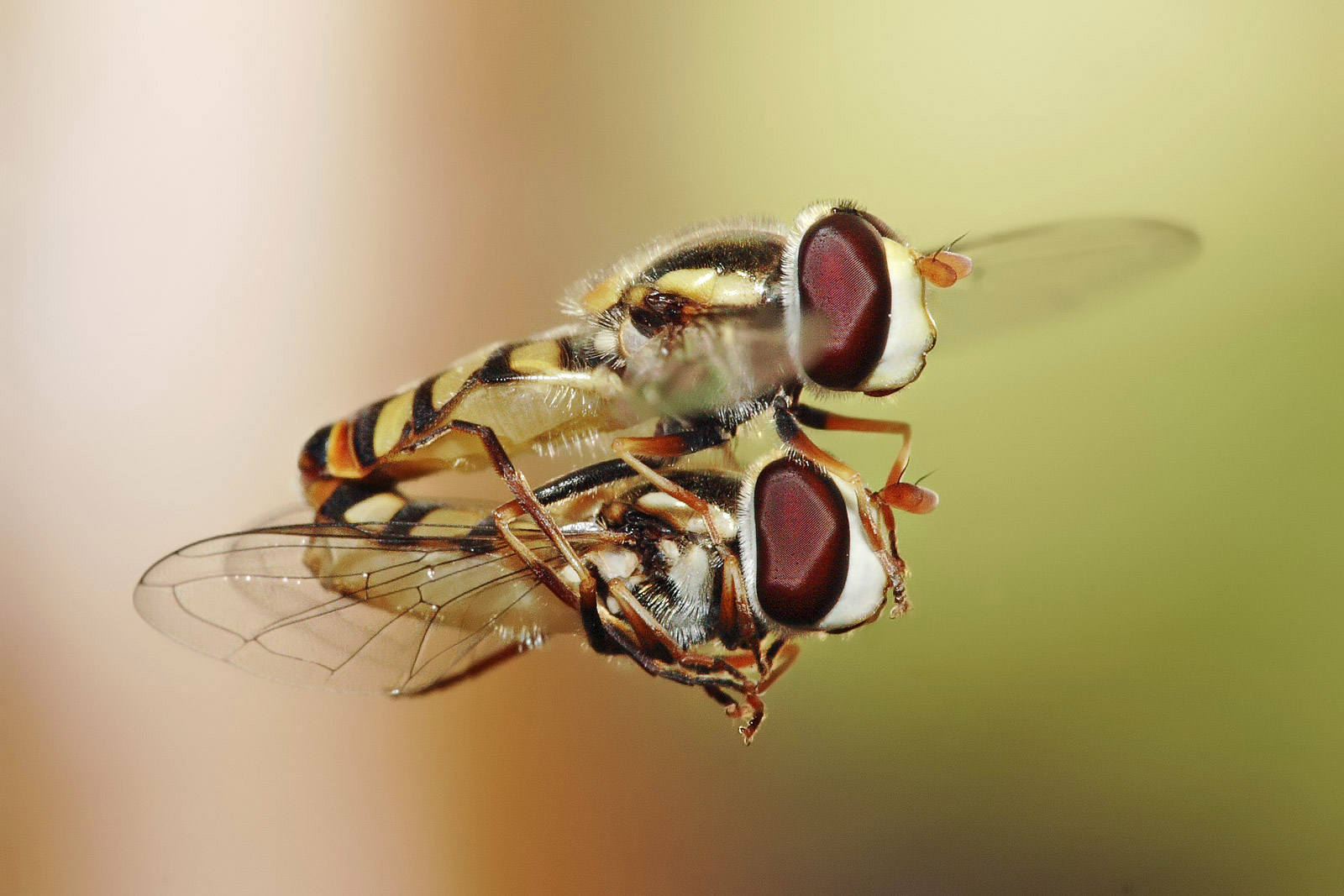
Plenty of other flies can hover, but hover-flies make an art of it. You'll often see them suspended above a flower, their wings beating to fast to see and their heads completely motionless. As this stunning photo from wikipedia user Fir002 (whose other photos can seen here) shows, hover-flies can do all sorts of things in mid air:
Labels: diptera, environment and ecology, hover-fly, photos, sci-blogs, sunday spinelessness, Syrphidae
Sunday, April 4, 2010
Sunday Spinelessness - A Nobel Prize Winning Insect
I think invertebrates are important. The 95% of animal species that don’t have a backbone are not simply the base of the animal kingdom’s pyramid, they are the little creatures that run the world. A third of the planet’s food production relies on honey bees, collembola and corpse-feeding insects turn dead tissue into living tissue and coral reefs can turn the nutrient-poor tropical seas into submarine rainforests. There are even a couple of invertebrate animals that have won the Nobel Prize.
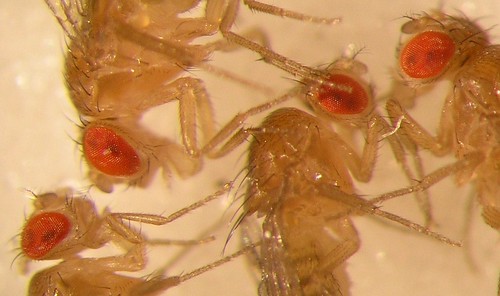
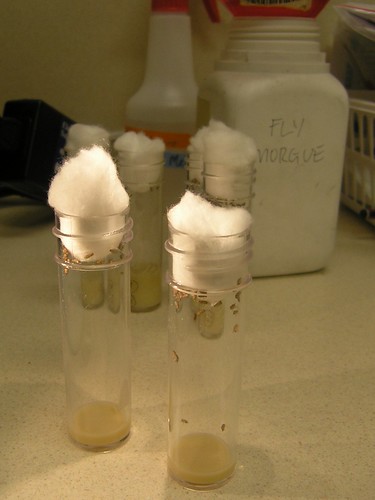
Drosophila melanogaster has probably taught us more about genetics than any other animal on earth. In the wild D. melanogaster larvae develop on rotting fruit so, just like the flesh-flies that were featured here a couple of weeks ago, they are faced with the problem of having to complete their entire developmental program in the short period of time the fruit they are born in is a viable food source. Thanks to these environmental constraints, D. melanogaster has a very short life cycle. Under optimal conditions they can go from egg to adult in a week. This remarkable developmental haste means drosophilists can run genetic experiments that cover many generations in a few months, and they can run many replicates of these experiments because each of them takes up about this much space:
Drosophila has been kept in laboratories since the the turn of the 20th Century but T.H. Morgan was the first person to put Drosophila at the forefront of genetic research. Morgan was an embryologist by training and, like a lot of embryologists then and now, he became interested in a school of evolutionary thought called mutationism. As the name suggests, the mutationists argued that one-off mutations were the creative engine of evolution, relegating natural selection to weeding out maladaptive mutants. In order to test the creative power of mutation Morgan grew up generation after generation of Drosophila and bombarded them with anything he thought might mutate them; radium, salts, sugars, acids, bases and even centrifugal force. Two years of this mutational bombardment got Morgan nowhere, he could induce changes in his flies but none that would be stably passed on. In 1910 he found a single white eyed male.
There is a story, which I can't find repeated by reliable sources, that holds that Morgan took the first white eyed male home with him in jar and slept with the jar next to his bed that night. I don't know if that story is true but that one fly does have a treasured place in the history of genetics. By crossing it to normal eyed (what geneticists call "wild type") females he was able to show that the genetic factor that made the fly's eyes white was part of the sex determining chromosome. For the first time a gene had been shown to be reside on a chromosome. A few years later he showed that multiple genes are arranged in linear fashion along chromosomes by demonstrating crossing over between the white eye gene and another called rudimentary. At Otago second year geneticists repeat Morgan's experiments, so this picture, sorting flies under a binocular microscope, will be familiar to anyone whose been through the program. (it will probably also bring back memories of escaped flies and a whiff of the (dilute) ether used to knock the files out...)
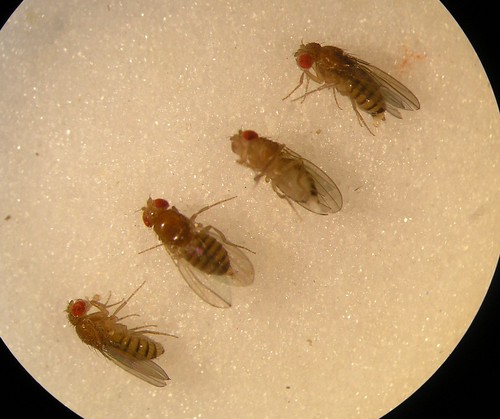
Morgan was awarded the Nobel Prize in 1933, in 1948 Drosophila research got another Nobel, this time to Hermam Muller for showing X-ray radiation could induce mutations. Geneticists have continued to use Drosophila as a model organism, perhaps most usefully in untangling the genetic interactions that underly the development process. In 1980 Christiane Nüsslein-Volhard and Eric Wieschaus presented the results of a mutational screen; that is, they mutated Drosophila stocks at random and recorded the developmental phenotypes that resulted. Nüsslein-Volhard and Wieschaus identified 15 genes involved with the very early stages of development. In quick time Drosophilists mapped that those genes to chromosomes and worked out how their products combined to pattern a developing embryo. Nüsslein-Volhard and Wieschaus' work laid the ground work for one of the most staggering findings of modern biology, almost all the genes that help shape the Drosophila embryo have counterparts in the human genome that play similar roles in our development. An insect can be a useful model for human development and disease genetics. Nüsslein-Volhard and Wieschaus were awarded the Nobel Prize in 1995, the third Nobel for work on Drosophila.
A big thanks to Sarah Morgan, one of Otago's fly pushers, for the photos that illustrate this post. Sarah's off to the US of A this week to show off her research at The Big Drosophila Meeting in Washington DC so she will probably have some less historical Drosophila science to talk about in the next little while...
Nüsslein-Volhard C, & Wieschaus E. (1980) Mutations affecting segment number and polarity in Drosophila. Nature, 287(5785), 795-801. PMID: 6776413
Rubin GM, & Lewis EB. (2000) A brief history of Drosophila's contributions to genome research. Science, 287(5461), 2216-8. PMID: 10731135
Labels: diptera, drosophila, environment and ecology, genetics, might interest someone, photos, sci-blogs, sunday spinelessness
Sunday, March 14, 2010
Sunday Spinelessness - Extreme Close-up
Almost all the photos I've used to illustrate these Sunday Spinelessness posts have been taken with my fixed lens digital camera. I think it does a pretty nice job in macro mode but sometimes you just want to get a little closer to your subject. I photographed each of the landsnails I collected for my PhD research so that I could have a record of their pigmentation, which degrades once you preserve a specimen in ethanol. Obviously, the more detail I could get the better so I borrowed some very exciting toys from the department's photography office:

The camera is a DSLR with a 100mm f2.8 macro lens, an extension tube and a twin flash. The mammal crashing this invertebrate-celebrating series is me.
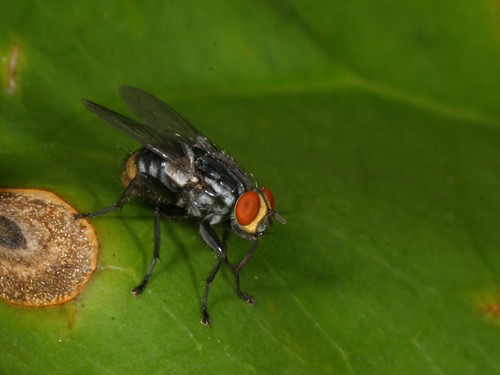
Of course, I couldn't have a toy like this to play with and limit myself entirely to photographing snails. In amongst those important snail photos I have jumping spiders, hornets, geckos and really anything else that chanced across the porch I was taking photos on. One of the more striking subjects is this red-eyed fly:
And the head-on shot...
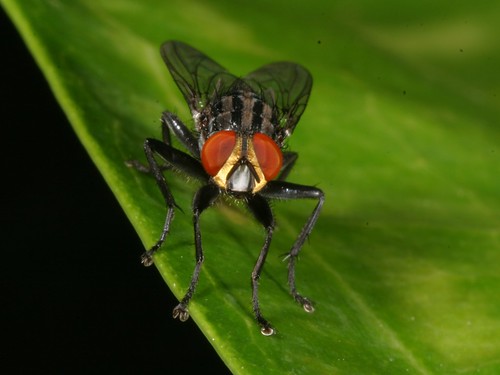
It turns out the pretty red-eyed fly is Oxysarcodexia taitensis, one of the Sarcophagidae. That family name gives you a clue to how this fly makes its living, it translates as "flesh eating" (it stems from the same root words as sarcophagus, the Greeks believed limestone ate away at corpses sealed in it). Most of the flesh-flies feed on dead animals but a few have earned a place in vertebrate nightmares, horror movies and even medical practice by depositing their maggots in on open wounds.
Relying on dead animals for food is a chancy business. Corpses are usually patchily distributed and there a plenty of other scavangers out there to compete with. This problem is especially bad for the larval stages of insects, without wings to get them to the next corpse their entire future depends on the continued existence of the flesh they are born on. The sarcophogids have developed a neat trick for making the most of corpse when they find one - they give birth to live maggots. Technically, the flesh flies are ovo-larviparous, meaning the larva develops inside an egg which is retained in the female until the larva hatches. Flesh-fly maggots can start eating as soon as they are born, maximizing their chances of getting through their lifecycle before another scavenger eats the corpse they live in.
It's easy to get freaked out about a creature that spends it's life eating decaying flesh but we should remember that flesh-flies play an important role in ecosystems. Sarcophigids and other scavengers turn dead flesh into living flesh. WD Hamilton, one of evolutionary biology's most insightful and original thinkers, recognised the important role of carrion feeding insects in his burial instructions:
"I will leave a sum in my last will for my body to be carried to Brazil and to these forests. It will be laid out in a manner secure against the possums and the vultures just as we make our chickens secure; and this great Coprophanaeus beetle will bury me. They will enter, will bury, will live on my flesh; and in the shape of their children and mine, I will escape death. No worm for me nor sordid fly, I will buzz in the dusk like a huge bumble bee. I will be many, buzz even as a swarm of motorbikes, be borne, body by flying body out into the Brazilian wilderness beneath the stars, lofted under those beautiful and un-fused elytra which we will all hold over our backs. So finally I too will shine like a violet ground beetle under a stone.".
Labels: Cook Islands, diptera, environment and ecology, flesh-fly, might interest someone, photos, Sarcophagidae, sci-blogs
Sunday, February 14, 2010
Sunday Spinelessness - robber fly
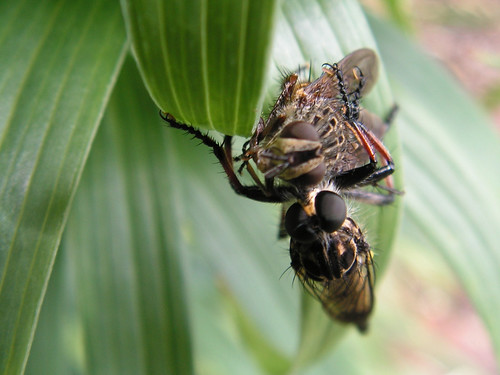
I've said before that the bugs in my parents' back yard seemed especially hungry over the Christmas break. Above you see more evidence to this fact. In the lower half of the photo is a robber fly and above is its meal, a blowfly of some sort. I've never seen live robber flies in Dunedin (though there is a dead one here) but the species captured above seems to be reasonably common in the Wairarapa. The first time I spotted one of them I struggled as to where to place it among the insects. The robber flies have long slender bodies and large rounded eyes which misled me into thinking that first sighting might be a small dragonfly. The real taxonomic position of the robber flies is spelt out in bright yellow in the next photo.
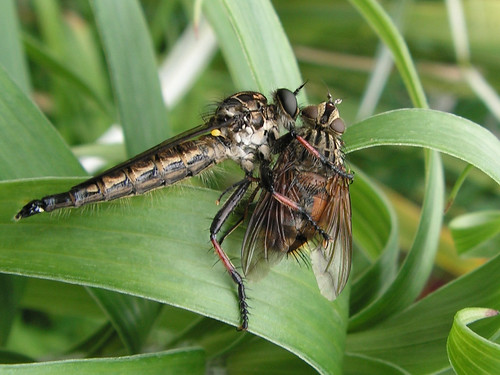
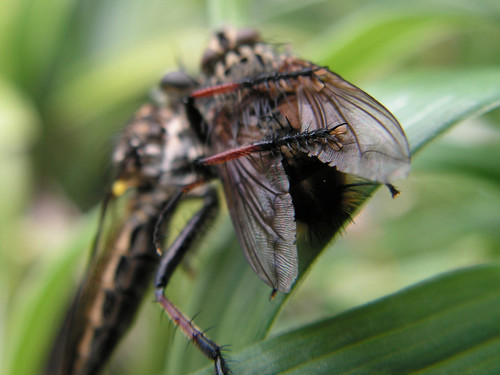
That bright yellow structur under the main wing is a haltere. Most insects have two sets of wings and we can tell quite a lot about where a given species fits in the insect scheme based on how it uses those two. Dragonflies and damselflies use both for flying, in beetles the forewings are "sclerotised" into a rigid case that protects the flight wings and the "true flies" ( order Diptera) have turned thier hind-wings into halteres - greatly reduced wings which act as gyroscopes stabilising the flies' flight and allowing them to perform aerobatic tricks. The robber flies from the extremely widespread and speciose family dipteran family Asilidae which includes a staggering 7 000 described species, meaning there are rather more robber fly species in the world than there are mammalian ones.
The features that led me to mistake that first robber fly that I saw for a dragonfly are likely the result of convergent evolution - dragonflies and robber flies are both predators that specialize in taking other insects on the wing. The robber flies differ from odonates in having piercing mouth-parts which they use to inject first a neurotoxin then digestive enzymes into their prey. The blowfly in the photos in this post is paralysed and its tissues are in the process of being liquified and sucked through the robber flies mouth parts. But ever before the neurotoxin entered the blowfly's body it was done for, the robber fly's strong "raptorial" legs are covered in sharp spikes and end in claws that offer little hope for escape once a catch is made.
Labels: Asilidae, diptera, environment and ecology, might interest someone, photos, sci-blogs, sunday spinelessness
Sunday, January 24, 2010
Sunday Spinelessness - Dipteran Deathtrap
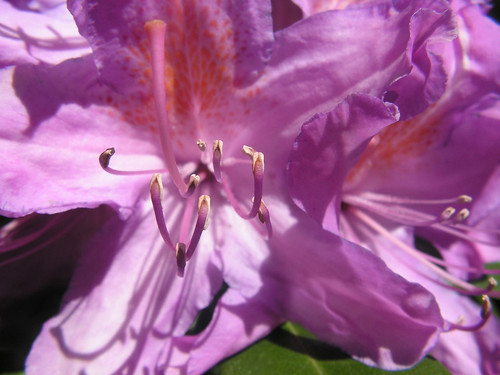
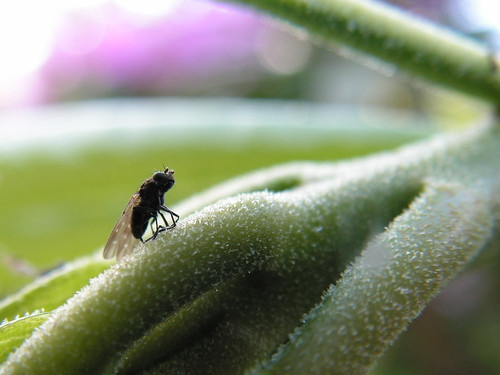
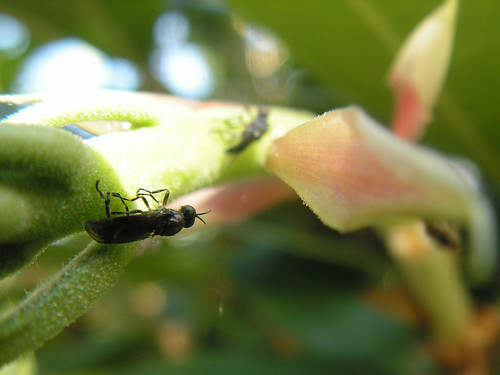
Hunting around the young shoots you can see spiders and beetles that have met the same fate but it seems it's the true flies of the order Diptera that suffer most and probably the soldier flies that do worst of all:
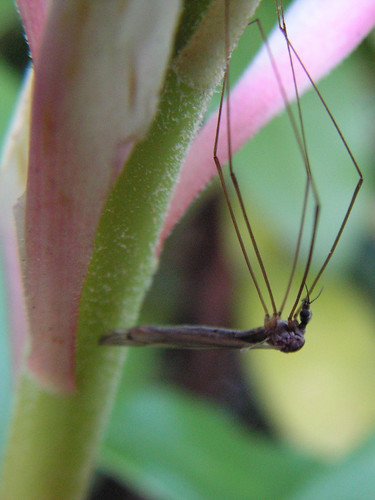
I realise most people will think taking photographs of dead flies is more than a little macabre but I contend there is something quite beautiful about a crane fly suspended gracefully by its long legs
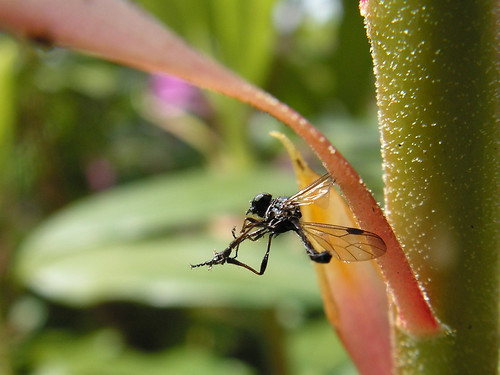
Ok, I promise I'll find something a bit more uplifting for next week's post!
Labels: Asilidae, diptera, environment and ecology, photos, rhododendron, sci-blogs, Stratiomyidae, sunday spinelessness, Tipulidae

All content not otherwise marked is licensed under a Creative Commons Attribution-ShareAlike 3.0 Unported License.


