
Sunday, February 14, 2010
Sunday Spinelessness - robber fly
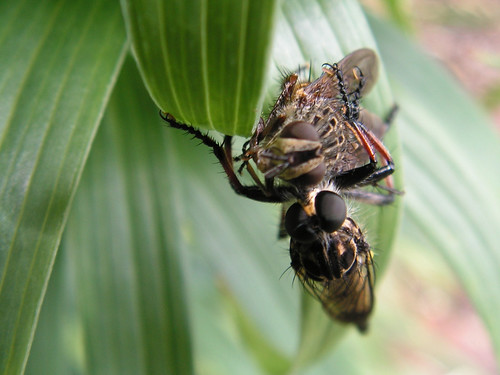
I've said before that the bugs in my parents' back yard seemed especially hungry over the Christmas break. Above you see more evidence to this fact. In the lower half of the photo is a robber fly and above is its meal, a blowfly of some sort. I've never seen live robber flies in Dunedin (though there is a dead one here) but the species captured above seems to be reasonably common in the Wairarapa. The first time I spotted one of them I struggled as to where to place it among the insects. The robber flies have long slender bodies and large rounded eyes which misled me into thinking that first sighting might be a small dragonfly. The real taxonomic position of the robber flies is spelt out in bright yellow in the next photo.
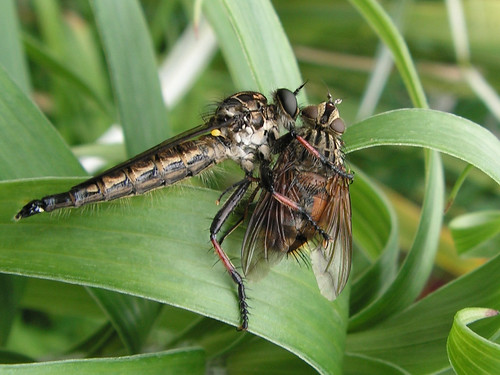
That bright yellow structur under the main wing is a haltere. Most insects have two sets of wings and we can tell quite a lot about where a given species fits in the insect scheme based on how it uses those two. Dragonflies and damselflies use both for flying, in beetles the forewings are "sclerotised" into a rigid case that protects the flight wings and the "true flies" ( order Diptera) have turned thier hind-wings into halteres - greatly reduced wings which act as gyroscopes stabilising the flies' flight and allowing them to perform aerobatic tricks. The robber flies from the extremely widespread and speciose family dipteran family Asilidae which includes a staggering 7 000 described species, meaning there are rather more robber fly species in the world than there are mammalian ones.
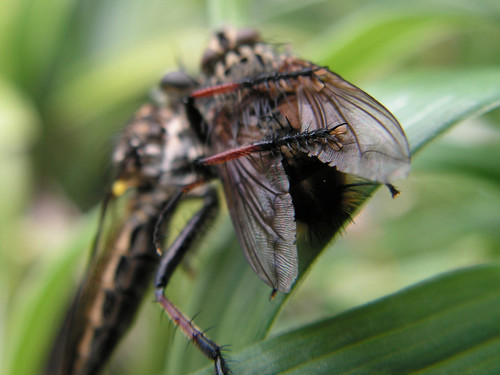
The features that led me to mistake that first robber fly that I saw for a dragonfly are likely the result of convergent evolution - dragonflies and robber flies are both predators that specialize in taking other insects on the wing. The robber flies differ from odonates in having piercing mouth-parts which they use to inject first a neurotoxin then digestive enzymes into their prey. The blowfly in the photos in this post is paralysed and its tissues are in the process of being liquified and sucked through the robber flies mouth parts. But ever before the neurotoxin entered the blowfly's body it was done for, the robber fly's strong "raptorial" legs are covered in sharp spikes and end in claws that offer little hope for escape once a catch is made.
Labels: Asilidae, diptera, environment and ecology, might interest someone, photos, sci-blogs, sunday spinelessness

Sunday, January 24, 2010
Sunday Spinelessness - Dipteran Deathtrap
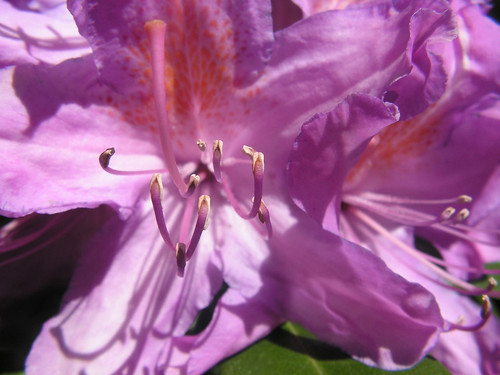
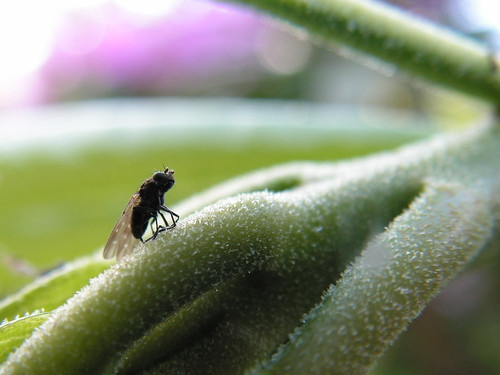
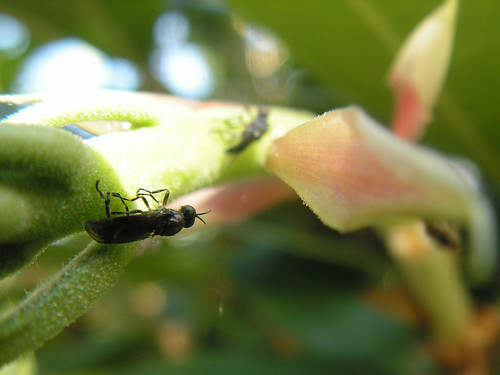
Hunting around the young shoots you can see spiders and beetles that have met the same fate but it seems it's the true flies of the order Diptera that suffer most and probably the soldier flies that do worst of all:
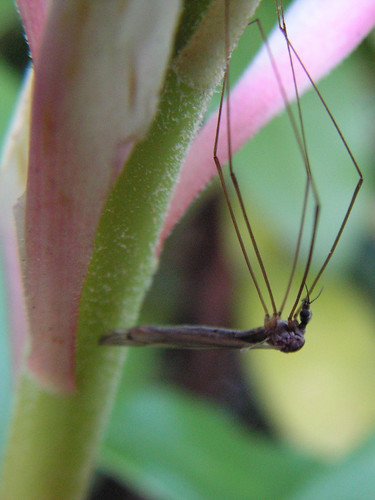
I realise most people will think taking photographs of dead flies is more than a little macabre but I contend there is something quite beautiful about a crane fly suspended gracefully by its long legs
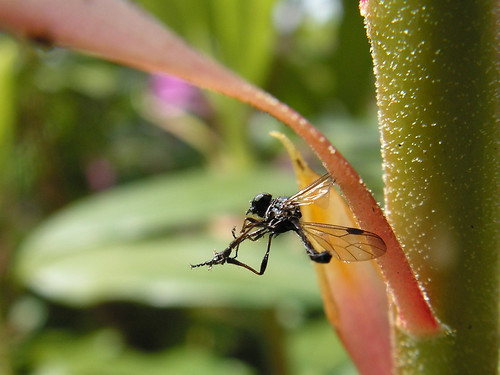
Ok, I promise I'll find something a bit more uplifting for next week's post!
Labels: Asilidae, diptera, environment and ecology, photos, rhododendron, sci-blogs, Stratiomyidae, sunday spinelessness, Tipulidae

All content not otherwise marked is licensed under a Creative Commons Attribution-ShareAlike 3.0 Unported License.


