
Sunday, February 13, 2011
Sunday Spinelessness - Murdering my darlings
Recently, there's been a little bit of talk among science bloggers about the need to murder your darlings. Christe, Carl and Ed are talking about excising some of your favourite passages of writing in order to let a whole post hold together, but I've been thinking about the phrase in a different context recently. I'm an invertebrate evangelist, and I utterly fail to understand how most people manage to package all the world's invertebrates into one giant and creepy category. But no matter how much you love bugs, you have admit some of them are just pests that need to be dealt with.
Lately our garden has been taken over by wasps. That's "wasp" in the every day sense in New Zealand, the murderous little yellow and black flying insects; we have thousands of native wasp species but they are all solitary and most are small and limited to native bush, so they don't really enter our consciousness. The German Wasp and its cousin the Common wasp (Vespula germanica and V. vulgaris), are something quite different. They are both social insects that build nests that support thousands of workers, each of which lives to bring up their queen's brood. Unlike honey bees and bumblebees, where the workers collect nectar and pollen to feed their young, wasp larvae need flesh. In late spring, the first generation of workers leave the nest and start collecting insects (especially caterpillars it seems) to feed to the developing larvae. The adults feed on nectar, but in the start of the season they are mainly sustained by a sugary substance the larvae produce in return for their food. In the middle of summer adults spend more time looking for their own food outside the nest, and that's why we start noticing them around fallen fruit and picnics come December or so.
There is nothing quite like these introduced wasps in the New Zealand fauna. The relative nativity of our insects, the lack of any predators and our relatively warm winters (which don't kill-off the nests every year) mean these wasps live at much greater densites in New Zealand than they do in Europe. In native beech forest, especially sourthern forests that produce honeydew thanks to native scale insects, there can be as many as ten thousand workers in one hectare, that's one wasp for every square metre of forest. In beech forests in particular, wasps are a complete disaster. They can wipe the forest floor clean of native insects and spiders and monopolise the honeydew, which is an important source of energy for native birds. Indeed, if you were to weigh all the wasps in some sections of native forests it would add up to more than the combined weight of all the native birds. In urban and rural settings wasps are a pain (literally, I was stung by one as a child and remember it well).

So, as opposed to almost every other invertebrate that crosses my path, when I see an introduced wasp I get just a little sense of revulsion. When i tracked down the the source of our graden's yellow and black plague to two different nests on our property I hardly thought twice before I bought a bottle of carbaryl to deal to them. The first nest was no problem, it was dug into our clay bank and had a nice clear entrance site that I could sneak up to at night - letting me cover the entrance with the poisoned powder. The other nest was tougher.The entrance to that one was obscured in amongst a compost pile, right next to some weedy flowers which are visited by honey, bumble and and even native bees. Carbaryl is a broad-spectrum insecticide, and bees are having a hard enough time without being caught in the crossfire of this war, so a scorched earth policy wasn't really an option. Instead, I got a long sleeved shirt* and a spade and began to excavate the entrance to the nest. This process basically involved me clearing away a little of obscuring material before dropping the spade as a bolt of WHITE-HOT ADRENALINE passed through my body as a single wasp flew in roughly my direction for a little while. Quite a few rounds of this process ended when the last blow of my spade revealed not the entrance to the nest, but the very middle of it.

I'd cut a wall of the nest open and revealed a swarming yellow and black mass of wasps (who were more interested in attacking the spade than me) and the cells they'd constructed to house their young. Once the initial buzz had died down, I managed to extract the section of the nest that I'd dismantled and in doing so I learned something. Wasps might murderous, stinging invasive pests, but they're also quite beautiful. In all the time I'd been cursing their presence in my garden, they'd built an incredible piece of architecture out of the weeds we'd thrown away. My photos hardly do their efforts justice, but you get an idea.

A section of the wasp nest with the major stages of development (eggs, larvae and pupae) on display
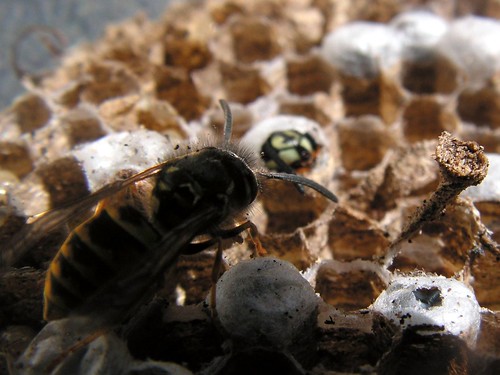

One of the very few spineless creatures that I thought had no place in my heart had really amazed me. Beautiful as their creation might have been, they are still a pest and later that evening I came back to their now exposed nest and killed them, but it was a much more difficult job than the first nest.
*Really. I don't know what sort of protection I though this was going to offer...
If you want more posts dealing with ravenous hordes of social insects, Alex Wild at Mrymecos declared last week "Army Ant Week" and celebrated by producing some of the most wonderful photographs and interesting posts you're likely to find.
Labels: environment and ecology, photos, sci-blogs, sunday spinelessness, wasp

Sunday, June 6, 2010
Sunday Spinelesness - One for the arachnophobes?
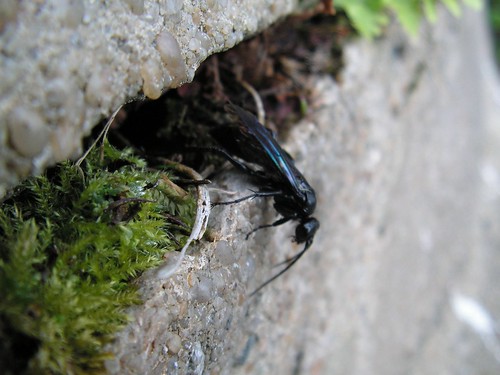
It occurs to me that some readers might be put off by my affection for spiders. I'd be interested to see which creature, the wasp or the spider, you find yourself cheering for at the end of this post. Let's introuduce them. First, the large black hunting wasp Priocnemis monachus emerging from its burrow in one of the steps on our garden path (I messed up the focus, but nature has a way of refusing to re-pose):
And the creature the black hunting wasp has been hunting, one of the native tunnelwebs Porrhothele antipodiana:
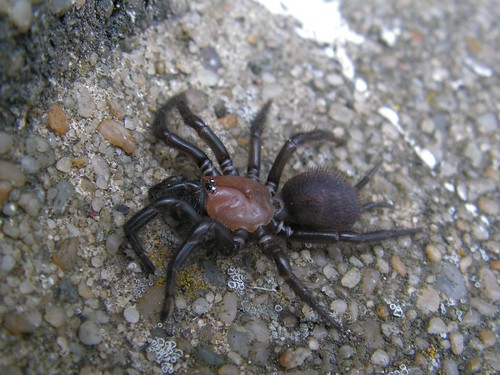
Po. antipodiana is pretty cool spider, it's one of very few that are capable of eating snails. Snails usually avoid the attentions of ground dwelling spiders by being too slimy to get a hold off and being able to retract into their shell. Po. antipodiana get's around those defenses by hooking its fangs into the snail's body and holding on while the snail struggles, produces tonnes of mucus and finally succumbs to the spider. A couple of months ago I gave a talk to a local school who wanted someone to help their study of invertebrate lifestyles and one of the kids told me that he'd seen a tunnelweb eating a snail. The budding naturalist didn't seem at all proud when I told him that he'd observed a behaviour that was only recognised by scientist 30 years ago. I guess 30 years seems an impossibly long time when your 10!
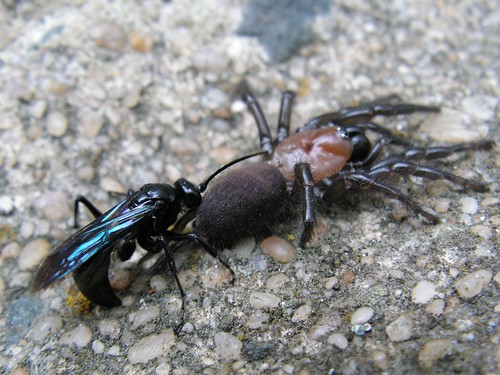
If this particular spider looks a bit bedraggled it's because it has already been anesthetised by the wasp. Pr. monachus is a member of the family Pompilidae which, like the ichneumonidae that featured here last week, use the living bodies of other arthropods as incubators to grow their young. While most of the ichneumonidae use caterpillars to grow their larvae the pompilids specialise in spiders (which has earned them the name spider wasps). There are ten described species of spider wasp in New Zealand, each targeting a range of spider species. Pr. monachus the largest of our spider wasps, and by choosing Po. antipodiana to provision her nest this one has taken on of New Zealand's largest spiders:


Labels: environment and ecology, might interest someone, parasitism, photos, Pompilidae, Porrhothele antipodiana, Priocnemis monachus, sci-blogs, spider, sunday spinelessness, wasp
Sunday, May 30, 2010
Sunday Spinelessness - The Wasp That Did For Darwin's Faith?
I own that I cannot see as plainly as others do, and as I should wish to do, evidence of design and beneficence on all sides of us. There seems to me too much misery in the world. I cannot persuade myself that a beneficent and omnipotent God would have designedly created the Ichneumonidae ...
Here's one the Ichneumonidae, the family of wasps that Darwin couldn't fit into a world with a loving god.
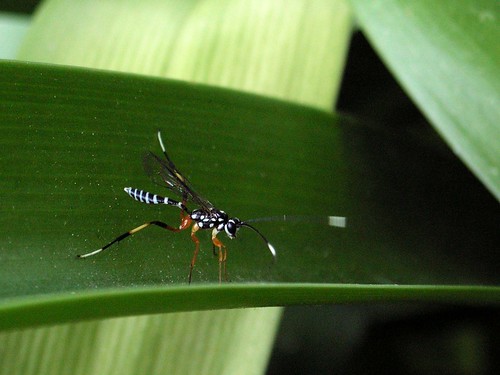
What could Darwin find so abhorrent about such a fine looking creature? It was their unique approach to parenting the put Darwin off. Ichneumon are diligent parents, to make sure their offspring have all the food they could ever need the wasps lay their eggs in the bodies of other insects. The larva develops within the host insect, carefully keeping the doomed creature alive as it eats its way through first its fat stores then its non-essential organs. Finally, with the larvae almost fully grown it turns its attention to the host's essential organs before it eats its way through the skin. The ichneumon life-cycle was the inspiration for the chest bursting aliens in the Alien movies.
The quote that started this post is often presented as an observation unique to Darwin, or even as a sort of epiphany that did for Darwin's faith. In fact, Darwin was repeating what had become an old saw by the time he wrote it. The ichneumon lifecycle was widely discussed by Victorian naturalists and theologians. At that time there was a great deal of interest in an idea called natural theology, which amounted to learning about god by studying his creation. But some pats of nature don't seem to reveal a beneficent god. The natural theologians managed to convince themselves that the lion hadn't yet laid down with the lamb because predators saved their prey a worse fate, but the idea of ichhneumon larvae rasping away at their hosts from the inside out proved a greater challenge.
Stephen Jay Gould wrote an essay on the problem of the ichneumon which lists some of the ways natural theologians tried to deal with it. William Kirby, the great entomologists who also happened to be a reactor, emphasized the great dedication of the wasp to her offspring and praised the larvae's sustainable approach to eating their hosts while saving mroe live tissue for later. For modern readers it seems very odd to be describing wasps as virtuous. By and large we've come to realise that nature doesn't provide moral lessons, but we haven't quite given up the naturalistic fallacy that drove the natural theologians. How many times have you hear peddlers of snake oil claim their product was safe "because it's natural"? Or people object to genetic engineering or vaccines because they are unnatural?
We even still look on nature as a source for morality, proponents on either side of the debate for gay rights swap statistics on how common homosexuality is among other animals - as if the sex lives of bonobos or prairie voles had anything to do with human rights. If there is a lesson to learn from the gruesome life-cycle of the Ichneumonidae it's that nature just is, and we need to turn elsewhere for moral lessons.
Hold on, these posts are meant to be about celebrating weird bugs. Let's end with the great David Attinbrorough on the Ichneumonidae.
Labels: environment and ecology, Helpis minitabunda, ichneumonidae, insects, photos, sci-blogs, wasp
Sunday, November 8, 2009
Sunday Spinelessness - action sequence
s Lately I've been trying to get some photos of the wolf spiders that scurry about in the bark chips we use as mulch on our garden. Unfortunately those guys are camera shy, really fast and pretty well camouflaged so I don't have any photos of them worth sharing with you but it's amazing what you see when you sit down and wait for a little while. It turns out I'm not the only one keen on our garden's spiders, while I was failing to photograph them a solitary wasp (as opposed to a social one, though there was also just one of them) had gone into the garden to find a suitable host for its larvae and got itself into a lot of trouble - it was crawling out with a worker ant (possibly the endemic species Monomorium antarcticum) attached to its hind leg.
Labels: ant, photos, sci-blogs, sunday spinelessness, wasp

All content not otherwise marked is licensed under a Creative Commons Attribution-ShareAlike 3.0 Unported License.


