
Sunday, November 14, 2010
Sunday Spinelessness - My own ID challenge
Some of the cooler kids in bug-blog world post identification challenges from time to time (1,2,3). I seldom get very far on those challenges, in fact, they usually serve only to make me wonder if there is any obscure insect group Ted McRae can't ID from a single photo.This month I've had my own little ID challenge sitting out in the garden, the Pittosporum is infested with these:

Sadly, I have to admit I didn't even recognise these guys as animals on the first take (the greatest taxonomy fail ever?). Just passing by the bush it's easy to mistake the dark patches for some sort of of blemish within the leaves themselves. But blemishs don't tend to move, and they're not usually so unerringly associated with winged bugs:

The 'blemishes' must actually be flattened sap-sucking nymphs on their way to becoming the adults on the left. "Flattened sap-sucking nymphs" sounds a lot like scale insects. Scales are a diverse group of true bugs known to gardners because one group, the mealy bugs, are a fairly common plant pest. In New Zealand, scale insects are of immense ecological importance. Ultracoelostoma scales live within the bark of Southern Beech (Nothofagus spp.) trees. These scales act like little siphons, they stick their mouths into the phloem (the sap) of the tree while the other end of their digestive tract extends out from the tree's trunk on a long waxy filament. The excreted sap, which is still very energy-rich, forms in a droplet at the end of the anal filament. If the sugary droplet stayed at the end of the filament for too long it might harden, and prevent the flow or more sap into the scale insect's body. There isn't much risk of that happening though, the 'honeydew' provided by scale insects is a valuable food source in beech forests (which are usually short on fruit and flowers). Nectar eating birds, including the tui, bellbird and kaka, visit trees every few minutes to drink the scale insect's honeydew.
Sadly, these days introduced yellow jacket wasps are probably even more frequent visitors to scale insects. A healthy beech forest can support 10 000 of these social wasps per hectare (about ten times the density they reach in the Northern Hemisphere), that's a big enough army of wasps to take the honeydew resource away native birds and to go on and kill thousands of native invertebrates. (Landcare Research have page explaining the beech scale insect and the impact of wasps)
But that's all an aside, because the nymphs on my Pittosporum can't be scales. Scales are one of the few animals I can think of in which one sex doesn't develop as far as the other. The long maintaince of juvinile characters in adult organisms is called neoteny (the axolotl, a salamander that never metamorphoses but still reproduces, is probaly the most familar example of this phenomenom). In scale insects the adult female looks for all the world like those flat-bodied nymphs, while the adult is a two-winged bug (which looks... like nothing else really). There is a diagram of the adult scales in Project Gutenberg's version of The Life Story of Insects:
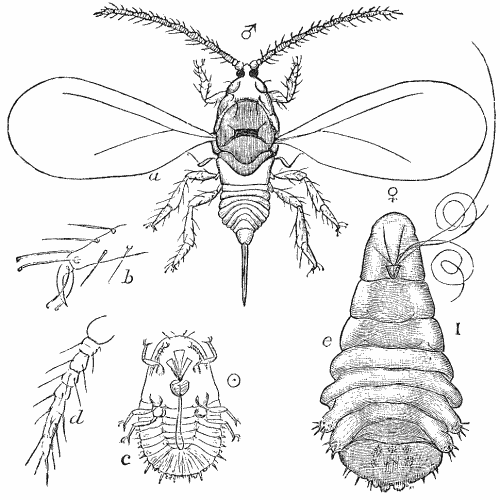
I have reason to belive that the adult females on our Pittosporum look aobut the same as the adult males:

Actually, the fact these guys are living on the Pittosporum should have been the give away to what they are. Plant sucking insects often become highly specialized, with species adapting to a particular host plant. These insects are the most common Pittosporum pest species Trioza vitreoradiata, the Pittosporum pysllid*. Apart from the fact the psyllids are related to aphids and scales and few other primative true bugs I can't tell you a lot more about them. Apparently they make good eating, I've seen worker ants and this fly abscond with nymphs:

I've also noticed one other, quite endearing habit. Almost any time one of the adults moves they do so by pointing their head down and their butt up and wiggling. Here, for the first time, is the psyllid boogie recorded for your viewing pleasure (this particular performance was delivered on my outstretched hand, which this psyllid thought would be a safe place to escape to when it got sick of having a camera in its face):
*This isn't a particularly accurate name. Pysllid is a name describing members of the family Psyllidae, but most recent taxonomies have placed Trioza in a separate family. Both are still in the superfamily Psylloidea, so I guess they should be called psylloids, which sounds even more sci-fi then there usual name.
Labels: bugs, environment and ecology, photos, psyllids, scale insects, sci-blogs, sunday spinelessness

Sunday, October 3, 2010
Sunday Spinelessness - How the aphid got its blush
Once upon a time, a green aphid lived on a plant somewhere. Like most of her kind, this particular green aphid didn't have wings so her whole life was going to be spent on this one plant, sucking away at the plant's sweet sap. You might be quite jealous of this aphid's life, since for an aphid a plant's sap really is an Exceptional Confection and she spends her time doing nothing but drinking it. But her life was harder than you might imagine, at the moment she was pregnant and her one goal in life was to make sure her babies would have a safe life here on this plant. This was long before gardeners came in to the world with pyrethrum and soap spray, but she had plenty of other enemies that could make life very hard for her and her babies. The scariest of all of the aphid's enemies were the wasps. The wasps would fly from plant to plant, smelling the air with their manically twitching antennae and searching for little green bodies with their eyes. This was very bad for the aphids, because theses wasps, just like the Ichneumon you already know about, would like nothing better than to use an aphid's body as an incubator for the their own babies.
And here comes the magic bit of our story. Our aphid wasn't feeling very well, she was infected by some fungus or other which was spreading through her body. You know that when you feel ill that you get hotter and you might swell up, and that's because you body is fighting back against your illness. The aphid's body was fighting back too, breaking up the fungus cells and stopping their spread. The aphid didn't know that her body was fighting fungi, all she knew was that she was starting to feel better, but something amazing was happening inside here. All those broken up fungal cells in her body had left their genes floating around, and one of those genes found its way into one of the aphid's babies.
A few weeks later the aphid was feeling much better, and it was time for her to give birth to her babies. Can you imagine her surprise when one of her babies wasn't green, like every other aphid that had ever existed until now, but was bright pink! She was staggered, but she always called her pink baby her Best Beloved and she never cared for her less than her green babies. And when the wasps came, with their twitching antennae and their giant scanning eyes, they always missed the pink bodied aphid. So the pink bodied aphid grew up and had pink bodied babies, and they got missed by the twitching, scanning wasps too so they had even more babies. So now, all these years after our aphid lived on her plant somewhere every pink aphid in the world can thank her, and her fungal infection, for their lovely colour.
***
No, I can't write the whole thing as a Just So Story, and I certainly can't write the poem that should finish it. But I do want to talk a little more about these guys:

I guess for most people a rose covered in little pink aphids is one of the less welcome signs of spring. I'd like to see the rose do well and produce lots of flowers, but I was also happy to see such a wonderful illustration for one of the most interesting pieces of evolutionary genetics to be published this year:
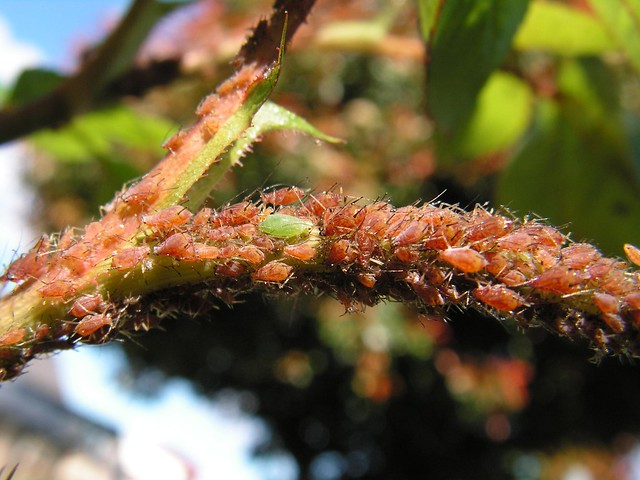
Lots of aphid species come in pink and green flavours, but just how the pink ones keep up their colouration has been a bit of a mystery. It's been known for a long time that the pink pigments are caratenoids, the same family of chemicals that make carrots orange and tomatoes red. These chemicals are important parts of lots of biochemical pathways, but animals can't make their own and have to rely on what they can eat. Except for aphids. Aphid caratenoids are slighltly different than those of their host plants, so they must be making their own but just how they can do that had been a mystery until this year. Mike Bok at Arthropoda and Ed Yong at Not Exactly Rocket Science covered the story when it broke, so here's the short version:
The pea aphid, Acyrthosiphon pisum, has become something on an unlikely model organism recently, and has even had its genome sequenced. Nancy Moran and Tyler Jarvick realised that the release of the pea aphid genome data was their chance to work out how the aphid got its caratenoids. They searched for genes similar to those that make up the caratenoid production pathway in plants, fungi and bacteria in the aphid genome and found some. Even more excitingly, there were able to relate the aphid genes to their relatives across the biological world and conclude that the genes of the aphid catatenoid pathway are most closley related to fungal genes - the aphids got their pink colouration from a fungus genome.
The transfer of genes from one organism to another outside of the traditional parent-offspring relationship is called horizontal gene transfer. In recent years it's become increasingly obvious that single celled organisms have been swapping genes in this way since life began, but the aphid case is among the first times horizontal gene transfer has been confirmed in animals. I should say, my little tale up there is a just so story in more ways that one. We really don't know how an aphid acquired fungal genes. Perhaps it was an infective fungus broken down an immune response, maybe it was raw RNA reverse transcribed into the aphid's genome or maybe there was a bacterial conduit. Wild aphid populations have a lot of symbiotic bacteria which can help them adapt to particular host plants and environments, perhaps in the past they had another that used fungal genes to change the aphid's colour and those genes have since migrated to the aphid's own genome.
Moran, N., & Jarvik, T. (2010). Lateral Transfer of Genes from Fungi Underlies Carotenoid Production in Aphids Science, 328 (5978), 624-627 DOI: 10.1126/science.1187113
Labels: aphids, bugs, environment and ecology, photos, sci-blogs, sunday spinelessness
Sunday, September 26, 2010
Sunday Spinelessness - At last a bug
I've been going at this Sunday Spinelessness thing for the best part of year now, in that time I've been able to cover a decent amount of the diversity among animals without spines. But up until today there was one clearing omission, so here is The Atavism's first bug:

In day to day speech we use the word 'bug' to describe any creeping, crawling or flying creature that happens to have its skeleton on the outside It would take a taxonomic pedant of the highest order to object to that usage, but 'bug' can also refer to a specific insect order. The Hemiptera are a group of insects with mouthparts specially adapted to sucking. Cicadas, plant hoppers, bed bugs, aphids, scale insects and water striders can all be called "true bugs" as can the star of today's post. It's a member of the shield bugs, or Pentomidae. Both those names refer to the shape of these bugs' bodies:

Like most insects, bugs have two sets of wings. In the shield bugs the base of the forewings is very leathery and sits over top of the much finer and membranous hindwings whcih are used for flying. This particular shield bug didn't seem to the least bit interested in using its wings, I picked it up from the garden path (where I very nearly stood on it) and was quite happy for me to pick it up and drop it off on some plants for a photo shoot.
Labels: bugs, insects, photos, sci-blogs, sunday spinelessness

All content not otherwise marked is licensed under a Creative Commons Attribution-ShareAlike 3.0 Unported License.


