
Sunday, July 17, 2011
Sunday Spinelessness - What the... ?
Issac Asimov provided one of my favourite quotes about science
The most exciting phrase to hear in science, the one that heralds new discoveries, is not 'Eureka!' (I found it!) but 'That's funny...
Scientific questions are almost never solved in eureka moments. Answers take time, planning, analysis and, finally, results from multiple studies made available for the scientific community to scrutinize. But there plenty of exciting moments in science, and there is nothing quite like the feeling of noticing something that doesn't quite fit with the way you think the world works. From there you can start spinning off theories that might explain the anomaly, and most excitingly, think how you might test those ideas against reality.
Something a little bit similar goes on in the life of a bug nerd. There are lots of creatures I'd love to see and never have. I've never seen a tardigrade, or a mantidfly [you really want to click that link, they're amazing] and reading Ted's blog means I'm forever looking out for one of our native tiger beetles. It's definitely a thrill seeing finally seeing some creature that you're read about and seen photos of, but it's at least as exciting to see something you didn't even know existed. For a bug nerd, "What the ..." is just as exciting a phrase as "A'huh", and that's exactly what I said when I turned some tree bark and found this spiky little guy:

Just as "That's funny ..." is a trigger to hypothesising and mentally developing a research proposal, "What the ..." is a precursor to reading searching, viewing and poking about in the hope of placing the strange creature into what we know about life. I have to admit I haven't got very far in this particular example. The thickest of those tufts mark the back end of the animal, and I'm pretty confident it's a beetle larva (you can make out two of the three legs on the near side of the body is this photo). Beyond that I'm a bit stuck, there are plenty of weevils with larvae that live under bark, but this doesn't look like any I've been able to find. Similarly, quite a few beetles in the family Dermestidae (called 'skin beetles' since some species are scavengers of animal corpses and some even specialise in eating hide) have spikey looking larvae like this one, but I can't find any helpful references for these beetles in New Zealand and don't know if there is a give away as to whether this animal fits in that family. If anyone knows what this is, or might be, I'd love to learn!
Labels: beetle, larvae, photos, sci-blogs, sunday spinelessness

Sunday, May 29, 2011
Sunday Spinelessness - Earth Measuring Caterpillars
It's Sunday night. So, of course, it's time for me to find an excuse for not writing that post I've been going on and on about and, instead, put up some photos and get back to work (or at least, stop working in time to watch Sherock).
The excuse is same old boring one, too much work and too little time. The photos were chosen to honour Weird Bug Lady (owner of the coolest Etsy shop in the world) and her brand new blog, dedicated entirely to caterpillars.

I'm not very good at the taxonomy of butterflies and moths, but it's very easy to see what family this caterpillar belongs when you see it move (terrible photo I'm afraid...):

That's the familiar gait of the "inch-worm", "looper" or geometrid. I've talked about geometrids before, but this was a good chance to talk about the anatomy that makes their caterpillars different than those of other moths. Most caterpillars get about with a combination of six "true legs" (labeled 3 in the diagram below) combined with a set of "prolegs" (short stubby limbs not unlike the ones that propel onychophorans through the leaf litter, and labeled 4 below). Quite a few species have particularly well developed prolegs on their final segment, which are to clasp on surfaces (labeled 5)

Michał Komorniczak for making this CC 3.0
Compare that pattern to this caterpillar:

The true legs are there:

But the prolegs are gone, except for a big pair of claspers:

"Inchworms" move around by hanging on with their true legs and dragging their rear-end forward (making a loop out of their body in the process) before they clasp on the surface and extend their whole bodies forward. When you see an "looper" making its way along a leaf or a twig it really does look like it's measuring out a set distance along its length, which gave them the common name "inchworm" and the scientific name Geometridae - which means earth measurer.
I have no idea what species this caterpillar belongs to. Landcare Research has photos of adults from about fifty species from New Zealand. Browsing through those photos, you can see some lovely examples of the camouflage patterns moths have developed to hide from hungry birds while they sleep on tree branches and trunks during the day:
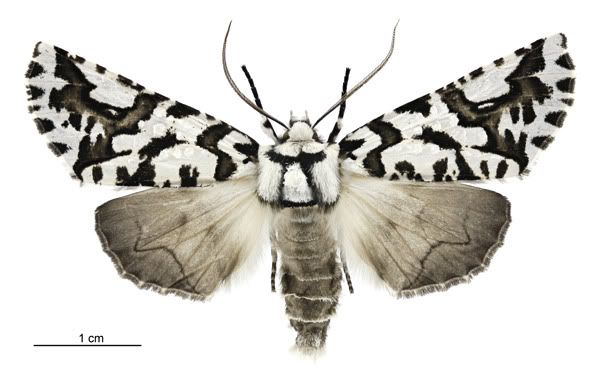
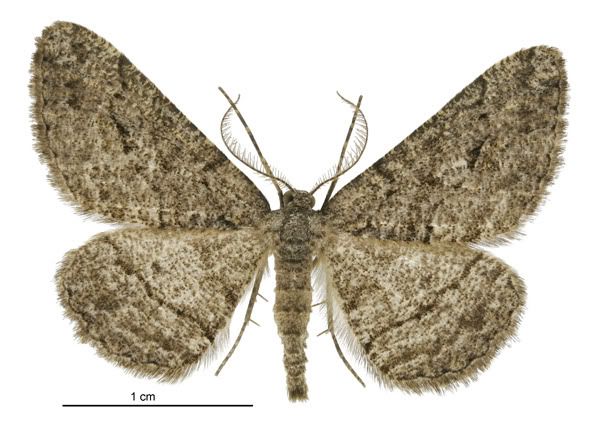
Labels: environment and ecology, larvae, lepidoptera, photos, sci-blogs, sunday spinelessness
Sunday, July 18, 2010
Sunday Spinelessness - Behold, the Future Worm!
Ok, I let my Sunday get completely out of control, so here's a very quick Sunday Spinelessness. Behold, the Worm of the Future!

Err, actually I found this little caterpillar in one of the smaller paths in Stanely Park in Vancouver. As every schoolboy knows, all insects hae six legs, but most caterpillars supplement their "true legs" with a set of porlegs along the length of their body. The prolegs are quite different to the jointed true legs, they act more like the legs of onchyphrans, moving in ripples down the body to move the caterpillar . But caterpillars like this one, which grow up to become geometer moths, don't have prolegs along their whole body, just a few at each end. They get around by alternatively extending their bodies forward with the hindlegs clasping a surface and dragging themselves forward with their forelegs hanging on. This unique way of moving makes geometer caterpillars look like they are measuring out the set distance along a twig, which has earned them the name "inchworm" (and in fact, geometer means "earth measurer", making these moths among the very few insect groups named for their larvae)
I framed this photo to try and show one of the inchworm's characteristic behaviours; when they feel threatened the cling to a branch with one set of lets and extend themselves out. Impersonating a twig. Once I realised there was going to be no way of getting the shot without getting a bit of lens flare I decided to go all out for the science fiction movie meets mid 2000s web design look. I quite like it.
Labels: environment and ecology, larvae, moth, photos, sci-blogs, sunday spinelessness

All content not otherwise marked is licensed under a Creative Commons Attribution-ShareAlike 3.0 Unported License.


