
Sunday, December 9, 2012
Sunday Spinelessness - A Clearwing moth

I'm helping design an undergraduate lab on systematics and taxonomy at the moment. Since the new lab is about insects I've suddenly become very aware of the traits that distinguish various insect groups. Moths, along with butterflies, make up the order Lepidoptera. You can see a few lepitoperan characters in the above photo: a mouth designed for siphoning nectar from flowers and a body covered in fine scales.
"Lepitoptera" actually mans "scaley wing", and, indeed most butterflies and moths have scales on their wings. This species, though, has got rid of most of it's wing scales (there are plenty of scales on the trialing edge though):


Labels: environment and ecology, lepidoptera, moths, photo, sci-blogs, sesiidae, sunday spinelessness, Synanthedon tipuliformis

Sunday, October 30, 2011
Sunday Spinelessness - Om nom nom nom


Labels: caterpillar, lepidoptera, photos, sci-blogs, sunday spinelessness
Sunday, October 23, 2011
Sunday Spinelessness - Spike

I can't tell if this is the endemic species Nyctemera annulata, or its cousin from across the Tasmin sea, N. amica. The latter has established itself in New Zealand, and, since the two species are very closely related and can seemingly interbreed quite happily, it seems we may be witnessing the re-amalgamation of previously seperate evolutionary lineages. The philosophical implications of such a process, and what it means for the definition of species or the goals of conservation biology (did you know DoC shoots pied stilts that pair-off with the endemic black stilt?) will have to wait until I have enough time to say something sensible about them. For now, the caterpillars are pretty cool:


Labels: environment and ecology, lepidoptera, photos, sci-blogs, sunday spinelessness
Sunday, July 31, 2011
Sunday Spinelessness - Butterflies!
Just a couple of pretty pictures today, and what could be prettier than tropical butterfiles? There is a great butterfly house at the Otago Museum, and every time I visit I try and challenge myself to find another angle from which to photograph these beautiful creatures. Sometimes the butterflies themselves make that all too easy:

But my favourite one took a little more work, trying to approach a Heliconius while it surveyed the artificial jungle the musuem has created for the butterflies

Labels: butterfly, environment and ecology, lepidoptera, photos, sci-blogs, sunday spinelessness
Sunday, May 29, 2011
Sunday Spinelessness - Earth Measuring Caterpillars
It's Sunday night. So, of course, it's time for me to find an excuse for not writing that post I've been going on and on about and, instead, put up some photos and get back to work (or at least, stop working in time to watch Sherock).
The excuse is same old boring one, too much work and too little time. The photos were chosen to honour Weird Bug Lady (owner of the coolest Etsy shop in the world) and her brand new blog, dedicated entirely to caterpillars.

I'm not very good at the taxonomy of butterflies and moths, but it's very easy to see what family this caterpillar belongs when you see it move (terrible photo I'm afraid...):

That's the familiar gait of the "inch-worm", "looper" or geometrid. I've talked about geometrids before, but this was a good chance to talk about the anatomy that makes their caterpillars different than those of other moths. Most caterpillars get about with a combination of six "true legs" (labeled 3 in the diagram below) combined with a set of "prolegs" (short stubby limbs not unlike the ones that propel onychophorans through the leaf litter, and labeled 4 below). Quite a few species have particularly well developed prolegs on their final segment, which are to clasp on surfaces (labeled 5)

Michał Komorniczak for making this CC 3.0
Compare that pattern to this caterpillar:

The true legs are there:

But the prolegs are gone, except for a big pair of claspers:

"Inchworms" move around by hanging on with their true legs and dragging their rear-end forward (making a loop out of their body in the process) before they clasp on the surface and extend their whole bodies forward. When you see an "looper" making its way along a leaf or a twig it really does look like it's measuring out a set distance along its length, which gave them the common name "inchworm" and the scientific name Geometridae - which means earth measurer.
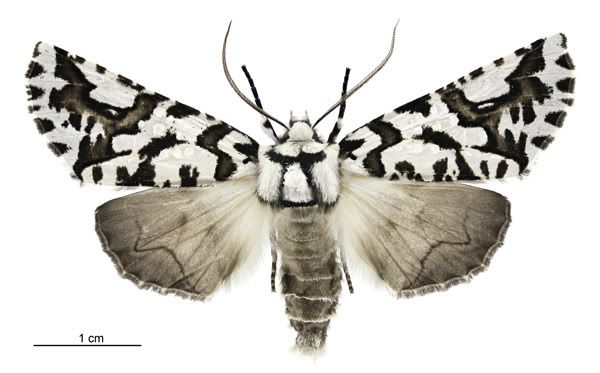
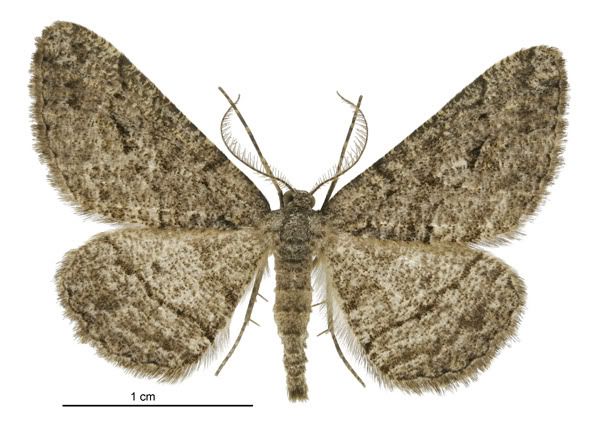
I have no idea what species this caterpillar belongs to. Landcare Research has photos of adults from about fifty species from New Zealand. Browsing through those photos, you can see some lovely examples of the camouflage patterns moths have developed to hide from hungry birds while they sleep on tree branches and trunks during the day:
Labels: environment and ecology, larvae, lepidoptera, photos, sci-blogs, sunday spinelessness

All content not otherwise marked is licensed under a Creative Commons Attribution-ShareAlike 3.0 Unported License.


